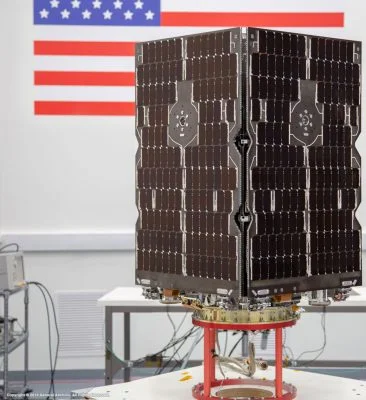
SAN DIEGO, California. General Atomics Electromagnetic Systems (GA-EMS) announced on May 20 that its Orbital Test Bed (OTB) satellite has arrived at Kennedy Space Center, Cape Canaveral, FL to complete launch preparations in anticipation of launching the spacecraft as part of the U.S. Air Force’s Space Technology Program 2 (STP-2) flight on the SpaceX Falcon Heavy rocket.
“The arrival of the OTB spacecraft at Cape Canaveral marks the start of final preparations and integration on board the Falcon Heavy in anticipation of the launch, bringing our hosted payload customers that much closer to executing their missions,” stated Scott Forney, president of GA-EMS. “This will be our first OTB satellite launch, and we are extremely excited to be delivering new technology demonstrations into orbit that will help drive future space exploration.”

OTB satellites host multiple payloads on a single platform for on-orbit technology demonstration. Among the OTB hosted payloads scheduled for launch on Falcon Heavy is NASA’s Space Technology Mission Directorate’s Deep Space Atomic Clock, designed and built at NASA’s Jet Propulsion Laboratory, which supports deep space navigation and exploration. Additional payloads include: a Modular Solar Array developed for the U.S. Air Force Research Laboratory (AFRL); an Integrated Miniaturized Electrostatic Analyzer sensor payload developed by cadets at the U.S. Air Force Academy; the RadMon next generation radiation effects monitor; FlexRX programmable satellite receiver; and Celestis cremains.
“OTB’s modularity and versatility allow for the simultaneous launch of multiple demonstration payloads on a single satellite. This eliminates the need for customers to bear the costly burden of a dedicated platform and launch,” added Nick Bucci, vice president of Missile Defense and Space Systems at GA-EMS.
As the small satellite industry grows, the OTB hosted payload platform can increase the number of flight opportunities, reduce the cost to access space, and provide a more adaptable approach to managing the integration, launch, and on-orbit operations to allow commercial, civil, educational, and military customers to rapidly space-qualify new equipment. GA-EMS has also been awarded services contracts to provide hosted services on two additional OTB satellites scheduled for launch in 2021 and 2022.
GA-EMS continues to expand its portfolio of small satellites and mission-support capabilities, providing ground-to-on-orbit solutions that offer a high degree of modularity and payload flexibility to suit a variety of missions and customer requirements delivering payloads where they are needed, when they are needed.