


Every armoured officer of my generation learned that the tank is the weapon. Steel, gun, engine, crew. Get those right, and the rest follows. That belief served us for decades. Today it may be the most dangerous idea we could carry into the next war.
Look at what Ukraine has shown us. A tank now moves beneath a sky that watches it. A drone costing a fraction of a tank round can find it, follow it, and, more and more often, kill it before the crew has seen anything through the sight. The tank no longer fights the enemy in front of it. It fights whatever is hunting it from ten or twenty kilometres away, out of sight and out of reach. Survival comes first. Firepower and manoeuvre come after, if there is an after.

The usual answer is a better tank. Thicker protection, a smarter fire control system, a new platform to replace the old ones. I have spent a lifetime around tanks, and I like that answer, but it solves the wrong problem. A single vehicle, however good, cannot out-sense a battlespace full of cheap sensors. The unit that has to change is the regiment.
Within the fighting squadron, the change is smaller but just as telling. Four tanks to a troop instead of three. The fourth, under the troop leader, stops being another gun and becomes the manager of drones and counter-drone cover. The troop then splits into an overwatch pair and an assault pair. If one tank is lost, the troop still works
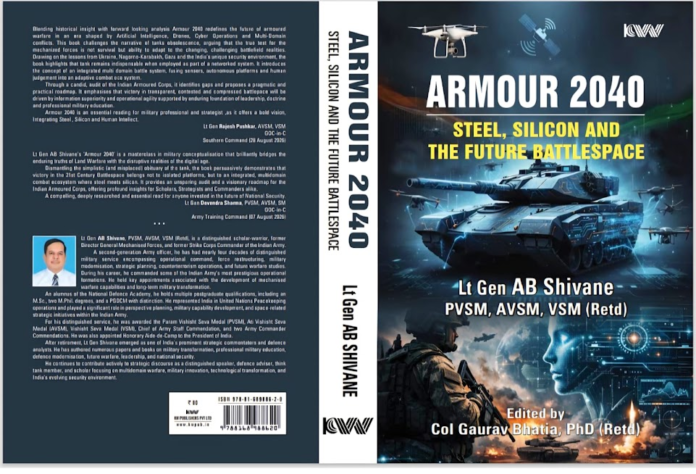
That is the idea at the centre of my recent book, Armour 2040, and I want to explain it plainly because the phrase is easy to misread. It does not mean putting a chip in a tank. It means treating the regiment as a single distributed fighting system, where sensing, deciding and striking are shared across many nodes, some crewed and some not, and where no single loss brings the whole thing down. The aim is to concentrate effects without concentrating platforms. A massed armoured column is a gift to a surveillance network. A scattered one that can still deliver a decisive blow is a problem.
Within the fighting squadron, the change is smaller but just as telling, and it sits alongside a new regimental element. Four tanks to a troop instead of three. The fourth, under the troop leader, stops being another gun and becomes the troop’s manager of drones and counter-drone cover. The troop then naturally splits into an overwatch pair and an assault pair. If one tank is lost, the troop still works. That sounds like arithmetic, but it is really a statement about what we expect from war. We should expect to lose vehicles and design for the day it happens.
A harder question lies beneath all this, and it is about the people. Artificial intelligence excels at the work that drowns human beings in a transparent battlefield: correlating reports, spotting anomalies, ranking targets, and suggesting options. Humans remain better at judgment, context, and accepting responsibility. The sensible division is that the machine observes and proposes while the commander decides, with autonomous action following only under human intent. I believe in that division. I also remain concerned about how quickly it can erode. When a system produces a good recommendation every few seconds, the human step slowly becomes a reflex. A tired commander at three in the morning will approve what the screen suggests. If we want real human control over lethal decisions, we have to design the human role so that it stays real, and train for it until it becomes a habit.

Then there is the adversary. China speaks of making war intelligent, integrating AI, big data, space-based sensing and autonomous systems under its theatre commands. Pakistan is reorganising towards more centralised command and will remain a convenient place to test Chinese systems and concepts along our borders
The second hard truth is that all of this will be applied in a hostile electromagnetic environment. Satellite navigation will be jammed or spoofed. Links will drop. Some of the clever devices we buy will simply stop working at the worst moment. A regiment that fights well only when connected has built a dependency, not a capability. So the architecture has to assume failure. Local compute on the platforms, data held and forwarded when the link returns, several communication paths chosen automatically, and a clear degraded mode in which squadrons keep fighting on the commander’s intent. This is where the Armoured Corps already has an advantage. Mission command is in our blood. Technology should serve it, not replace it.
Then there is the adversary. China has openly spoken of making war intelligent, integrating AI, big data, space-based sensing and autonomous systems under its theatre commands. Pakistan is reorganising towards more centralised command and will remain a convenient place to test Chinese systems and concepts along our borders. The result is not a single threat but a cycle that keeps renewing itself. Any answer built on existing procurement cycles will be obsolete before delivery. That argues for open architectures over single-vendor stacks, for sovereign data and intelligence services, and for a steady stream of Indian start-ups who understand the problem. Those young engineers know software, yet few have ever been in a tank squadron at dusk. Retired armour veterans carry exactly that experience, and I would like to see more of them put it to use in their workshops.

None of this is free of risk. Drones and robots need supply chains, charging, repair and spares. Junior leaders will be asked to handle more information than any generation before them. Budgets are finite, and MRO is challenging yet most vital. And the biggest obstacle is not technical at all. It is the quiet attachment of a proud arm to the shape it has always had. Reorganising a regiment means changing who commands what, which skills earn respect and what a squadron commander actually does all day. That is a cultural fight, and cultural fights are won by evidence, not by argument.
So, the sensible path is to build a regimental element of drones, ground robots and electronic warfare that senses and shapes the ground 10 to 25 kilometres ahead. Train it on a digital twin before it touches a real exercise. The window for demonstrations over the next two years is closing, and it is enough if we begin now
So, the sensible path is to build a regimental element of drones, ground robots and electronic warfare that senses and shapes the ground ten to twenty-five kilometres ahead. Train it on a digital twin before it touches a real exercise. Let it fail where failure is cheap, then harden it, then compare it honestly against a regiment organised the old way. The window for demonstrations over the next two years is closing, and it is enough if we begin now. Yet own the sovereignty over the parts that decide the fight: the autonomy software and its source code, the data link, the command interface and the right to modify all three.
Let me end with a picture, offered as imagination, not prediction. It is a decade from now, at high altitude in Ladakh. A squadron commander looks at a clean overlay of the ground ahead. Small autonomous machines and drones went out hours ago and returned with their findings. Two of them did not return, which nobody mourns. The commander’s tanks are spread wider than any instructor of mine would have allowed, yet they remain one formation. Somewhere, an enemy’s links are being jammed, and so are ours. The squadron carries on regardless, because it was built to do so with the new dominant battlespace awareness and decision superiority.
In that picture, the tank is still there, and it still matters. It is no longer alone, nor is it the whole story. That, to my mind, is the real lesson. The challenge is not to build an AI-enabled tank. It is to build a regiment that can sense, strike and keep fighting when everything around it has gone quiet.

The writer, a PVSM, AVSM, VSM has had an illustrious career spanning nearly four decades. A distinguished Armoured Corps officer, he has served in various prestigious staff and command appointments including Commander Independent Armoured Brigade, ADG PP, GOC Armoured Division and GOC Strike 1. The officer retired as DG Mechanised Forces in December 2017 during which he was the architect to initiate process for reintroduction of Light Tank and Chairman on the study on C5ISR for Indian Army. Subsequently he was Consultant MoD/OFB from 2018 to 2020. He is also a reputed defence analyst, a motivational speaker and prolific writer on matters of military, defence technology and national security. The views expressed are personal and do not necessarily carry the views of Raksha Anirveda






