

Norwegian companies Eelume and Maritime Robotics have unveiled a mine-hunting system that combines an unmanned surface vessel with autonomous underwater vehicles, aiming to search for underwater mines while keeping crews farther from hazardous waters. The system was presented as a flexible option for coastal and confined environments, where conventional mine-countermeasure vessels can face operational constraints.
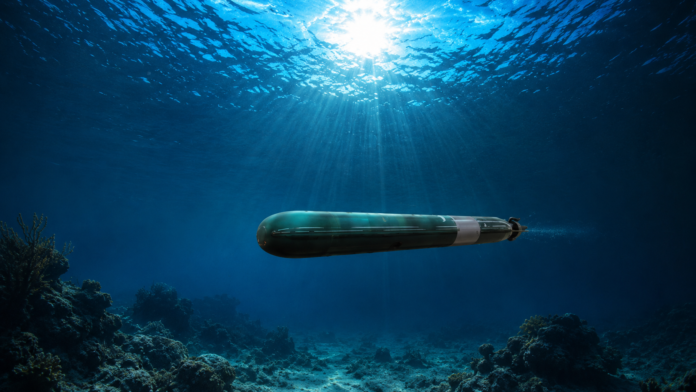
At its center is the Eelume WP960, a 9.6-metre unmanned surface vessel that can operate autonomously or with a crew. It is designed to carry up to eight Eelume S All-Terrain autonomous underwater vehicles, which can survey the seabed and investigate objects of interest. Other underwater drones, including Blueye Robotics vehicles, can also be deployed from the platform.

The WP960 can work independently, as part of a fleet, or from a larger vessel. Its shallow draft is intended to support operations in coastal waters, while the system’s modular payload can include sonar and multibeam echo sounders. The companies say the arrangement offers a way to combine surface autonomy, underwater sensing and remote inspection without requiring a dedicated crewed minehunter to enter the search area.
Eelume’s S-series vehicles are designed to operate close to complex seabed terrain, including slopes, rocks and confined spaces. The company says the platform can carry sonar and optical sensors to detect, classify and identify underwater objects. That integrated approach could reduce the need to send a separate remotely operated vehicle to inspect every suspicious contact, although the publicly available reporting does not establish operational performance in a real mine-clearance mission.
The approach reflects a broader shift in mine countermeasures: separate the people from the danger zone, use uncrewed systems to locate and assess possible mines, then deploy a dedicated neutraliser where required. Detection is only one stage. Operators must distinguish mines from other seabed objects, confirm the threat and determine an appropriate response. Autonomous systems can support those tasks, but their effectiveness depends on sensor quality, communications, reliable navigation and human oversight.
Other navies are pursuing similar concepts. In the United Kingdom, the Royal Navy’s Adventure mine-hunting system forms part of a UK-France programme built around uncrewed equipment, including sonar, autonomous underwater vehicles and remote neutralisers. The system is designed to search for, classify and neutralise mines from a stand-off distance, rather than relying solely on traditional minesweeping ships operating directly over suspected minefields.

The United States is also investing in remote mine-hunting systems. A recent contract awarded to Advanced Acoustic Concepts covers two modules intended to detect and classify underwater mines while keeping crewed ships outside dangerous waters. The system is part of a wider architecture that includes unmanned surface vessels and sonar-equipped mission packages; neutralisation remains a separate capability within that broader effort.
For Norway’s companies, the WP960 system is also an example of industrial collaboration. Maritime Robotics contributes autonomy and system integration, Eelume supplies underwater vehicles, and Blueye Robotics provides additional underwater drones. The vessel is based on a hull design developed with Westplast and KACE, bringing together existing maritime platforms and autonomous technologies rather than relying on a single new-purpose-built ship.

The system’s practical value will depend on more than its ability to carry drones. Mine-hunting requires dependable seabed coverage, accurate contact identification and safe coordination between the surface vessel, underwater vehicles and operators. Weather, water conditions, communications limits and the complexity of the seabed can all affect missions. The companies’ announcement describes the system’s intended capabilities, but does not provide independent test results or evidence of deployment in an operational mine-clearance mission.
Still, the direction is clear: navies are seeking ways to detect and investigate mines without putting sailors and expensive crewed ships directly at risk. If the Norwegian system can demonstrate reliable performance in trials, its combination of an autonomous surface carrier and multiple underwater vehicles could offer a scalable addition to mine-countermeasure operations. For now, it is a newly unveiled capability – not proof that autonomous systems can replace every task performed by traditional minehunters.