


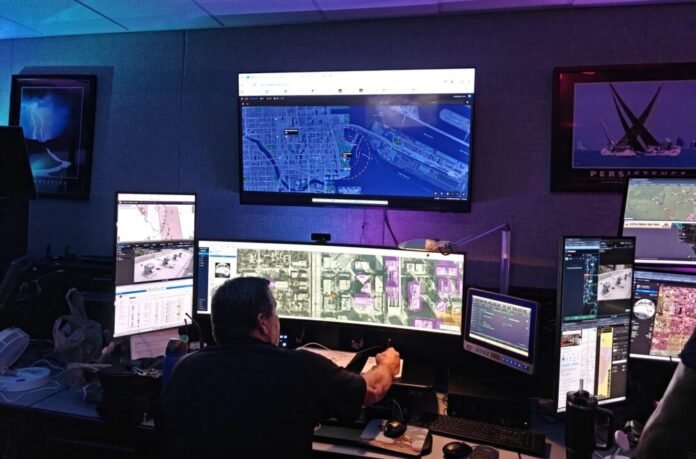
Tel Aviv: Unmanned aerial systems of all types and sizes are filling the airspaces of countries around the world and cause a major problem. The problem is acute in the low altitudes when conventional sensors cannot solve the problem. While the number of drones increase in an unprecedented pace, another infrastructure challenge is emerging: who actually governs this increasingly complex airspace those systems operate in?
Israeli company Airwayz has developed a system it claims solves the problem. Brig Gen Yaron Rosen (Res.), executive chairman of Airwayz explained this growing problem. He said that as the number of aerial systems grows, organisations need to determine not only what is in the sky, but what should be there and what action should follow.

”Adding more radars, sensors and effectors does not by itself solve the coordination problem,” he said and pointed to the fact that NATO is investing heavily to counter-drone capabilities, while recent NATO exercises have focused heavily on integrating sensors, command systems and response options across multiple systems.
NATO is testing dozens of C-UAS systems and C2 applications, highlighting the challenge of getting different technologies to operate from a common understanding of the airspace.
As autonomous systems move beyond military applications, the same low-altitude airspace will increasingly need to accommodate defence, public-safety, commercial and autonomous operations. Airwayz’s vision is to provide the digital infrastructure that connects the technologies governing low-altitude airspace, rather than becoming another proprietary sensor or detection system.
Brig Gen Yaron Rosen (Res.), the executive chairman of Airwayz, the world’s first airspace governance platform and the coordination layer for autonomous airspace, joined Airwayz in 2025. He brings nearly four decades of military leadership and extensive experience across cyber, air power and technology entrepreneurship.

Airwayz develops low-altitude airspace management, U-Space, and command-and-control (C2) systems for autonomous drones and critical infrastructure.
The Israeli company developed a defence-grade command-and-control (C2) and airspace governance platform that fuses data from sensors, drones, and agencies to create a unified operational picture. It handles threat detection, authorised versus hostile traffic differentiation, mission planning, and audit logging.

In December 2023, Airwayz became the first recipient of the U-Space service provider (USSP) certification from the Israeli Civil Aviation Authority, serving as the official license for managing low-altitude drone services across Israeli airspace. The company’s system is currently deployed in real-world environments such as the Port of Ashdod for autonomous drone missions, as well as international deployments (including major event security support like the Miami FIFA World Cup).
The system developed by Israeli company is an AI-driven Unmanned Traffic Management (UTM) and airspace command-and-control platform (known as Over Watch) that acts as a digital air traffic controller for dense, low-altitude drone and autonomous airspace.
Unlike traditional systems that rely on fixed flight paths and manual approvals, Airwayz uses real-time, cloud-connected AI to continuously plan, simulate, and tactically deconflict flights in seconds (often within ~5 seconds of validation).
Operators can plan missions using large language model (LLM)-style assistants in plain language, while background optimisation engines handle routing, priorities, and regulatory compliance. The platform dynamically reroutes drones’ mid-flight to avoid manned aircraft, pop-up emergencies, bad weather, no-fly zones, or security events without pausing overall operations.
While automated decision-making handles real-time coordination and traffic separation, human operators remain “in the loop” to oversee, monitor, and override critical decisions. The military- and defence-grade layer of the system provides unified airspace situational awareness. The platform fuses live RF, GPS, and spectrum-intelligence data to detect non-cooperative or rogue drones alongside authorised traffic.

-The writer is an Israel-based freelance journalist. The views expressed are of the writer and do not necessarily reflect the views of Raksha Anirveda






