


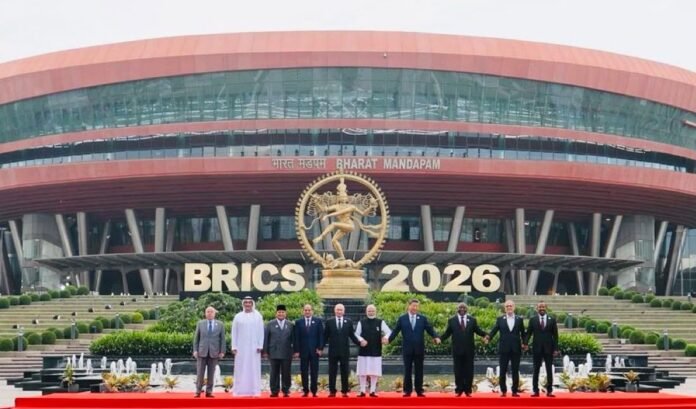
As the sun set on September 13, 2026, the Russian President’s Flying Kremlin, IL-96-300PU, took off from Indira Gandhi International Airport, New Delhi, for Moscow, after the successful conclusion of the 18th BRICS Summit. Later, the Chinese President’s Boeing 747-8 departed for Beijing, followed by aircraft of other member nations. The BRICS summit was held in New Delhi, and India welcomed delegates from 11 member nations, 10 partner countries, and international organisations.
The grand venue of the event was the beautiful conch shell-shaped Bharat Mandapam located at Pragati Maidan. New Delhi wore a beautiful bridal look, but it was converted into an invincible fort with multi-level security rings, with Black Cat Commandos hovering in Mi-17s, covering all points from ground and air threats. Prime Minister Narendra Modi took over the BRICS chairmanship on January 1, 2026, and was the chief host of the mega event of Global South nations. India was Chairman of BRICS earlier in 2012, 2016, and 2021. The main theme of the 2026 summit was “Building for Resilience, Innovation, Cooperation and Sustainability.”

The BRICS journey is now 20 years long. The grouping was established in 2006, with the aim of uplifting and developing Global South nations. The founding nations that formalised the structure and mission of the organisation were Brazil, Russia, India and China (BRIC). The first formal summit was held in Yekaterinburg, Russia, on June 16, 2009, and it discussed freedom of navigation, supply Chains, trade promotion, Free trade among members, and geopolitical issues.
The second meeting was held in Brasilia, Brazil, in 2010, during which South Africa was added as the fifth member, and the organisation became BRICS. The third forum was held in Sanya, China, in 2011. The fourth meeting was held in New Delhi in 2012 during the tenure of Prime Minister Manmohan Singh. The fifth summit was in Durban, South Africa, in 2013, the sixth in Brazil in 2014, and the seventh in Ufa, Russia, in 2015.
BRICS was established in 2006, with the aim of uplifting and developing Global South nations. The founding nations that formalised the structure and mission of the organisation were Brazil, Russia, India and China (BRIC)
The eighth summit was held on October 15-16, 2016, in Goa under Prime Minister Narendra Modi. The ninth summit was held in Xiamen, China, under President Xi Jinping, in 2017. The tenth summit was held in Johannesburg, South Africa, in 2018. Brazil hosted the 11th summit in 2019; Russia was the venue of the 12th summit in 2020 at Saint Petersburg.
During the Covid pandemic, India held the 13th summit virtually in 2021. Beijing was the venue of the 14th summit in 2022. The 15th summit was held in South Africa in 2023. The 16th summit was hosted by Russia in Kazan in 2024. Rio de Janeiro, Brazil, was the venue for the 17th Summit in 2025.

The five new members, namely Egypt, Ethiopia, Indonesia, Iran, and the United Arab Emirates, were added to the organisation in 2021. Saudi Arabia joined in 2022. The total number of permanent members as of date is 11 countries. The core group also approved 10 partner nations to be invited for the New Delhi summit in 2026. The partner nations are Belarus, Bolivia, Cuba, Kazakhstan, Malaysia, Nigeria, Thailand, Uganda, Uzbekistan, and Vietnam. There are also special invitees for the forum from the FM of Bahrain, the President of Burundi, the President of the Philippines, the FM of Saudi Arabia, and the FM of Uruguay. Moreover, United Nations General Secretary Antonio Guterres, WHO head Tedros Ghebreyesus, WTO Chief Ngozi Okonjo-Iweala, Dilma Rousseff, President of the Asian Development Bank, and Zou Jiayi, President of the Asian Infrastructure Development Bank, were also invited as Guests of Honour.
“BRICS is a formidable group. It accounted for 50% of the world population, 40% of the world’s GDP, and 27% of world trade. We are expanding for the good of the entire globe. We were four in 2009 and now 21 in 2026 (11 permanent members and 10 Partner nations),” says Prime Minister Modi
India officially assumed the presidency on January 1, 2026, from Brazil and began preparations for the 18th Summit. Bharat Mandapam was selected as the summit venue, which was also used for the G20 summit in 2023 and was appreciated by all invitees and member nations. It has a plenary conference hall, which can accommodate 7000 delegates. The Indian government launched the official website for the summit on January 13, 2026, and selected the theme and logo of a multi–coloured lotus.

Schedule of Events
- September 11, 2026 (BRICS Business Forum) Phase 1: The forum was held at 11 am at Bharat Mandapam, and it was attended by government teams, business delegations, financial institutions, startup delegates, BRICS Business Council and BRICS Women’s Alliance members from core and partner nations. The forum was welcomed by Minister of Commerce and Industry Piyush Goel, who said, “We, the Global South, have to get together and find solutions to the global crisis.” Prime Minister Modi said, “BRICS is a formidable group. It accounted for 50% of the world population, 40% of the world’s GDP, and 27% of world trade. We are expanding for the good of the entire globe. We were four in 2009 and now 21 in 2026 (11 permanent members and 10 Partner nations).” (Bharat Innovation Exposition) Phase 2: All delegates visited the exhibition of new start-ups organised by the Ministry of Education with MEA. It showcased 37 Indian deep-technology startups and new ventures by students, research bodies, institutions and young entrepreneurs intended to connect with local and global corporates and develop international partnerships.
The forum strongly condemned all forms of terrorism, including cross-border terrorism and terror funding, and called for zero tolerance and accountability. All members condemned the terror attack in Pahalgam, Kashmir, and offered tributes to victims
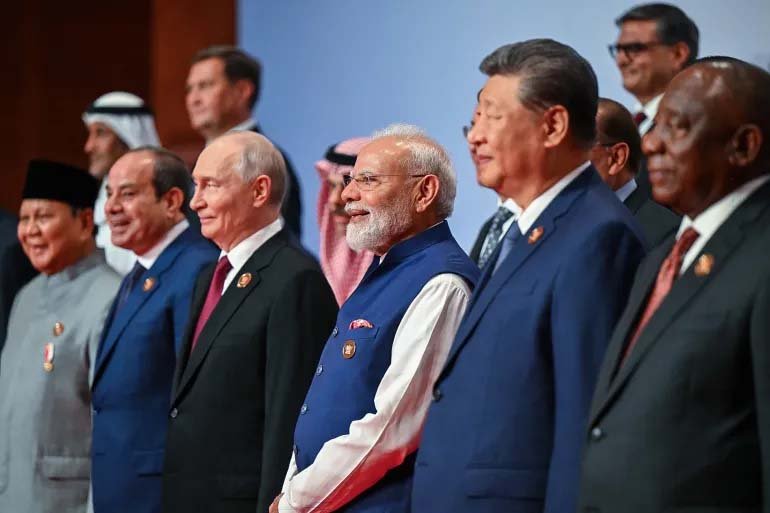
- September 12, 2026 (Main Summit) Leaders’ Summit – Phase 1: The session began with Prime Minister Modi welcoming all member countries one by one. Then, it was a closed plenary session for permanent member countries’ heads of state/representatives. All leaders addressed the chair one by one. Prime Minister Modi gave the closing address and ended the session. Phase 2: All primary leaders visited the Bharat Innovation Exposition, followed by Lunch. Later, a family photograph session and a plantation drive. Phase 3: PM Modi hosted a gala dinner at Bharat Mandapam main hall for BRICS leaders and delegates.
- September 13, 2026 (Open Leaders’ Summit) Phase 1: Plenary session by all members, invitees and international organisation heads. Information regarding New Delhi Declaration given to forum and adopted by the house. Phase 2: Visit to Bharat Exposition and family photograph and closing ceremony and declaring the next venue and presidency to the People’s Republic of China.
New Delhi Declaration: The 45-page New Delhi Declaration was unanimously accepted by the forum on September 12. It had carefully worded 140 paragraphs. The key points of the New Delhi Declaration are as under:
- Terrorism: The entire forum strongly condemned all forms of terrorism, including cross-border terrorism, terror funding, and called for zero tolerance and accountability. All members strongly condemned the terror attack in Pahalgam, Kashmir, and offered tributes to victims.
- Conflict Resolution: The declaration advocated conflict prevention through diplomacy and dialogue while strongly rejecting unilateral acts of war and aggression and growing nuclear threat and risk. This is not an era of war and should be solved mutually.
- Global Governance: It stressed structural reforms and updates of multilateral global institutions, especially the United Nations Security Council and financial bodies such as the World Bank and IMF. Global South must be given stronger representation. BRICS nations should develop their own UPI network and agree to trade in local currencies.
- Trade and Tariffs: The forum expressed concern over the imposition of unilateral high tariffs, non-tariff barriers, and sanctions on a few countries by developed nations as violations of WTO agreements and rules. Global South nations should not be targeted. The focus should be on Free Trade.
- Maritime Safety and Freedom of Navigation: The resolution included safeguarding the logistics supply chain, safety of maritime commercial shipping, and protection of seafarers. This is in reference to attacks on commercial oil tankers/ocean liners in the Persian Gulf and in the Red Sea.
- Resilience, Innovation, Cooperation, and Sustainability will be the four strong pillars among the BRICS fraternity and support each other in crisis.
Prime Minister Modi held 15 bilateral meetings with Russia, China, Iran, the UAE, Kazakhstan, Nigeria, Burundi, Malaysia, Indonesia, Ethiopia, Saudi Arabia, the Philippines, Brazil, Egypt, and South Africa. Bilateral meetings were held between member nations also; especially, Iran and the UAE held cordial meetings
Bilateral Interactions: New Delhi became the most friendly and warm-hearted capital, and Bharat Mandapam was the venue of bilateral meetings, which generated happiness and tranquillity and will greatly help world peace and harmony. PM Modi held 15 bilateral meetings with Russia, China, Iran, the UAE, Kazakhstan, Nigeria, Burundi, Malaysia, Indonesia, Ethiopia, Saudi Arabia, the Philippines, Brazil, Egypt, and South Africa. There were various meetings between member nations; especially Iran and the UAE had cordial meetings.
PM Modi, in his address to the business forum, highlighted that the 18th summit is the “largest forum so far in 20 years. “We represent 50% of the global population and 23% of world trade. We must adopt growth with stability. India is developing strong infrastructure by building expressways, a high-speed rail network, and new airports for better connectivity. We have initiated 2 lakh new start-ups and are promoting the Make in India initiative and Make for the World. India has almost 80% digital payments through UPI, and we wish to link with other members. We are promoting MSME portals. We have made free trade agreements with almost 40 countries. India will be a global solutions hub,” he said.
He stressed that global trade will prosper only if “we have freedom of navigation, secured sea lanes, open supply routes, and safety of commercial ships and Seafarers.” He also appreciated and welcomed 200 women CEOs participating in the forum. On September 12, while addressing the forum of permanent members, he strongly advocated that this was not the era for war; mutual dialogue and diplomacy should be adopted for conflict resolution.
-The writer is an Indian Army veteran and a defence analyst. He has keen interest in Geo-strategic affairs and writes regularly on internal and external affairs issues related to India and neighbours. The views expressed are personal and do not necessarily reflect the views of Raksha Anirveda





