


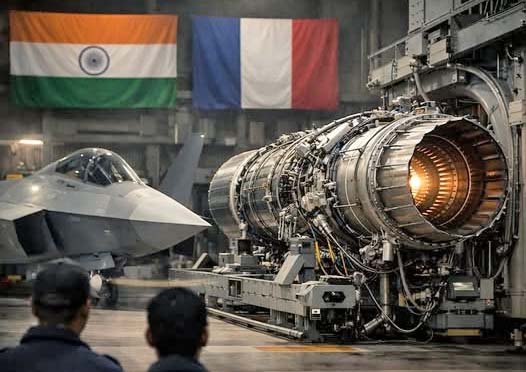
Koraput, Odisha. India’s ambition to build an advanced stealth fighter increasingly hinges on a challenge that has constrained its military aviation for decades: developing a powerful jet engine at home. Defence Minister Rajnath Singh made the case for indigenous propulsion during a visit to Hindustan Aeronautics Limited’s Koraput division in Odisha, where he witnessed delivery of the facility’s 2,000th aero-engine.
The proposed high-thrust engine effort, with an investment of around ₹5,000 crore, is intended to strengthen domestic capability in advanced propulsion. Singh also highlighted work to indigenise raw materials in partnership with Mishra Dhatu Nigam Limited (MIDHANI) and plans for India’s first indigenous high-thrust engine testing facility. He said self-reliance in aero-engines was essential to aerospace sovereignty, particularly for the AMCA.

The AMCA is India’s planned next-generation combat aircraft. But building the airframe domestically would not by itself ensure control over a fighter’s most demanding technologies. Engine design and manufacture require specialised expertise in materials, metallurgy, precision engineering, cooling, testing and quality assurance-areas Singh identified as central to creating a durable propulsion base.
The Koraput ceremony also showcased HAL’s existing manufacturing and maintenance role. The division, established in 1964, has produced engines for aircraft including the MiG-21, MiG-27, MiG-29 and Su-30MKI, and has overhauled more than 9,000 engines, according to reports on Singh’s remarks. He described production and overhaul as complementary to military readiness: new engines add capacity, while repair work can extend service life and return equipment to operational use.
Singh announced a second production line for the Shakti helicopter engine, involving an investment of ₹218 crore. The new line is expected to make up to 100 engines a year and be fully established by 2028-29. It is intended to support helicopters including the Dhruv Advanced Light Helicopter and Prachand Light Combat Helicopter. The Shakti engine was developed through cooperation between HAL and France’s Safran Helicopter Engines.
HAL is also expanding production of the Russian-origin AL-31FP engine used in the Su-30MKI. Singh said annual capacity would rise from 30 to 50 engines, backed by ₹335 crore in investment. The government placed an order with HAL in 2024 for 240 engines; the company had delivered 63 by the end of the second year, against a target of 60, according to Singh’s remarks reported by the media.

India’s pursuit of a more sovereign fighter engine is also unfolding through international cooperation. Reports in late 2025 said Safran had agreed to co-develop a clean-sheet engine with India’s Defence Research and Development Organisation, with technology transfer covering critical areas such as the hot section. That partnership, if carried through as reported, would represent a step beyond assembling or locally modifying an existing foreign design.
Yet, co-development does not make the challenge short-term or risk-free. A fighter engine must meet demanding performance and reliability standards, and a domestic programme needs sustained funding, specialised test infrastructure, skilled engineers and suppliers able to manufacture critical components consistently. Public reporting has not established a final delivery schedule for an AMCA engine under the ₹5,000-crore effort.

Singh called for bringing private companies, start-ups, small businesses, universities and research institutions into the propulsion ecosystem, and urged HAL to develop Koraput beyond an engine factory into a broader industrial network. The goal is not simply to assemble more engines, but to build domestic expertise across design, materials, production, testing and lifecycle support.
For India’s fighter programme, that distinction will matter. AMCA’s long-term prospects depend not only on the aircraft’s design, but also on whether its engine can be developed, tested and produced at scale. Koraput’s output milestones demonstrate accumulated manufacturing and overhaul experience; though converting that base into an indigenous high-thrust capability remains the larger test.






