


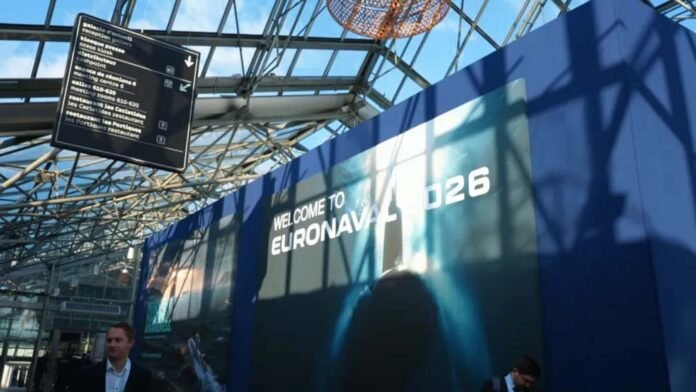
Paris Nord Villepinte, France. Euronaval continued on Wednesday, November 4, with autonomous systems and maritime surveillance among the prominent themes at the naval defence exhibition. One of the day’s reported developments came from Saildrone, which announced an arrangement with a manufacturing partner in Norway to expand its European market reach and production capacity for its Surveyor uncrewed surface vessel.
Saildrone chief executive Tom Fidjeland told media that manufacturing the Surveyor was “technically not difficult” and that the company was preparing a first mould. The announcement points to a practical challenge for the rapidly developing maritime-drone sector: converting demand and product demonstrations into manufacturing capacity, local partnerships and systems that can be supplied and maintained at scale.

The French shipbuilder Naval Group unveiled SCX26, a research-stage concept for an 8,000-ton vessel designed to deploy surface, aerial and underwater drones. It also presented the Seaquest M uncrewed surface vessel
The Surveyor is designed for uncrewed maritime operations, including persistent data collection. Saildrone’s production move in Norway also reflects the strategic importance of regional industrial cooperation as European countries look to strengthen maritime monitoring and security. The announcement does not, by itself, indicate a naval procurement or a government order; it signals a commercial expansion and a manufacturing step.
That distinction matters at an exhibition where companies display technologies for military and civilian maritime applications, while procurement decisions remain the responsibility of governments and armed forces. Euronaval’s 2026 edition runs from November 3 to 6 at Paris Nord Villepinte. The organisers describe this 30th edition as 40 per cent larger in exhibitor numbers than in 2024, with displays spanning autonomous systems, drones, artificial intelligence, cyber defence, electronic warfare, propulsion and seabed operations.
Saildrone announced a Norwegian manufacturing partnership to expand production and European reach for its Surveyor uncrewed surface vessel, designed for extended maritime data-gathering missions
Uncrewed vehicles are gaining attention as navies seek to monitor broad ocean areas, gather intelligence and inspect underwater infrastructure without placing crews in every operating environment. Surface drones can carry sensors over extended periods, while underwater systems can survey seabed, inspect cables and pipelines, or support mine-countermeasure missions. Their usefulness depends not only on endurance and sensors, but also on communications, navigation, data analysis and the ability to operate when satellite signals are unavailable or disrupted.
These demands overlap with other prominent themes at the show. Exail, for example, says its display includes solutions for operations in GNSS-denied environments, underwater threat neutralisation and persistent surveillance. The company’s Euronaval material also highlights seabed security and mine warfare – areas where uncrewed platforms and remote sensing can reduce risks to personnel while improving awareness of potential threats.

Exail displayed its Neptis system, which combines Oryx uncrewed surface vessels, sensors and command-and-control software for persistent maritime surveillance. The company also showcased autonomous and seabed-security capabilities
The industry’s focus comes amid growing concern about the vulnerability of maritime infrastructure and the difficulty of maintaining awareness across large sea areas. Subsea cables and energy links are essential to communications and commerce, yet they can be difficult to monitor continuously. Naval and civilian agencies are exploring sensors, autonomous vehicles and data-sharing approaches to identify unusual activity and assess incidents more quickly.
However, deploying more drones does not automatically deliver better maritime security. Systems must be able to communicate securely, work alongside crewed ships and aircraft, and produce reliable information that operators can interpret. They also raise questions about command responsibility, cybersecurity, interoperability and how a force should respond when an autonomous platform detects a possible threat. For navies, the operational concept matters as much as the vehicle itself.

Euronaval’s overall theme, “Towards high intensity”, reflects this broader push to prepare naval forces for more demanding environments. The event’s programme combines exhibitions with conferences, business meetings and technology presentations. The organisers say the show brings together manufacturers, political and military decision-makers, and international delegations to discuss the technologies shaping future maritime operations.
The CB90 CX is an optionally crewed fast assault craft by Saab, intended for missions including surveillance and reconnaissance. Saab says it is developing options for launching drones from the vessel
The exhibition’s scale provides a platform for companies to announce partnerships and demonstrate products, but the value of those announcements will depend on what follows: production, trials, contracts and integration into operational fleets. Saildrone’s Norwegian manufacturing arrangement is an example of the industrial groundwork that can support wider deployment, though the company has not announced a specific naval order through the reported development.
As delegates at Euronaval continue their discussions, unmanned systems are likely to remain a central topic – not as a replacement for crewed vessels, but as part of a mixed force designed to extend surveillance, reduce exposure to danger and respond to threats across the surface and seabed domains.
Companies at Euronaval are presenting drones and autonomous craft for different roles, from persistent ocean surveillance to coastal combat and underwater operations. Saildrone said it was preparing to manufacture its Surveyor uncrewed surface vessel in Norway through a local manufacturing partnership, a move aimed at expanding its European market reach and production capacity. The Surveyor is intended for long-duration data collection at sea.
KNDS and SeaOwl presented a one-way attack surface drone aimed at protecting ports and ships, reflecting interest in lower-cost uncrewed systems for maritime security
Naval Group’s display includes the Seaquest M, a medium uncrewed surface vessel, while France has tasked the company with developing a demonstrator for a large oceangoing underwater drone. Sea trials for the underwater demonstrator are planned for 2028. The company has also presented the SCX26, a research concept for a ship designed to carry drones.
Saab’s CB90 CX takes a different approach: it is an optionally crewed fast assault craft, offered in intelligence, surveillance and reconnaissance, anti-ship and short-range air-defence configurations. The Swedish company says it is developing options to launch drones from the vessel as well.
Together, the exhibits show how “drone” now covers a range of systems – not only small aerial vehicles, but surface craft, underwater platforms and crewed vessels designed to work with uncrewed assets. The systems remain at different stages of development and procurement; display at the show does not necessarily mean a contract or operational deployment.







