


The Ballot Strikes Back: Washington has woken to a political earthquake. Two years after Donald Trump returned promising to reshape America, voters have handed Democrats control of both chambers of Congress. Their gains in Republican territory amount to a rebuke of his agenda and a warning about the limits of personal authority.
The verdict was shaped by kitchen-table anxieties as much as ideology. Inflation, living costs and fuel prices weighed heavily. The Iran war added a foreign-policy burden to domestic discontent; Trump and JD Vance have acknowledged its electoral cost. Tariffs and governance concerns further unsettled the coalition that powered the Republican victory in 2024. The message is clear: voters held the President accountable for the consequences of his decisions.

This is not a change of government. Trump remains President and retains executive powers. What has changed is the terrain: Congress, once an ally, becomes a counterweight. The election has not removed Trump; it has made his power more contested. The American system has delivered its midterm correction. The question is whether Washington can absorb it without turning governance into permanent combat.
Democratic victories in both chambers of Congress establish a formidable legislative counterweight, turning President Trump’s remaining term into a high-stakes struggle over authority, oversight, and budgets
The White House Meets Its Walls: Power Under Siege
Divided government will turn the next two years into a struggle over authority, accountability and the national agenda.
The Legislative Choke Point. Immigration, taxation, spending and regulatory proposals will face a Congress controlled by the opposition. Trump can veto legislation, but cannot easily advance major new laws without negotiation.
Oversight becomes a Weapon. Democratic committee chairs will control hearings, investigations and subpoenas. Administration decisions, government contracts and executive conduct will face sharper scrutiny.

Budgets become Bargaining Arenas. Funding bills and debt-limit negotiations could become high-stakes confrontations. A shutdown would damage markets and public confidence.
Republicans face an Identity Test. The party must decide whether Trumpism remains its organising principle or whether it needs a broader political language before 2028. The result will intensify questions about leadership, succession and the future of the America First coalition.

Democrats inherit Responsibility. They must demonstrate that they can lower costs, protect public services and govern, rather than define themselves solely through opposition.
With opposition committee chairs wielding investigation and subpoena powers, Republicans face an identity test over the future of the “America First” agenda, while Democrats inherit the burden of constructive governance
The President retains latitude in national security, diplomacy and trade. Congress can use funding, legislation, confirmations and oversight to constrain him, not dictate every decision. Friction is inevitable. Washington may struggle to sustain a coherent strategy precisely when the world demands consistency.
Washington Trembles, the World Recalculates
The most consequential aftershock will be felt far beyond America. The United States remains a formidable military, technological and financial power. But influence also depends on credibility, continuity and confidence that commitments will survive domestic political cycles. The midterms put all three under scrutiny.
China and the Strategic Opening. Beijing will study the political distraction in Washington for signs of hesitation or opportunity. It may test American resolve around Taiwan, the South China Sea or technology restrictions. Yet, competition with China has bipartisan roots. A Democratic Congress could reinforce pressure for stronger alliances and tighter technology controls. Washington’s danger is not necessarily a softer China policy, but a divided process that blurs its signals.
Russia and Ukraine. Congressional Democrats may press for continued support to Kyiv and closer scrutiny of any settlement with Moscow. This could narrow Trump’s negotiating room, although Congress cannot itself conduct diplomacy. Moscow, meanwhile, will look for fractures between the White House, Congress and European capitals. Washington’s internal contest may shape both battlefield support and diplomacy.
Iran and West Asia. The war’s electoral cost could strengthen demands for scrutiny and an exit strategy. A prolonged conflict would threaten energy flows, raise shipping and insurance costs, and destabilise an already volatile region. De-escalation could ease pressure without resolving deeper rivalries. Domestic constraints may produce restraint-or a diplomatic gamble.
Europe and NATO. European allies may find reassurance in a Congress more attentive to alliances, but they cannot assume that congressional sentiment will permanently anchor American policy. Policy swings will accelerate European defence spending and strategic autonomy. Dependence on Washington will be a risk to manage, not a guarantee to presume.
European and NATO allies must adjust to shifting political currents in Washington by accelerating their own defence spending and pursuing strategic autonomy rather than relying on guaranteed policy continuity
Trade and Globalisation. Tariffs have become instruments of domestic politics as well as economic policy. Congressional scrutiny may expose their costs, but executive trade powers remain significant. Businesses must prepare for volatility in markets and supply chains.
The Global South and Multilateralism. Governments across Asia, Africa and Latin America will watch whether Washington’s approach to development, climate, aid and international institutions changes. Some may welcome renewed multilateral engagement; others will distrust commitments reversible after another election. They will seek room for manoeuvre.
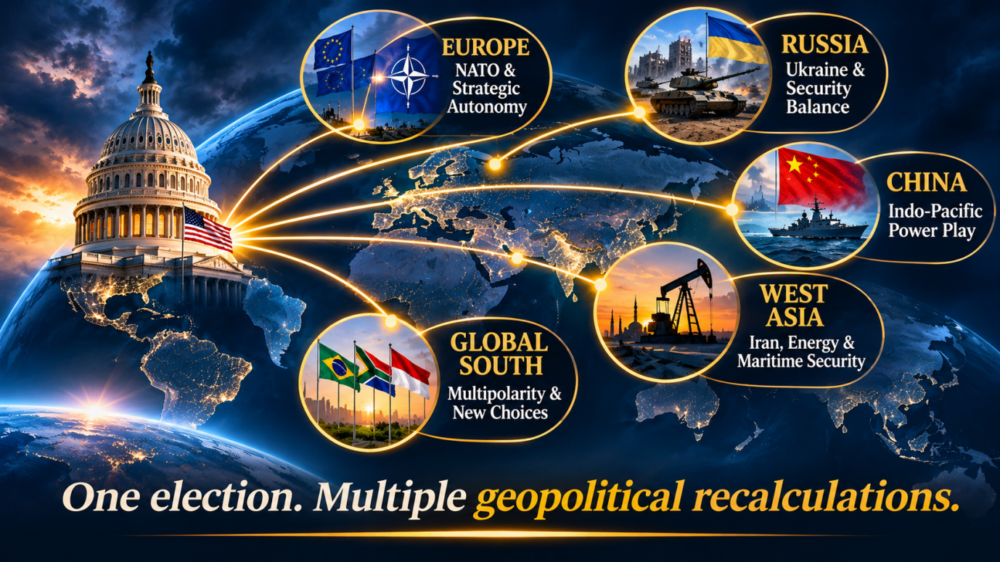
The shift is consequential: American power is not disappearing, but its political transmission is less reliable. Allies may hedge; adversaries’ probe and middle powers diversify. In a world of multiple centres of influence, Washington’s uncertainty accelerates the search for alternatives. The order will be shaped not only by who possesses power, but by who can exercise it consistently.
New Delhi’s Strategic Chessboard
For India, the election is neither windfall nor setback. It reminds us that America is a strategic partner, not a predictable instrument. New Delhi must engage the administration while building relationships across the political system. The objective is to convert uncertainty into room without confusing opportunity with dependence.
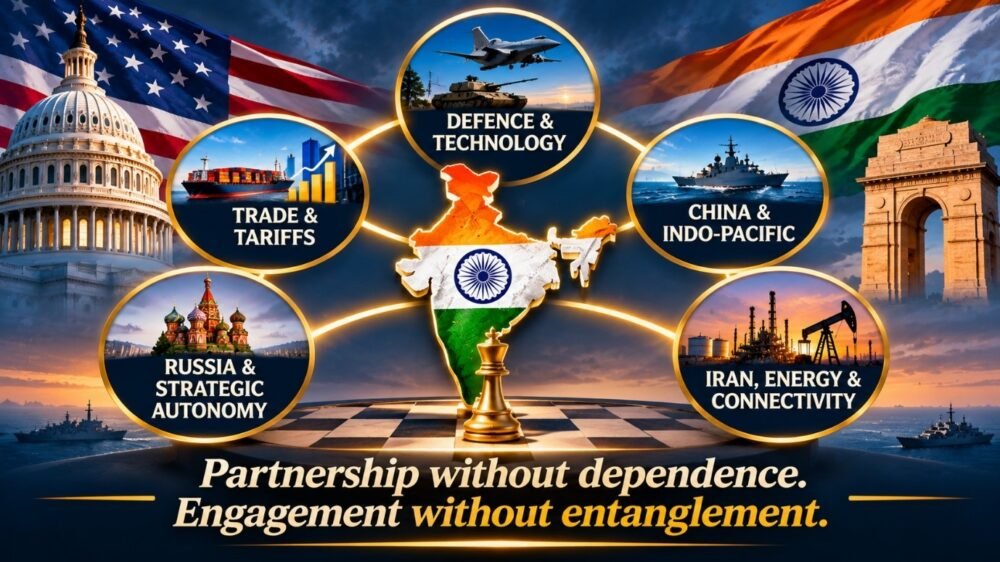
Trade and Tariffs. A Democratic Congress may scrutinise the economic consequences of tariff policy and press for greater predictability. India could use this space to seek a stable trade framework, improved market access and protection for sensitive sectors. Congressional control will not automatically reverse executive tariffs. Outcomes will depend on negotiation.
Defence and Technology. Co-development, co-production, maintenance, critical technologies, semiconductors and resilient supply chains can create durable interests on both sides. India should press for technology access and local industrial capacity, not merely additional platforms.
New Delhi faces a landscape requiring balanced congressional diplomacy, enabling it to navigate tariff debates, defence partnerships and energy risks without compromising its strategic autonomy
China and the Indo-Pacific. Strategic competition with Beijing remains a durable convergence. India’s geography and naval reach give it enduring weight. But cooperation must strengthen India’s capabilities, not draw it into alliance obligations inconsistent with its interests. New Delhi should shape the regional order, not merely align with another country’s design.
Russia and Strategic Autonomy. A more assertive Congress on sanctions or Ukraine could complicate India’s defence, energy and diplomatic links with Moscow. India must explain its interests clearly, manage sanctions exposure and preserve decision-making freedom. Strategic autonomy is not fence-sitting; it is the ability to make choices without external permission.
Iran, Chabahar and Connectivity. Any de-escalation between Washington and Tehran could improve the operating environment for Chabahar and India’s access to Afghanistan and Central Asia. Renewed confrontation could place connectivity projects under pressure. India must keep diplomatic channels open and protect the strategic logic of regional access.
Energy and Maritime Security. Conflict in the Gulf exposes India to oil-price shocks, shipping disruption and threats to seaborne trade. Diversified energy sourcing, strategic reserves, maritime domain awareness and capable naval partnerships are not optional insurance; they are elements of national security.
Congressional Diplomacy. India must deepen engagement with both parties, both chambers, state governments, business leaders and influential policy institutions. A relationship concentrated in the Oval Office is vulnerable to electoral weather. A relationship embedded across Washington is more resilient.
India must also manage differences over immigration, technology controls, human rights and trade. Sustained dialogue must prevent these differences from contaminating the wider strategic relationship. It should neither celebrate a Democratic victory as an automatic advantage nor retreat. It must negotiate hard, diversify intelligently and invest in its own capabilities. The strongest partnership is one in which both sides need each other, but neither substitutes the other for its own strength.
Beyond Trump: The World That Comes Next
The midterms have changed Washington’s balance, not settled America’s place in the world. Trump remains President, but his room to legislate and command consensus has narrowed. The next two years may bring investigations, budget brinkmanship and diplomatic gambles. Neither wholesale reversal nor uninterrupted continuity should be assumed.
As internal US politics introduce global uncertainty, middle powers and key international partners must focus on building resilient national capabilities rather than anchoring long-term goals to the American electoral calendar
The lesson extends beyond Trump. American commitments will be judged by the institutions, coalitions and resources sustaining them, not presidential words alone. Allies will seek reassurance; competitors test openings and middle powers widen their options. Domestic turbulence has become a force in the international order.
India must respond with strategic confidence. It should deepen partnerships without surrendering autonomy, strengthen defence and technological capacity, secure energy and connectivity, and engage every centre of influence in Washington. It must not make long-term interests’ hostage to another country’s electoral calendar.
The ballot has checked a President, but it has also sent a message to the world: American power remains immense, yet, its direction can no longer be taken for granted. For India, the task is not to predict Washington’s next turn. It is to build enough national strength to navigate whatever turn comes.

Lt Gen Rajeev Chaudhry (Retd) writes on contemporary national and international issues, strategic implications of infrastructure development towards national power, geo-moral dimension of international relations, and leadership nuances in a changing social construct. The views expressed are of the author and do not necessarily reflect the views of Raksha Anirveda






