


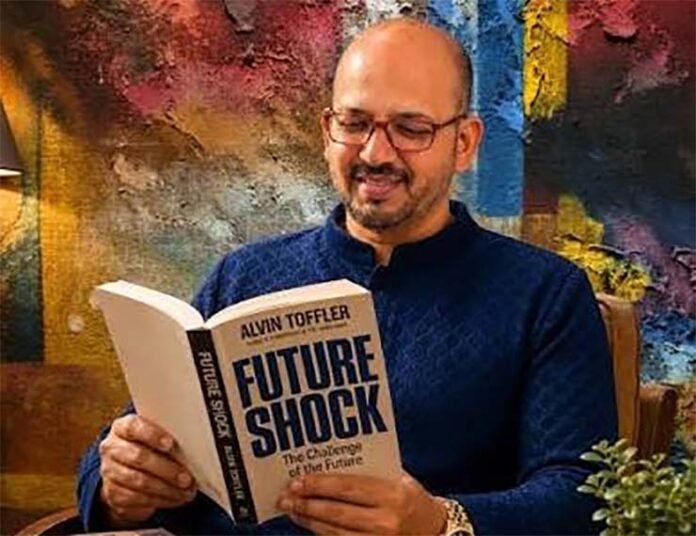
Alvin Toffler, author of ‘Future Shock, Power Shift and Third Wave’, explains in ‘Third Wave’ that the failure of modern leadership was not because of the lack of qualities and attributes among modern leaders but because of the breakdown of the very institutions on which their power depends. Test this statement against the leadership matrix of the modern world. Everywhere, leaders are undergoing a ‘torture test’ of competence and efficacy. Today, all leaders are instantly exposed for their intended or unintended errors through the magnifying glass of ‘social media’.
Social affinities of the past, which maintained cohesiveness of society, have crumbled. The breakdown of the joint family system and rising aspirations of individuals have affected family values and ethos, which in turn used to compel members to follow the ‘family elder’ blindly. The family was the foundation of the ‘Brand-Name’ theory of leadership, which has still not run out of favour, though it is fading out. These brand-name leaders may have some attributes needed to be effective, but not necessarily all of them.

Dynastic leadership is like a Banyan tree under which nothing grows. Farook Abdulla, Omar Abdulla, Akhilesh Yadav, Tejasvi Yadav, Stalin, Sachin Pilot, Rajiv Gandhi, Rahul Gandhi, even Mamata Banerjee, and all those dynastic scions swarming Indian politics are the best examples of this kind of leadership
Their brand catapulted them to leadership positions and gave rise to ‘dynasties and monarchies’. A certain class of people was considered ‘born to lead’. Dynastic leadership is like a Banyan tree under which nothing grows. Farook Abdulla, Omar Abdulla, Akhilesh Yadav, Tejasvi Yadav, Stalin, Sachin Pilot, Rajiv Gandhi, Rahul Gandhi, even Mamata Banerjee, and all those dynastic scions swarming Indian politics are the best examples of this kind of leadership.
Then came the time when a situation dictated the emergence of a leader in a group; this was captured in the ‘Situation-Model’ of leadership. This model advocated a different set of values in a person for him or her to emerge as a leader in a different field. To put it precisely, it implied that leaders of different fields like the corporate world, military organisations, or political institutions needed different traits suitable for each respective field.
One of the causes of the breakup of the Soviet Union was the extreme autocracy practiced by its leadership. Lenin, Stalin, Khrushchev, Kosygin, Brezhnev, and Andropov were all autocratic leaders. And when Glasnost and Perestroika were launched by Gorbachev, the Soviet Union fell apart
In fact, political situations are fertile grounds for the rise of ‘situational leaders’. Good examples of this category are the military dictators in Pakistan or other dictators elsewhere. Even democracies give rise to such leaders; Donald Trump or Narendra Modi would also fit the situation model, but in addition, they represent autocratic leaders.
Modern leadership demands a different set of values and a different ethos. Legal authority (as in the army or government service) might make one an overbearing boss but not necessarily a true leader of men. Authority only leads to autocracy. But such a leader is resented and forgotten as soon as his authority goes. They are neither respected nor revered but only obeyed. Saddam Hussein, Muammar Gaddafi and Hitler are some typical examples. Secrecy and centralised control were their USP.

As opposed to authority and autocracy, Dave Sidman, in his book ‘How’, says that ‘Transparency and Openness’ is the backbone of modern leadership. In the age of the social media explosion, secrecy cannot be maintained. Also, individualisation of families and communities has given an impetus to personal aspirations. This demands that a leader must be transparent and truthful. He must keep his followers informed through his actions and conduct. This is what a creative leader should be – like Nelson Mandela of South Africa.
The essence of these two statements is that a modern leader ought to be creative and adaptable rather than rigid and inflexible like an autocrat. While creative leaders are progressive and growth oriented; the autocratic leaders are stalemated votaries of status quo. This is applicable to all spheres of human activities, whether it is politics, the military, or the corporate world

Whether it is the political scene, military, or corporate world, the need of modern times is to have creative leaders. Narayanan Murthy of ‘Infosys’ is a shining example of creative leadership in the corporate world. If creative leadership is not nurtured, succession battles begin even in family businesses, whether it is the Birlas, Tatas, or even Ambanis
The role of a creative leader is not to have all the ideas; it is to create a culture where everyone can express ideas and feel valued. Leadership, in modern times, is not bossing around your men but consulting with them and coordinating them. Give them tasks and resources and let them perform, but never micromanage subordinates. Thus, good leaders not only guide their men to attain an objective but also create a congenial atmosphere that produces their own worthy replacements. Real leaders do not stick to their job forever; they create alternatives for themselves.
In short, a modern leader must learn to accept constructive criticism from subordinates. Those who do not do so are doomed to fail. Education and awareness of subordinates, coupled with individual aspirations, deprive modern leaders of blind following. The easy options of followers with ‘family-type bindings’ are no longer available. A leader must establish his supremacy over men through personal competence, transparency, and fairness. Legal authority is not left unquestioned today.
An autocratic leader is often likened to a Banyan tree; nothing grows underneath it. To put it more succinctly, an autocratic leader leaves a big vacuum after he goes. Mughal King Aurangzeb left a trail of incompetence after his death. Invariably, there is a leadership crisis after an autocratic leader disappears. Autocratic leaders are often the antithesis of consultation and toleration of differences of opinion. They are rigid and inflexible in their thoughts and actions. Thus, after the initial push, growth and development of an organisation suffer.
The military is no exception. The goodness of a Commanding Officer (CO) of a unit can only be gauged from the quality of the subordinates he nurtured: how many subordinates did he make capable of replacing him in due course of time?
One of the causes of the breakup of the Soviet Union was the extreme autocracy practiced by its leadership. Lenin, Stalin, Khrushchev, Kosygin, Brezhnev and Andropov were all autocratic leaders. And when Glasnost and Perestroika were launched by Gorbachev, the Soviet Union fell apart.
To conclude, whether it is the political scene, military, or corporate world, the need of modern times is to have creative leaders. Narayanan Murthy of Infosys is a shining example of creative leadership in the corporate world. If creative leadership is not nurtured, succession battles begin even in family businesses, whether it is Birlas, Tatas, or even Ambanis.
The military is no exception. The goodness of a Commanding Officer (CO) of a unit can only be gauged from the quality of the subordinates he nurtured: how many subordinates did he make capable of replacing him in due course of time? If a unit has to import Commanding Officers from outside, it is the failure of the last few COs whose personal interests dominated the unit’s interests.
Therefore, be it military or any other field, a leader in modern times will be judged by the quality of his successors. An autocratic leader may win a battle or two, but it is the creative leader who wins the war. In sum, this is the difference between the two. To conclude, one has to pay attention to what Ken Blanchard said: “The key to successful leadership today is influence, not authority.”

-An ex-NDA and Wellington Staff College graduate, Col Rajinder Singh is a renowned author and security analyst. He has authored four books, two individually and two in collaboration. His best-selling books are Kashmir – A Different Perspective and The ULFA Insurgency. The views expressed are of the author and do not necessarily reflect the views of Raksha Anirveda





