


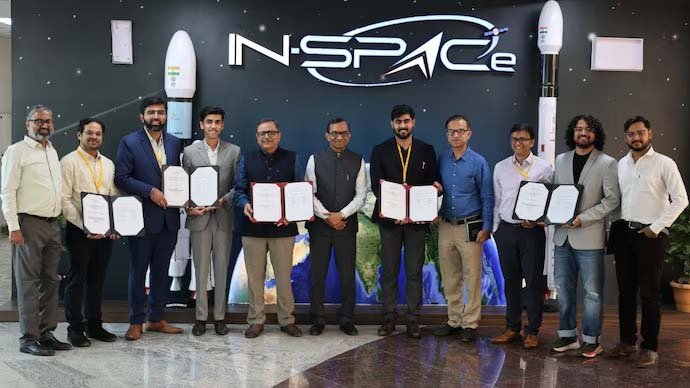
Mumbai. The Indian National Space Promotion and Authorisation Centre (IN-SPACe) has selected four companies for financial support under its Technology Adoption Fund (TAF), offering a combined ₹67.15 crore to develop technologies for satellites and space applications. The selected firms are Maharashtra-based Manastu Space, MumbaiSemi and Inspecity Space Laboratories and Bengaluru-based VyomIC.
The offers target hardware and systems that are important to satellite operations but are often sourced from established global suppliers. The projects cover electric propulsion for small satellites, a refuellable propulsion system for microsatellites, precision timing equipment and an integrated receiver chip for India’s NavIC navigation system and GPS. The companies will carry out their work against defined milestones, with progress and funding monitored under the scheme.

Mumbai-based Manastu Space has been offered ₹22.08 crore to develop an iodine-based Hall Effect Thruster for small satellites. The proposed system combines a thruster with a power-processing unit and a modular iodine feed and tank arrangement. Solid iodine could avoid the high-pressure tanks used with some conventional propellants, potentially simplifying storage and integration. IN-SPACe said the project would be the first Indian development of this type of technology.
Inspecity Space Laboratories has been offered ₹21.18 crore to develop a refuellable, six-degree-of-freedom propulsion system for microsatellites. Its planned green-bipropellant design includes a refuelling port and a self-pressurised propellant arrangement. If developed and adopted, refuelling capability could give operators greater flexibility to manoeuvre spacecraft and may support future in-orbit servicing. The offer funds development; it does not mean the system is already operational.
Bengaluru-based VyomIC has been offered ₹12.55 crore to develop stable, secure clocks for space applications. The proposed system combines miniature atomic clocks and oven-controlled crystal oscillators with adaptive filtering and steering algorithms. Accurate timing is central to satellite navigation and communications, and the technology is also intended for low-Earth-orbit positioning, navigation and timing services.
MumbaiSemi has been offered ₹11.34 crore to develop a multi-channel receiver system-on-chip that integrates radio-frequency and digital components for NavIC and GPS. The company says the reconfigurable chip is intended for standard-positioning and wideband applications. Domestic receiver technology could support wider use of NavIC, India’s regional satellite navigation system, while reducing reliance on imported components.

The four selections follow an earlier TAF round in June, when IN-SPACe chose Astrobase Space Technologies, SatSure Analytics India and TM2SPACE Technologies for projects involving rocket propulsion, Earth-observation analytics and satellite navigation. With the latest announcement, seven companies have been selected across the two rounds, according to reports.
IN-SPACe introduced the ₹500-crore fund in February 2025 to help Indian non-governmental entities move space technologies from development towards commercial products. The scheme offers partial project support-up to 60 per cent of eligible costs for startups and micro, small and medium enterprises, and up to 40 per cent for larger companies-with a maximum of ₹25 crore per project.

The fund addresses a difficult stage for technology firms: turning a promising design or prototype into something that can be manufactured, tested and sold. Space hardware typically requires specialised engineering and qualification, while customers may be reluctant to adopt systems that have not yet demonstrated performance in demanding conditions. Public funding can help companies advance development, but selection alone does not guarantee technical success, commercial orders or replacement of imported products.
For India, the chosen technologies span several links in the space supply chain, from spacecraft movement and servicing to navigation and precise timekeeping. Their significance will depend on whether the teams meet project milestones and demonstrate reliable systems that satellite operators can integrate. IN-SPACe’s announcement marks a funding offer and development commitment; the eventual measure will be how many of these technologies progress from funded projects to dependable, commercially adopted products.







