

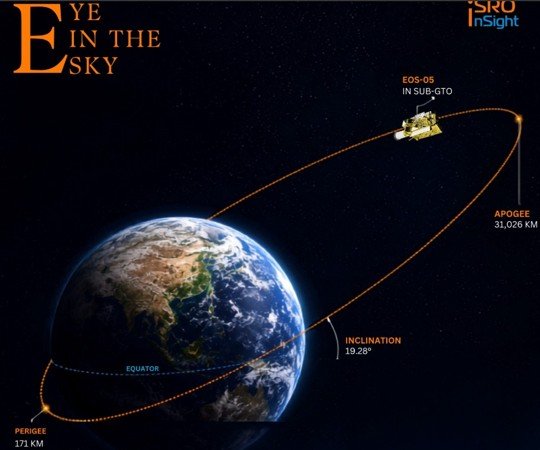
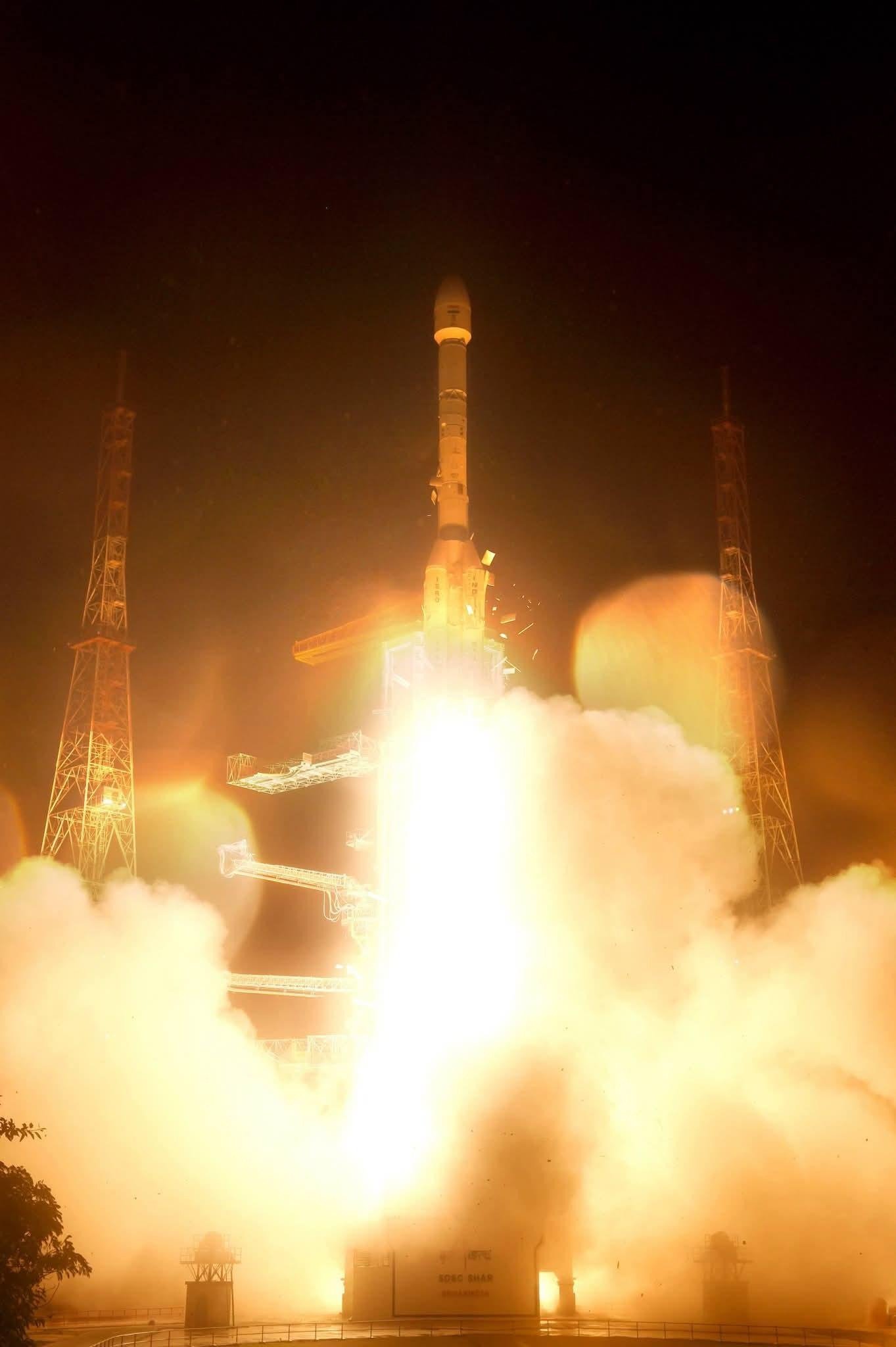
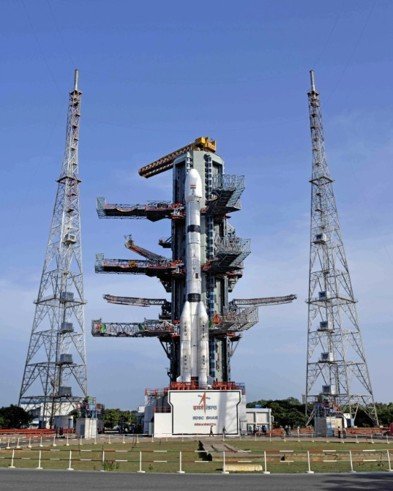
It was a glorious moment for the Indian Space Research Organisation (ISRO) on September 4 when it deployed India’s new ‘Eye in the Sky’ by successfully placing the EOS-05 spacecraft in its intended orbit using the GSLV-F17 rocket, launched from the Satish Dhawan Space Centre in Sriharikota.
The mission marks the 19th flight of India’s Geosynchronous Satellite Launch Vehicle and is aimed at strengthening Earth-observation capabilities, including monitoring weather, disasters, agriculture and other large-scale changes.

ISRO Chairman Dr V Narayanan, while addressing the mission staff and media, said the vehicle “successfully and precisely injected the Advanced Earth Observation Satellite 05, the geo-imaging satellite, in the intended and required orbit. We have injected the heaviest satellite, 2,367 kg, using this launch vehicle.”
“The vehicle successfully and precisely injected the Advanced Earth Observation Satellite 05, the geo-imaging satellite, in the intended and required orbit. We have injected the heaviest satellite, 2,367 kg, using this launch vehicle.” – ISRO Chairman Dr V Narayanan
Once fully operational, EOS-05 will become India’s first imaging satellite designed to work from a geosynchronous orbit, providing a very different kind of coverage compared to traditional low-Earth orbit (LEO) satellites.
The mission underlines the growing role of Indian industry and academia in ISRO’s programmes. Narayanan credited “the hard work of the entire ISRO team along with our industrial partners and academia” for the success, calling it “a great achievement in our country’s space programme”.

Narayanan told reporters that the space agency is targeting another six launches in the current financial year, spanning a mix of Earth-observation, communication and possibly technology-demonstration missions.
While most Earth-observation satellites orbit much lower, whizzing around the planet and passing over any given location for only a few seconds at a time, EOS-05 is placed in a geosynchronous orbit where it moves in sync with Earth’s rotation, effectively staying ‘locked’ over the Indian region like a camera mounted on a tall pole.

EOS-05 has added a new layer to India’s existing constellation of remote-sensing satellites, which mostly operate in lower orbits and offer higher spatial resolution but less frequent revisits.
EOS-05 is placed in a geosynchronous orbit where it moves in sync with Earth’s rotation, effectively staying ‘locked’ over the Indian region like a camera mounted on a tall pole
The launch attracted significant public attention, with students, teachers and space enthusiasts gathering in Sriharikota despite rain. Many stayed in the launch-viewing area to watch the GSLV-F17 lift off, reflecting the growing popular engagement with India’s space missions.
With EOS-05, India has joined a small group of countries operating dedicated imaging satellites from geosynchronous orbit, a capability that combines wide-area coverage with high temporal resolution. For a country prone to monsoon-driven disasters, with long borders and fast-growing infrastructure, the ability to ‘watch over Bharat’ almost continuously is a strategic upgrade.
Prime Minister Narendra Modi called the successful launch an ‘outstanding achievement’ and a proud moment for the nation. In a social media post, he wrote, “Yet another outstanding achievement by ISRO and a proud moment for our nation. The successful launch of GSLV-F17 carrying EOS-05, India’s first-ever imaging satellite from Geosynchronous orbit is a reflection of the excellence, innovation and growing capabilities that define India’s space sector.”
With EOS-05, India has joined a small group of countries operating dedicated imaging satellites from geosynchronous orbit, a capability that combines wide-area coverage with high temporal resolution
The Prime Minister said, “The growing partnership between ISRO and Indian industry is adding new strength and scale to our space programme and expanding India’s capabilities across the entire space ecosystem.”
ISRO is the national space agency and has its headquarters in Bengaluru. It is one of the top five space agencies in the world, along with NASA of the US, Roscosmos of Russia, European Space Agency (ESA), and CNSA of the People’s Republic of China. It serves as the principal research and development arm of the Department of Space and is primarily responsible for space exploration, international space cooperation, space-based operations, and development of space-related technology. It maintains and guards the Indian space assets, plans interplanetary missions and Earth orbit missions, and is directly responsible to the PMO.
The Indian National Committee for Space Research (INCOSPAR) was formed under the direction of Prime Minister Jawaharlal Nehru in 1962 by Dr Vikram Sarabhai and merged with the Department of Atomic Energy, headed by Dr Homi Jahangir Bhabha. It was renamed ISRO on August 15, 1969, under Dr Vikram Sarabhai, who was the founding father and first chairperson of ISRO. Prominent scientists including M G K Menon, Satish Dhawan, U R Rao, K Kasturirangan, G Madhavan Nair, K Radhakrishnan, S Naik, A Kiran Kumar, K Sivan and Dr S Somnath headed ISRO earlier

-The writer is an Indian Army veteran and a defence analyst. He has keen interest in Geo-strategic affairs and writes regularly on internal and external affairs issues related to India and neighbours. The views expressed are personal and do not necessarily reflect the views of Raksha Anirveda





