


CEBU, Philippines – US Defence Secretary Pete Hegseth has proposed an “ambitious” US-ASEAN defence cooperation framework, pitching deeper maritime coordination as defence ministers from across the region gathered in Cebu for talks on security and strategic cooperation.
Hegseth made the proposal on Wednesday ahead of a meeting with defence chiefs from the Association of Southeast Asian Nations (ASEAN). He offered few specifics, describing the proposed framework as a practical guide for cooperation over the coming years. The US was ready to begin developing it as Singapore prepares to assume the ASEAN Defence Ministers’ Meeting (ADMM) chairmanship in 2027, he said.

Hegseth called for stronger maritime domain awareness and more advanced cooperation among naval forces, including training, planning and joint learning. He said the coming years would be “critically important” and urged countries to work together where interests overlap, even when they disagree on other issues.
The proposal comes as the United States seeks to strengthen its defence partnerships in the Indo-Pacific, where tensions and strategic competition have increased. The ADMM-Plus brings together ASEAN’s 11 members and eight dialogue partners – Australia, China, India, Japan, New Zealand, Russia, South Korea and the United States. Unlike a military alliance, it provides a forum for defence dialogue and cooperation among regional powers.
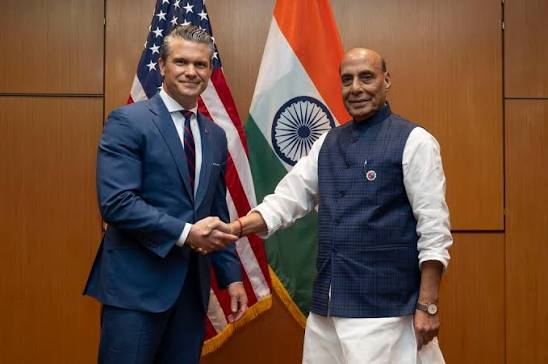
India used the gathering to review defence ties with several partners. Defence Minister Rajnath Singh met US Secretary of War Pete Hegseth and said they discussed progress under the 10-year India-US Defence Framework, including military technology, information-sharing and co-production. The defence ministries also discussed military exchanges, maritime security, supply chains and operational readiness. Hegseth reaffirmed US support for India’s efforts against cross-border terrorism, according to India’s account.
Singh also met his Japanese and Australian counterparts, Shinjiro Koizumi and Richard Marles. With Koizumi, he discussed maritime security, naval cooperation and plans to advance bilateral defence engagement. Singh described the India-Australia relationship as a comprehensive strategic partnership important to a free, open and secure Indo-Pacific. He invited Marles to attend Aero India 2027, scheduled for Bengaluru in February.

In talks with South Korean Defence Minister Kang Shin-chul, Singh reviewed bilateral cooperation and explored the co-development of military technologies. He also met Singapore’s Chan Chun Sing, with both sides reaffirming their commitment to stronger defence ties and regional security.
China’s defence minister, Dong Jun, did not attend the Cebu meetings; Beijing sent its defence attaché in the Philippines instead. Dong’s absence coincided with a major Communist Party meeting in Beijing, where he was expected to participate as a Central Committee member. China has attended the ADMM-Plus at ministerial level in previous years, making the change notable, though no official reason for his absence was reported.

The absence sharpened the contrast between the forum’s inclusive design and the increasingly competitive security environment surrounding it. The ADMM-Plus brings China and the United States, alongside India, Japan and other partners, into a shared setting for dialogue. Hegseth’s call for a US-ASEAN framework, meanwhile, signals Washington’s interest in building more structured cooperation with Southeast Asian governments, particularly on maritime security.
The proposal’s substance remains to be worked out. Hegseth did not specify its scope, commitments or timetable, beyond saying development could begin as Singapore takes over the chairmanship. ASEAN governments will have to decide how a new arrangement fits alongside existing regional mechanisms and the bloc’s practice of consensus.
For India, the Cebu meetings offered a chance to strengthen bilateral defence links while engaging in a wider regional forum. For ASEAN, the central challenge is to expand practical cooperation without narrowing the space for dialogue among competing powers.







