


Berlin. The Contra system, which Helsing describes as autonomous, combines sensors, command-and-control software and weapons to identify and respond to incoming threats. The company says Contra can coordinate engagements against hundreds or thousands of drones and missiles simultaneously, while leaving people in control of decision-making and target priorities. Those performance claims have not been independently verified.
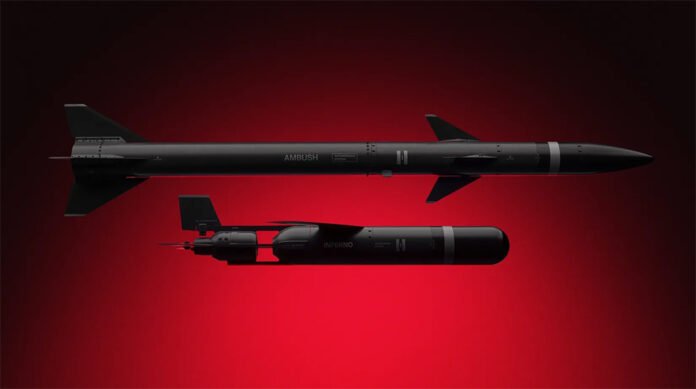
The launch includes two interceptors: the jet-powered AD-1 Inferno and the solid-rocket-powered AD-2 Ambush. Helsing says the weapons are intended to address different kinds of fast-moving aerial threats and will be launched from containers, allowing them to be deployed alongside Contra’s ground-based systems.

Inferno is designed to loiter, operate in swarms and make repeated attempts to engage a target, according to the company. Ambush is intended for rapid interception. Helsing says it can reach Mach 2.5 and has a range exceeding 20 kilometres. Both missiles are designed to receive mid-course guidance from Contra radar stations, then use onboard radar seekers for terminal guidance in all weather.
The system’s command-and-control layer is built around Helsing’s Altra platform, which the company says fuses information from sensors and coordinates available weapons into a shared air picture. Contra is also designed to work with equipment made by other companies, including interceptors, counter-drone lasers, guns and net-based systems. Helsing says it is demonstrating several such integrations to military customers.
The concept addresses a growing challenge for air-defence planners: defending against large numbers of relatively inexpensive drones without relying exclusively on costly missiles designed for more demanding targets. Using premium interceptors against cheap, mass-produced aerial threats can quickly strain inventories and budgets. NATO’s own demonstration of the Merops counter-drone system in Poland in 2025 highlighted the push to field lower-cost options that can be integrated with existing sensors and used against drones entering allied airspace.
Helsing has not disclosed prices for either new interceptor. It says the weapons will be substantially cheaper than existing missile interceptors and plans to manufacture them at its Resilience Factories. The company also cites two independent European supply chains for the interceptors, a feature it presents as a way to support production and reduce reliance on constrained sources.

The market for affordable air-defence weapons is attracting several companies. Reporting on the launch noted that Anduril, Lockheed Martin and CHAOS Industries have also introduced or promoted lower-cost interceptor options, as defence manufacturers respond to demand for weapons that can be produced in larger numbers. But announcements and design claims are not the same as operational capability: delivery schedules, production rates, reliability and performance under combat conditions will determine whether these systems can make a difference.
Helsing’s announcement comes as the company points to the development of faster jet-powered drones and cruise missiles as a reason for building a layered response. It cited intelligence assessments that Russian Geran-4 and Geran-5 production had reached a combined 4,000 units per month. That figure is Helsing’s characterisation of those assessments, not a publicly verified production count in the material accompanying the launch.

According to additional reporting, Contra is still being tested, with Helsing’s chief executive saying the system is expected to reach market readiness in the second half of 2027. The report said the company had already signed one contract, though it did not identify the customer or disclose the contract’s value. The timeline applies to the system’s readiness for the market, not necessarily to full operational deployment.
For Helsing, the pitch is not simply a pair of new missiles but an integrated approach: connect sensors, software and multiple types of weapons, then coordinate responses at scale. Whether that combination can deliver affordable, dependable defence against mass attacks will depend on testing, production capacity and how well it integrates with customers’ existing systems.






