


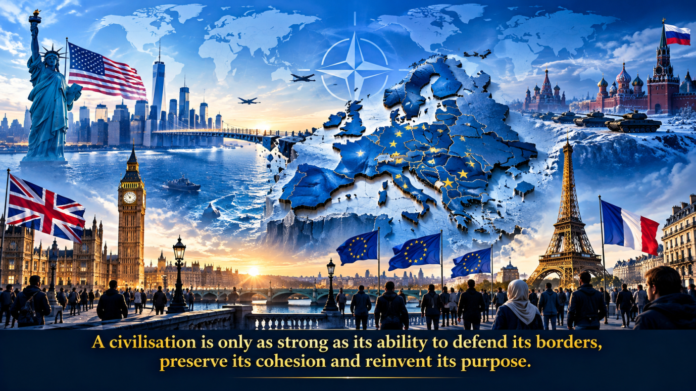
Europe possesses immense collective wealth, advanced technology, educated populations, and institutions that helped shape the modern international order. Yet its economic weight has not translated into equivalent strategic coherence. National interests diverge, defence industries remain fragmented, and political consensus often arrives slowly. The continent has enjoyed an extended period in which American power underwrote its security, allowing many governments to prioritise welfare and prosperity over military preparedness. That arrangement is now under pressure. Russia’s war against Ukraine has brought territorial conquest back to Europe’s strategic calculations, while instability to its South and East compounds the challenge. The paradox is not that Europe is weak; it is that considerable resources coexist with incomplete capacity to act collectively. Strategic influence requires more than markets, regulations and diplomatic declarations. It requires the ability to protect interests, absorb shocks and make difficult choices before a crisis dictates them. Its geography compounds the challenge: Russia borders Europe, while instability and migration routes connect it to crises.
In June 2026, US European Command announced plans to right-size American contributions to NATO’s force model, explicitly arguing that Europe should assume primary responsibility for its conventional defence
Russia, Ukraine and the Revelation of War
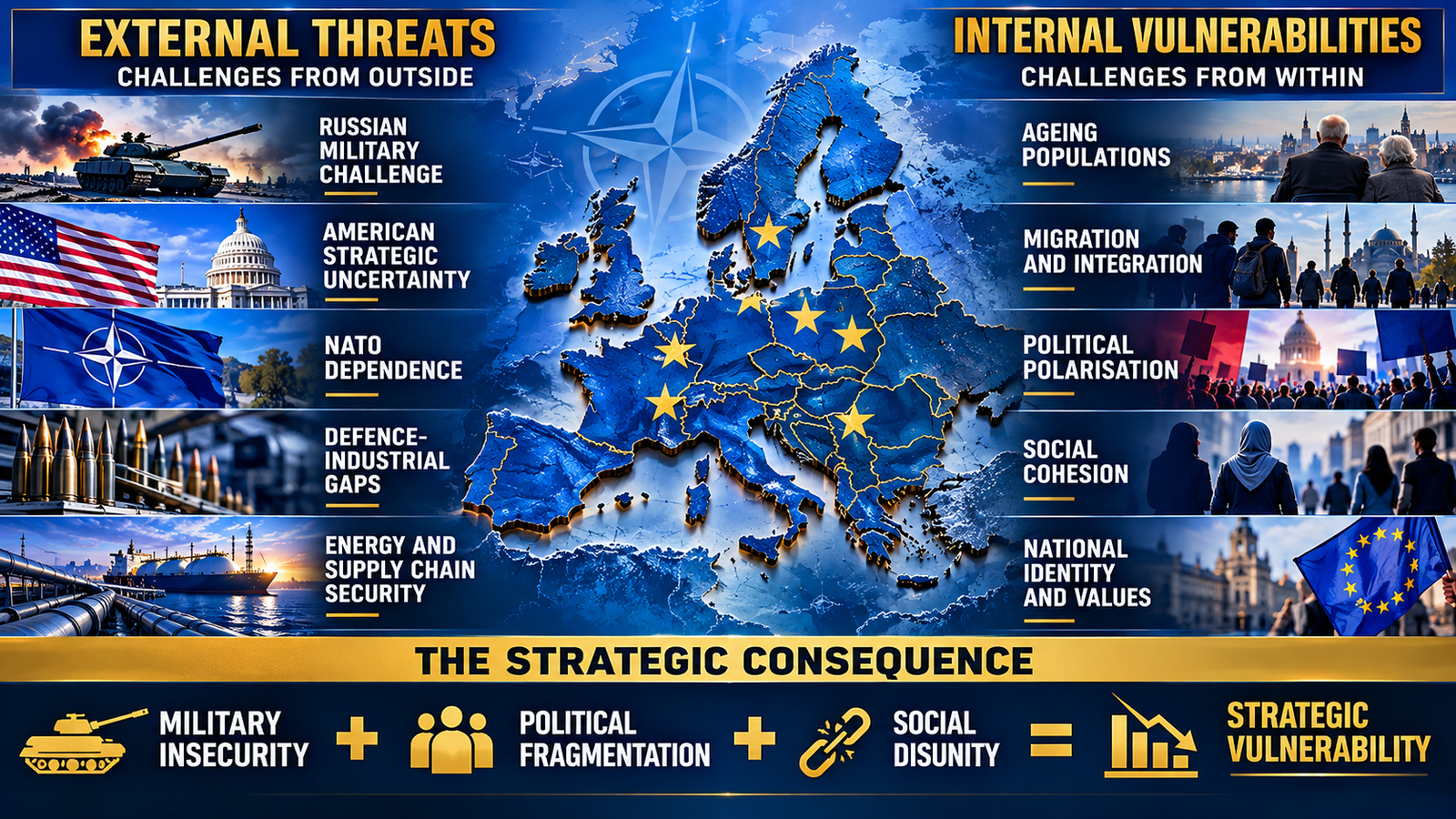
The war in Ukraine has punctured assumptions that large-scale conventional conflict had become improbable in Europe. Ukraine’s resistance has demonstrated the importance of national will, dispersed command, intelligence, drones, electronic warfare and rapid adaptation. Russia, despite severe losses and operational shortcomings, has shown an ability to sustain a prolonged war, mobilise resources and learn under pressure. For Europe, the conflict has exposed shortages in ammunition, air defence, industrial surge capacity and logistical depth. It has also demonstrated that military assistance depends on political endurance among supporting states. The lesson is not that Russia is invincible, or that Ukraine’s experience can be mechanically transferred elsewhere; it is that deterrence rests on credible readiness, resilient supply chains and societies prepared for prolonged uncertainty. A continent cannot rebuild these foundations overnight, once war has already begun. The battlefield has blurred the boundary between civilian and military resilience. Commercial satellites, digital networks, energy systems, and private technology firms now shape operational outcomes. European governments must protect infrastructure, prepare civilians, and rapidly convert industrial capacity into military output over time.

America First: The Uncertain American Umbrella
The United States remains Europe’s most consequential military ally, but Washington’s priorities are being recalibrated. Competition with China, Indo-Pacific commitments, homeland security and demands for allied burden-sharing increasingly shape American strategy. In June 2026, US European Command announced plans to right-size American contributions to NATO’s force model, explicitly arguing that Europe should assume primary responsibility for its conventional defence. This is a policy signal, not proof that America is abandoning Europe; Washington continues to describe the transatlantic bond as important. Nevertheless, uncertainty about the scale, timing and conditions of American support changes European calculations.
NATO is not collapsing, but its operating assumptions are being tested. NATO’s future may be a more balanced partnership, rather than an American-led arrangement in its familiar form. Its credibility will be measured by capability and cohesion
The continent relies on US intelligence, strategic lift, refuelling, command systems, precision weapons and nuclear guarantees. Replacing these capabilities will require money, industrial coordination and time. The deeper question is whether Europe can become a stronger partner without mistaking strategic autonomy for separation from America. American policy is also shaped by debate, electoral change and competing views of global leadership. European planners cannot assume administration will interpret alliance obligations identically. Nor should they mistake Washington’s focus on Asia for indifference to Europe: both theatres compete for resources and test deterrence. The task is to plan for uncertainty without turning it into prophecy.
NATO: An Alliance at the Crossroads
NATO is not collapsing, but its operating assumptions are being tested. Article 5 remains the foundation of collective defence, and allied governments continue to affirm it. Yet an alliance depends not only on treaty language but on political trust, interoperable forces and confidence that promised capabilities will arrive when needed. The 2025 Hague commitment to raise defence and security-related investment to 5% of GDP by 2035 reflects recognition that the previous division of labour is changing. European members must convert spending into deployable forces, ammunition, air and missile defence, intelligence, logistics and industrial capacity. They must also avoid duplicating national programmes or weakening the alliance through competing procurement choices. NATO’s future may be a more balanced partnership, rather than an American-led arrangement in its familiar form. Its credibility will be measured by capability and cohesion, not summit communiqués. The danger is a widening gap between solidarity and military power. If European forces cannot reinforce exposed allies quickly, adversaries may question NATO’s response time. A capable European pillar could strengthen the alliance by reducing overdependence and making burden-sharing credible.
Britain’s journey from imperial centre to contemporary middle power is one of history’s great strategic transitions. The empire has vanished, but its institutional inheritance remains visible in the English language, diplomatic networks, financial services and global military relationships
Britain: From Empire to England
Britain’s journey from imperial centre to contemporary middle power is one of history’s great strategic transitions. The empire has vanished, but its institutional inheritance remains visible in the English language, diplomatic networks, financial services and global military relationships. Britain retains nuclear weapons, a permanent Security Council seat and significant intelligence and defence capabilities. Yet its room for manoeuvre is constrained by economic pressures, reduced imperial reach and the consequences of Brexit. At home, the constitutional question remains unsettled. Scottish independence, debates over Welsh autonomy and Northern Ireland’s place in the Union expose the complexity of holding together a multinational state. The phrase ‘from Empire to England’ is deliberately provocative, but Britain has not become merely England; it remains a union whose future depends on consent, political imagination and practical cooperation. Former grandeur cannot substitute for a contemporary national purpose. Sovereignty is sustained not only by flags and institutions but by a political settlement citizens regard as legitimate. Preoccupation with former reach can obscure the work of renewing unity and relevance abroad.

France: Republic and the Challenge of Integration
France remains a major European power: nuclear-armed, diplomatically influential and committed to the idea of European strategic autonomy. Its challenge is not an imminent loss of territory, but the demanding task of sustaining a shared republican compact across a diverse society. INSEE estimated that immigrants represented 11.6% of France’s population in 2025; the figure describes demographic change, not a verdict on integration or citizenship. France must reconcile secular republican principles, freedom of religion, equal citizenship and the lived realities of communities facing unemployment, discrimination or alienation. Tensions in some suburbs, arguments over laïcité and political polarisation make these questions intensely contested. They cannot be reduced to religion or origin. The strategic test is whether public institutions can secure equal opportunity, uphold common laws and foster belonging without suppressing legitimate differences. Social cohesion is built through credible institutions, not slogans. France must translate republican principles into everyday equality. Responses to violence must be firm, proportionate and consistent with law; otherwise, they risk deepening the alienation they seek to contain.
France remains a major European power: nuclear-armed, diplomatically influential and committed to European strategic autonomy. Its challenge is not an imminent loss of territory, but the demanding task of sustaining a shared republican compact across a diverse society
The Internal Front: Demography, Identity and Civilisational Confidence
Europe’s internal pressures extend beyond migration. Ageing populations, low fertility in many countries, labour shortages, uneven growth, housing pressures and strained public services complicate the social contract. Migration can replenish workforces and enrich societies, but poorly managed entry, weak integration and exclusion can deepen distrust. Extremist movements, whether religious or political, exploit grievance and magnify divisions; so do disinformation campaigns and polarising domestic politics. The danger lies in treating diversity itself as a security threat, or in pretending that integration will happen automatically. A stable society needs enforceable laws, language and educational pathways, economic participation, civic equality and a shared commitment to democratic institutions. It must also confront discrimination and give citizens confidence that rules apply fairly. Europe’s strategic vulnerability, therefore, is not that it has become diverse, but that parts of its political systems struggle to turn diversity into solidarity. External adversaries may exploit fractures, but the responsibility for repairing them rests principally within European societies.

Europe’s debate contains a contradiction: economies need workers and humanitarian obligations remain, while voters expect governments to control borders and maintain public confidence. Policy must acknowledge both realities. Transparent migration systems, credible asylum procedures and investment in local services matter as much as enforcement. Leaders who exaggerate threats distort evidence; those who dismiss public anxiety surrender debate to extremists. Confidence requires candour without scapegoating.
Europe’s internal pressures extend beyond migration. Ageing populations, low fertility in many countries, labour shortages, uneven growth, housing pressures and strained public services complicate the social contract
India: Strategic Implications and Lessons
For India, Europe’s predicament is neither a spectacle to celebrate nor a crisis to imitate. It is a strategic case study in the costs of dependence, delayed preparedness and neglected cohesion.
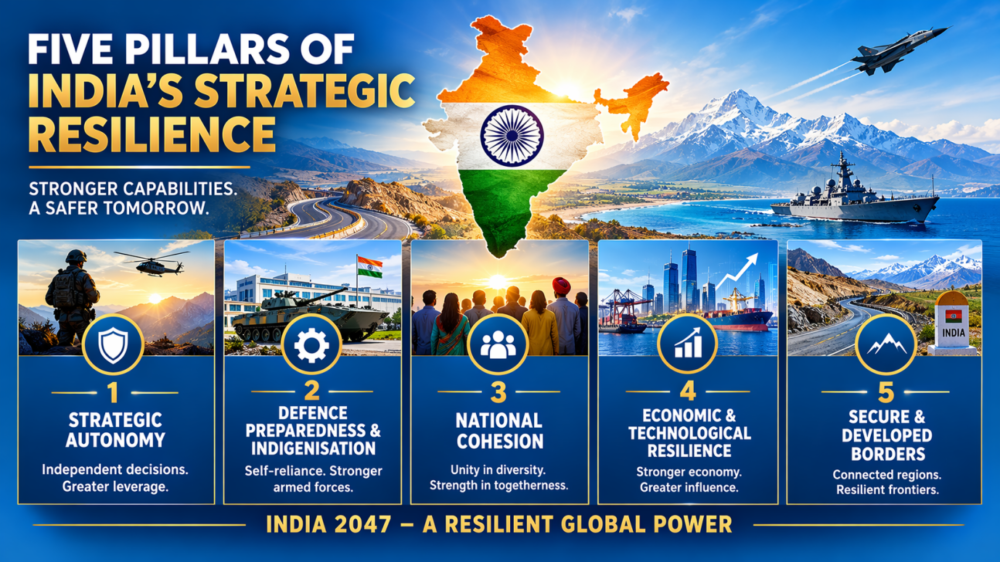
- Strategic autonomy must be supported by capability. Partnerships with the United States, France, Russia, Japan and others are valuable, but no relationship can replace India’s independent capacity to assess threats and make decisions. Diversification of suppliers, technology access and resilient supply chains must accompany diplomacy.
- Defence preparedness must precede a crisis. Indigenous design and production, ammunition reserves, maintenance, cyber resilience, space assets, intelligence and joint logistics are not industrial slogans; they are foundations of deterrence. India’s growing defence production and exports are encouraging, but quality, scale, timely delivery and critical technologies remain essential tests.
- Alliances should reinforce national power, not become substitutes for it. Flexible partnerships such as the Quad can advance shared interests while preserving strategic choice.
- National cohesion is a security asset. India’s pluralism requires constitutional confidence, equal citizenship, social harmony, fair institutions, and an unwavering rejection of communal hostility. Diversity becomes strength when citizens share a civic compact and trust the state to protect them impartially.
For India, the larger lesson is that power has several foundations: military strength, economic vitality, technological competence, political purpose and social trust. Neglect one for too long and the others become less secure
- Economic strength must translate into strategic resilience through manufacturing, energy security, maritime capability, infrastructure and technological innovation. India’s continental borders, long coastline and neighbourhood demand sustained investment, not episodic urgency.
- The European experience also cautions against assuming that economic interdependence guarantees peace, or that past stature ensures future influence. India must balance development with defence, openness with prudent border management, and ambition with institutional capacity. The objective is not autarky or isolation, but dependable national capability and partnerships chosen from strength.
- The same logic applies to border communities, where roads, communications, healthcare and livelihoods contribute to resilience. India’s frontier infrastructure must serve civilian opportunity and operational readiness. A secure border is not merely a line held by troops; it is also a region whose people trust the Republic. India should cultivate foresight across government, industry and the armed forces, anticipating technological shifts.
Strategic Reckoning: Power, Purpose and Survival
Europe is not destined to decline, and the Western alliance is not inevitably approaching disintegration. Europe retains formidable universities, industries, capital, democratic institutions and military capabilities; NATO is adapting, and European governments are increasing defence investment. But adjustment must become delivery. Britain must renew the consent that sustains its Union; France must strengthen the institutions that make republican citizenship meaningful; and Europe must build the capacity to defend itself while preserving a credible transatlantic partnership. America, too, must recognise that alliances are strategic assets whose reliability cannot be measured only in immediate transactions. For India, the larger lesson is that power has several foundations: military strength, economic vitality, technological competence, political purpose and social trust. Neglect one for too long and the others become less secure. Civilisations endure not through nostalgia, demographic arithmetic or declarations of greatness, but through adaptation, fairness and collective resolve. The question before every major power is not simply what it inherited, but what it is prepared to build and defend.
Renewal requires leaders to explain necessary sacrifices, distribute burdens fairly, and sustain public consent. Resilience begins when national purpose becomes institutional capability and public trust.

Lt Gen Rajeev Chaudhry (Retd) writes on contemporary national and international issues, strategic implications of infrastructure development towards national power, geo-moral dimension of international relations, and leadership nuances in a changing social construct. The views expressed are of the author and do not necessarily reflect the views of Raksha Anirveda






