


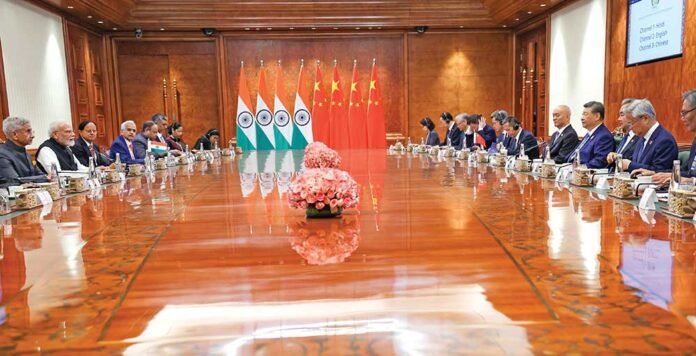
Diplomacy, it is said, is an all-weather exercise. Regimes change, leaders come and go, but diplomacy maintains its steady pace. This assumes particular importance in the context of a relationship as comprehensive as the India-China ties. Two Asian behemoths, India and China, have seen their bilateral relationship swing back and forth. Despite the strength of their trade ties, differing interpretations of their respective boundaries have been a sore point, often sparking clashes.
In the June 2020 Galwan Clash, Indian and Chinese troops clashed in the Galwan Valley in Eastern Ladakh over the contestation of the Line of Actual Control (LAC), claiming the lives of 20 Indian soldiers and an unknown number of Chinese troops. Ties plummeted after this, with governments of both sides taking tit-for-tat measures. More than five years later, we are slowly witnessing the thawing of this ice.

It began at the BRICS summit held in Kazan, Russia, in 2024, and gathered pace in 2026. This thawing can be analysed from the perspective of three consequential developments:
NSA Ajit Doval’s Visit to China
Ajit Doval, India’s National Security Advisor (NSA), visited Beijing to hold bilateral discussions with the Chinese Foreign Minister Wang Yi. Doval and Yi are the boundary representatives of their respective countries. The visit aimed at finding a solution to the knotty issue of the contested nature of the LAC. In pursuance of that aim, the bilateral discussions yielded eight outcomes: the important ones being an agreement on two new border military hotlines in the eastern and middle sectors of the LAC; two new meeting points for military commander-level meetings; and holding the trans-border river meeting soon.
But perhaps the more substantial outcomes were to advance discussions on “an early and substantial harvest” of the boundary delimitation and border management. This perhaps marks the first step on the long road to ensuring the resolution of the almost 4,000-kilometre-long border. Reaching a definitive agreement on the boundary question is imperative, as the Sino-Indian war of 1962 was triggered by China’s irredentist behaviour along the eastern sector, prompted by a lack of proper demarcation of the border.
SCO Stopover
With the Doval-Yi meeting setting the ground for rapprochement between the two sides, the momentum was carried forward by the 26th Shanghai Cooperation Organisation (SCO) summit held in Bishkek, Kyrgyzstan, in August. Notwithstanding the fact that the bloc is dominated by Beijing due to its financial and diplomatic clout, coupled with the presence of India’s arch-nemesis Pakistan, it is considered essential in diplomacy to engage politically and morally problematic actors.

NSA Ajit Doval visited Beijing to hold bilateral discussions with Chinese Foreign Minister Wang Yi. The talks yielded eight outcomes, including an agreement to establish two new military hotlines in the eastern and middle sectors of the LAC, designate two new meeting points for military commander-level meetings and hold the trans-border river meeting soon
In that regard, PM Modi highlighted terrorism, extremism, and fundamentalism as some of the biggest threats of the 21st century and, underlining the need for the grouping to resolutely act against these, India sought to convey to Beijing that there has been a marked change in New Delhi’s stance on these threats. In this context, India’s reiteration of its zero-tolerance approach to terrorism should further reinforce the message in Beijing that assisting sponsors of terrorism like Pakistan will carry costs — directly and indirectly. This message assumes particular significance against the backdrop of the revelations that China assisted Pakistan during Operation Sindoor. Therefore, for the sake of the broader nature of the bilateral ties, both sides continued to take their ‘positive’ engagement in the next high-level summit — BRICS.
The BRICS Touch
Held on September 12-13, the 18th BRICS summit was hosted by India. Notwithstanding the many contradictions among the members of the grouping, the stakeholders managed to set aside their mutual differences and formulated the Delhi Declaration. Among the key takeaways, the ongoing war in the Middle East featured prominently, with the member states calling for restraint in the Middle East alongside the need to protect civilian infrastructure and halt attacks on nuclear facilities; the declaration, however, strategically avoided condemning the US-Israeli strikes or Iran’s targeting of Gulf countries in the region as a retaliatory measure. In addition, without naming the United States, the stakeholders criticised the imposition of tariffs by the American administration under Donald Trump, arguing that the global trading order is firmly based on globalisation where no one country can call the shots.

Unlike in the past, idealism won’t work this time. It is imperative that we internalise hard-nosed realism in our ties with Beijing. The era of the Hindi-Chini bhai bhai is over; it is time that we adopt a formal, transactional and calculated relationship with the dragon
The consensus underlines India’s careful balancing act — to become a prominent voice of the Global South without sounding anti-West. In the context of the Sino-Indian relationship, it can be inferred that both sides want to move away from the ‘painful memories’ of the Galwan setback. In that vein, at a time when the world is bearing the brunt of American misadventures, whether in the form of the Iran war or in the upending of the global financial order, China and India are trying to put aside their differences to come to a modicum of understanding to jointly hedge against this turbulence.
However, this strategy is not without its pitfalls.
Treading With Extreme Caution
For India, a rapprochement with China may be essential, but the matter must not be rushed. George Santayana, the Spanish-American philosopher and essayist, said, “Those who cannot remember the past are condemned to repeat it.” This is apt in India’s context; throughout our bilateral relationship, India has taken the lead in improving the ties, only to be betrayed again and again.
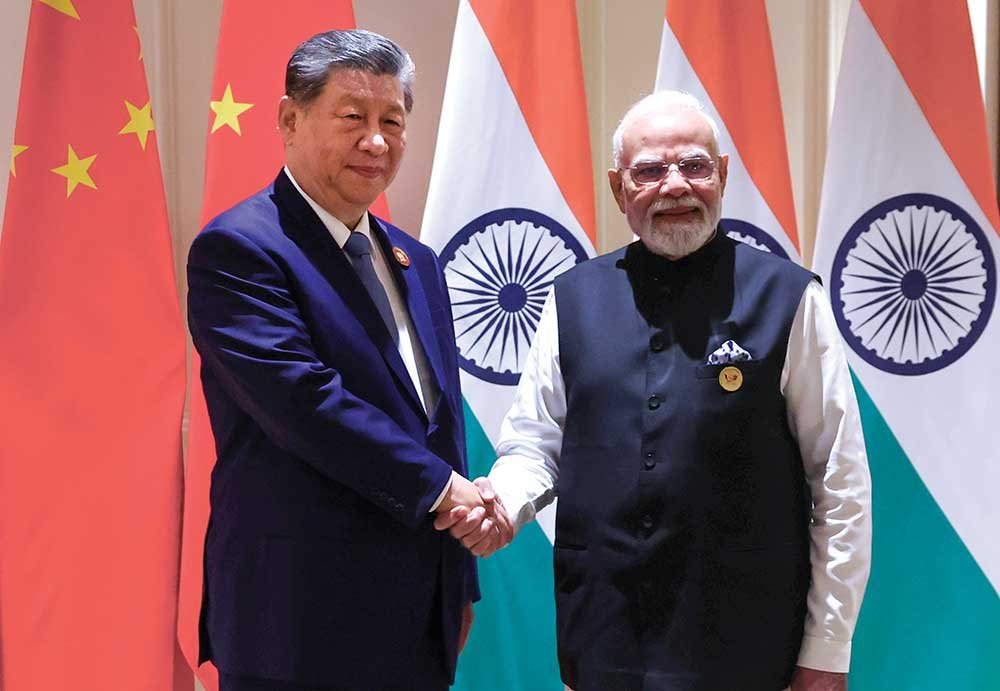
This time, however, New Delhi should exercise extreme vigilance. Boundary management must involve a quid pro quo. On the trade imbalance, Beijing must open its market to Indian companies; apart from this, it should demonstrate, in a concrete manner, that it is committed to addressing the trade deficit by buying more goods from India. Further, it is necessary for India to brainstorm possible countermeasures in case China again imposes restrictions on the export of rare-earth magnets; this may require establishing alternative sources of supply from other partner countries while working towards exploration and extraction of critical minerals and rare-earth elements on home soil.
Unlike in the past, idealism won’t work this time. It is imperative that we internalise hard-nosed realism in our ties with Beijing. The era of the Hindi-Chini bhai bhai is over; it is time that we adopt a formal, transactional, and calculated relationship with the dragon.

The writer is a doctoral candidate in Political Science at Mahatma Gandhi Central University. The views expressed are personal and do not necessarily reflect the views of Raksha Anirveda






