


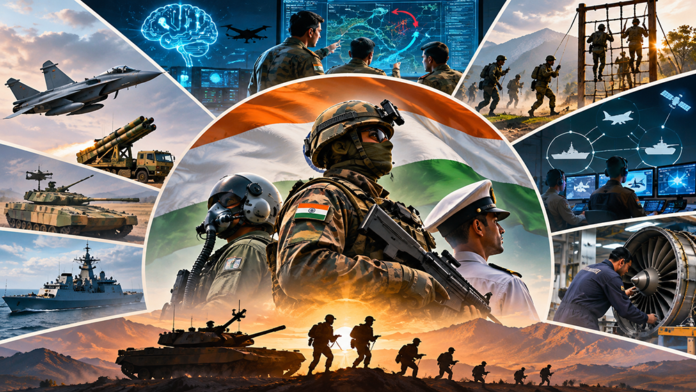
A military can acquire modern aircraft, sophisticated weapons and advanced surveillance systems and still find itself inadequately prepared for the next conflict.
The problem is not necessarily the quality of the equipment. It may lie in how that equipment is integrated, how commanders are trained to employ it, whether information reaches them in time, and whether the systems can be sustained when operations become prolonged.

This is a question India must confront as it moves into the next phase of defence modernisation.
The Indian Army’s Army Commanders’ Conference, held in New Delhi from October 21 to 23, 2026, brought this issue into focus with the release of a new Land Warfare Doctrine. Defence Minister Rajnath Singh described the doctrine as an overarching framework to prepare the Army for the evolving character of warfare and future conflicts. He also emphasised long-term strategic planning, multi-domain capabilities and seamless coordination in joint operations.
Around the same time, DRDO shortlisted SSS Defence and Kalyani Group as development-cum-production partners for an indigenous 20-mm aviation gun and turret system intended for the Rudra and Light Combat Helicopter platforms.
Defence Minister Rajnath Singh described the doctrine as an overarching framework to prepare the Army for the evolving character of warfare and future conflicts. He also emphasised long-term strategic planning, multi-domain capabilities and seamless coordination in joint operations
These are different initiatives. Yet both point towards the same requirement: India’s defence modernisation must be driven by operational needs, not simply by the availability of new platforms or the announcement of indigenous projects.

Doctrine Must Shape Acquisition
The contemporary battlefield does not allow land operations to be considered in isolation.
A ground formation may depend on satellite-based information, surveillance drones, secure communication networks and intelligence gathered across multiple domains. Electronic warfare can disrupt communications. Precision weapons can threaten command posts and logistics nodes. Unmanned systems can expose troop movement and challenge traditional ideas of concealment.

None of this diminishes the importance of the soldier on the ground. Land forces must still hold territory, protect important locations, manoeuvre and achieve their assigned objectives. What has changed are the conditions under which they must do so.
A formation may have to operate under persistent surveillance, with intermittent communications and the possibility of precision attacks against supporting infrastructure. Commanders must be able to interpret information quickly, exercise initiative and continue operations when some of their supporting systems are unavailable.
A land warfare doctrine must provide the framework for dealing with these conditions. It must influence force organisation, operational concepts, training, equipment requirements and logistics.
The release of the new doctrine is an important development. But its real value will emerge only when its principles are reflected in the way formations train, prepare and operate.
Doctrine should shape acquisition. It should not be written afterwards to justify equipment already purchased.
India’s defence-industrial ecosystem must be assessed across the complete capability cycle: research, design, prototyping, testing, platform integration, production, training, maintenance and upgrades
A new platform may look impressive in an inventory statement, but what operational problem does it solve? Does it improve surveillance, mobility, firepower, protection or command capability? Can it function with existing systems? Does it reduce a vulnerability that commanders have identified?
These are the questions that should guide modernisation.
Indigenous Aviation Weapons: More than Import Substitution
The proposed indigenous 20-mm aviation gun and turret system offers a useful example of how domestic industry can contribute to a specific military requirement.
According to The Print’s report published on October 19, 2026, DRDO’s Armament Research and Development Establishment shortlisted SSS Defence and Kalyani Group as development-cum-production partners for the system. It is intended for the HAL Advanced Light Helicopter Mk-IV, known as Rudra, and the Light Combat Helicopter.
The significance lies in the subsystem itself.
An armed helicopter is not simply an aircraft carrying a weapon. Its operational effectiveness depends on the integration of the gun, turret, sensors, targeting arrangements, communications, crew training and mission planning.
A dependable indigenous aviation gun could improve India’s control over a critical weapon subsystem. It may also reduce exposure to external supply constraints and provide greater freedom to undertake future modifications.
The system still has to progress through design, development, testing, integration and acceptance. Safety, accuracy, reliability and performance under operational conditions will determine its eventual value.
Indigenisation should never become a reason to lower acceptance standards. Domestic production is strategically useful when it delivers dependable capability, not merely because the manufacturing activity takes place within the country.
Recent conflicts have reinforced the importance of ammunition stocks, rapid repair, equipment replacement, resilient supply chains and the ability to adapt technology as battlefield requirements change
This is where defence policy must remain disciplined. The objective is not to replace every imported item with a locally produced equivalent regardless of performance. It is to build the ability to design, manufacture, maintain and upgrade critical systems without excessive external dependence.
The Missing Link: Integration and Sustainment
A weapon system has limited value if it cannot be integrated into the force or kept available when required.
India’s defence-industrial ecosystem must therefore be assessed across the complete capability cycle: research, design, prototyping, testing, platform integration, production, training, maintenance and upgrades.
A weakness at any stage can reduce the operational value of the final product.
Consider a formation equipped with modern surveillance systems and precision weapons. If its communication network is unreliable, the information generated by those sensors may not reach the right decision-maker in time. If maintenance support is inadequate, equipment availability will decline. If personnel are not trained to employ the systems together, their individual capabilities may never translate into a meaningful operational advantage.
The same principle applies to logistics.
Recent conflicts have reinforced the importance of ammunition stocks, rapid repair, equipment replacement, resilient supply chains and the ability to adapt technology as battlefield requirements change. The lessons vary across theatres, but the underlying issue is common: a military cannot depend on the initial quality of its equipment alone.
It must be able to sustain that equipment through the demands of operations.
India’s acquisition framework should give greater weight to reliability, maintainability, upgrade potential and timely delivery. The cost of a weapon cannot be measured only by its purchase price. Its availability throughout its service life matters just as much
India’s acquisition framework should give greater weight to reliability, maintainability, upgrade potential and timely delivery. The cost of a weapon cannot be measured only by its purchase price. Its availability throughout its service life matters just as much.
A Stronger Partnership Between the Military and Industry
The shift towards doctrine-led capability development requires a more mature relationship among the Services, DRDO, public-sector defence enterprises, private manufacturers, start-ups and research institutions.
The military user must articulate the operational problem clearly. Developers need access to realistic user feedback, including during early design and prototyping. Testing must be demanding, but it should also identify weaknesses early enough for developers to correct them.
Private-sector participation can expand the design base, introduce competition and increase manufacturing capacity. Yet the number of companies participating in a programme is not the real measure of success.
Can they deliver dependable equipment? Can they scale production when required? Can they support the system throughout its service life? Can they respond when the military needs a modification?
These questions matter more than the number of announcements made at an industry event.
The Services also have responsibilities. New equipment must be absorbed into training and operational practice. Personnel need to understand its limitations, maintenance requirements and tactical employment. A system inducted without adequate training or logistical support can create a gap between its technical potential and its actual battlefield contribution.
The pace of technological change creates a difficult problem. A system may take years to move from development to acceptance. During that period, operational requirements can change, new threats can emerge, and better technologies can become available
This is where doctrine can provide direction. It can connect operational requirements with research priorities, procurement decisions and training outcomes.
The Acquisition System Must Become More Responsive
India’s defence acquisition system has to protect public money and maintain transparency. Competition, technical evaluation and accountability are essential. There is no case for weakening these safeguards.
But the pace of technological change creates a difficult problem. A system may take years to move from development to acceptance. During that period, operational requirements can change, new threats can emerge and better technologies can become available.
The answer is a more responsive process, not an unaccountable one.
Time-bound evaluations, clearly defined trial requirements, staged procurement and planned technology upgrades can help. Where appropriate, smaller initial orders may allow the Services to evaluate equipment in operational use before committing to larger purchases.
The relationship between military users and domestic manufacturers should also extend beyond the initial contract. Software updates, component availability, technical documentation, repair facilities and intellectual-property arrangements must be addressed from the outset.
No major military can develop every technology, component, or material independently. International partnerships and carefully managed imports will continue to have a role
There is also a need to avoid excessive concentration of supply. Multiple qualified suppliers, where technically and economically viable, can reduce vulnerability and encourage innovation.
Measuring the Defence Reset
India needs a broader way of measuring the progress of military modernisation.
How long does it take to move a system from development to acceptance? Can the manufacturer sustain production during a disruption in global supply chains? How quickly can defects be identified and corrected? Can the equipment be integrated with existing platforms and communication systems? Does it improve the ability of a formation to complete its assigned mission?
These questions should feature prominently in defence capability reviews.
They also bring out the distinction between self-reliance and self-sufficiency. No major military can develop every technology, component or material independently. International partnerships and carefully managed imports will continue to have a role.
But dependence on external suppliers for critical systems can constrain operational choices during a crisis. India must therefore identify the technologies and subsystems where domestic design, production and support provide the greatest strategic advantage.
India’s defence modernisation must move from counting platforms to measuring operational capability. The next conflict will not wait for procurement cycles, industrial targets or institutional comfort
The new Land Warfare Doctrine offers an opportunity to align these priorities. Indigenous aviation weapon development demonstrates how the domestic industrial base can contribute to a specific operational requirement.
The Real Meaning of Military Modernisation
India’s defence reset should not be seen as a choice between acquiring platforms and developing indigenous systems. Both remain necessary. The real change must be in the way decisions are made.
Modernisation should begin with the operational problem. It should then identify the doctrine, technology, force structure, training and logistics required to address it.
This calls for closer coordination across the Services, research institutions, industry and the government. It also requires institutional willingness to learn from field experience, accept technical shortcomings and correct them without unnecessary delay.
The ultimate test of Aatmanirbharta is not whether India can manufacture a weapon. It is whether Indian forces can deploy it, sustain it and improve it with confidence when the strategic environment turns unforgiving.
India’s defence modernisation must move from counting platforms to measuring operational capability. The next conflict will not wait for procurement cycles, industrial targets or institutional comfort. Doctrine, technology and military preparedness must move together.

The writer is an Independent Director, Strategic Governance commentator, and leadership practitioner. He writes on geopolitics, corporate governance, sustainability, and the intersection of national strategy, boardroom leadership, and sports, bridging the battlefield, the boardroom, and the sports fields. He can be contacted on: 5cg9220rg@gmail.com. The views expressed are personal and do not necessarily carry the views of Raksha Anirveda






