


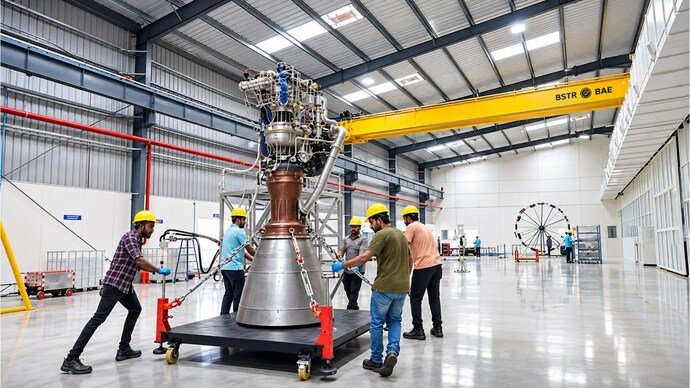
Astrobase Space Technologies has signed a memorandum of understanding with the Andhra Pradesh Economic Development Board to expand its rocket-engine testing facility at Thimmasamudram in Sri Sathya Sai district of Andhra Pradesh. The agreement was signed at the 31st CII Partnership Summit in Visakhapatnam on November 12, 2026. The company plans to add 339 acres to its existing site, taking the facility’s total area to approximately 360 acres.
The proposed ₹800-crore investment will support a wider range of launch-vehicle development and testing. Planned capabilities include static hot-fire tests of rocket engines, development and testing of rocket stages, stage-level “hop” tests and validation work for reusable systems. Hop tests involve a controlled lift-off and return, helping engineers assess a stage’s performance and recovery systems before attempting more demanding flight operations.

Astrobase chief executive and co-founder Neeraj Khandelwal said the larger site would enable critical testing programmes and help accelerate reusable launch-vehicle development. The company expects the project to create around 500 direct jobs and 1,000 indirect employment opportunities, according to reports of the announcement.
The expansion builds on an existing facility that the company describes as a private high-thrust engine-test site in Anantapur. Astrobase’s website says the current facility covers 21 acres and is designed to support thrust levels of hundreds of tons and exhaust temperatures above 3,000°C. The company says in-house testing infrastructure will give it greater control over the testing and iteration of its engine.
Astrobase is developing its Everest engine, a liquid-oxygen-and-methane engine using full-flow staged-combustion technology. The company describes Everest as an 800-kilonewton-class engine and says the propellant combination is intended to support reusable rockets. Its proposed two-stage launch vehicle is designed for medium- and heavy-lift missions, with four engines in the booster and one in the upper stage, according to the company. These are development plans and specifications, not evidence of an operational launch system.
The Andhra Pradesh announcement comes alongside the company’s proposed ₹500-crore investment in Karnataka for a manufacturing facility in Bengaluru. Planned capabilities there include additive manufacturing, fabrication, inspection and quality-control infrastructure, as well as engine and rocket-stage assembly. The facilities are intended to support development of the Everest engine and the AB220 medium-lift launch-vehicle programme.

Together, the two proposals point to a strategy spanning manufacturing, propulsion, testing and vehicle development. For a launch company, ground facilities are essential: engines, stages and integrated systems need repeated testing before a vehicle can be considered ready for flight. Expanding the test site could give Astrobase room to conduct more complex trials, though the announcement does not provide a construction timetable or specify when each new capability will become operational.
The company’s plans also reflect the widening role of private firms in India’s space sector. The sector was opened to private participation in 2020, while the Indian Space Policy 2023 set out a framework for non-government entities to take part across space activities. IN-SPACe serves as the authorisation and promotion agency for private-sector participation and access to relevant facilities.

Astrobase has stated a long-term ambition to build the capacity to transport 1,000 tonnes of payload to space annually from India. That figure is a company target, not current capacity. The Andhra Pradesh expansion would provide infrastructure for testing and development; whether it translates into reliable, repeatable launches will depend on engineering progress, regulatory approvals, financing and successful demonstrations.







