


The global commercial space station market could grow from $5.88 billion in 2025 to $23.51 billion by 2034, at a compound annual growth rate of 16.6%, according to Polaris Market Research. The forecast captures the scale of a potential post-ISS economy, but it is an industry estimate – not a guarantee that station operators will secure enough paying customers to sustain their businesses.
The immediate customer is likely to be the US government. NASA’s final request for proposals, released in October, seeks companies to design, build, test, certify and operate commercial destinations in low Earth orbit, alongside transportation services. Proposals are due December 8, with awards expected in spring 2027. NASA says it may select two or more companies for early development before later competition for design, certification and services.

That public procurement could help bridge the period between the ISS and privately operated stations. NASA’s stated aim is to buy services from commercial providers, while encouraging operators to develop additional customers and markets. But the transition relies on continued public commitment. A May analysis by the Center for Strategic and International Studies argued that NASA remains the essential buyer for the emerging sector and that stable agency funding and requirements are important to the business case.
Several projects are moving forward, but schedules underscore the technical and financial risks. Vast, now targets the first quarter of 2027 for the launch of its single-module Haven-1 station, later than its previous 2026 target. Starlab, the venture led by Voyager Technologies and Airbus, announced in February that it had completed a critical design review with NASA and moved toward fabrication, testing and assembly.
Axiom Space is pursuing a different path, initially attaching modules to the ISS before separating them into an independent station. In February, the company announced $350 million in financing, co-led by Qatar Investment Authority and Type One Ventures, to support station development and its spacesuit programme. The raise shows that private and international capital is available, although the investment alone does not establish a sustainable customer base for orbital research and manufacturing.
The commercial opportunity lies in repeat services: laboratory access, payload hosting, astronaut missions and potentially manufacturing in microgravity. Pharmaceutical and materials companies may become significant clients if experiments produce results worth repeating. But the market must convert interest and demonstrations into recurring bookings, with dependable transport, predictable schedules and clear prices. A station can be technically successful, yet struggle commercially if researchers cannot plan around delays or the cost of reaching orbit.

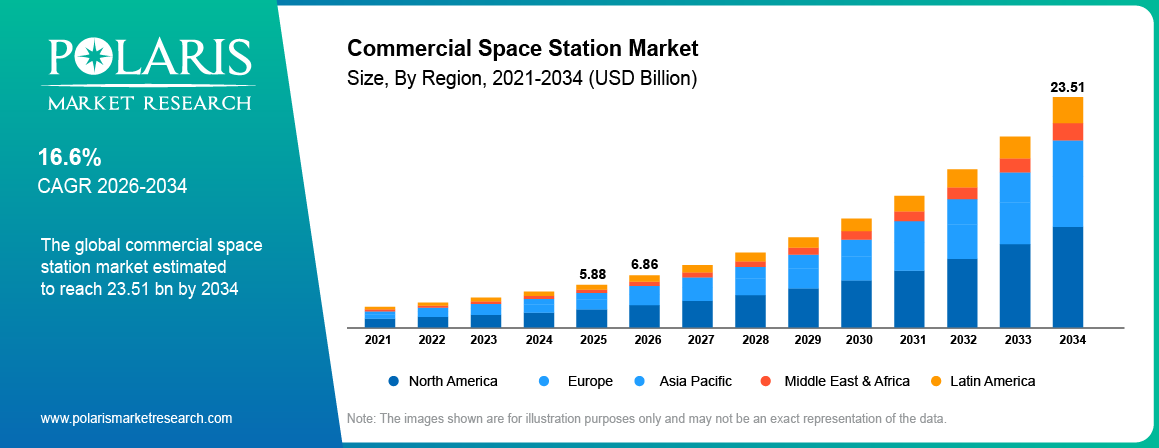
The market-size estimates themselves should be treated cautiously. Other research firms publish substantially different forecasts, reflecting differences in what they count as station-market revenue, from hardware and construction to crew, research and mission services. Polaris’s projection is therefore one scenario, not a settled industry benchmark. What is less uncertain is the need for expensive infrastructure, certification and reliable cargo and crew transport.

International programmes will also shape the competition. India has approved development of the first Bharatiya Antariksh Station module, targeted for 2028, with a five-module station planned to become operational by 2035. That is a national programme rather than a direct substitute for a commercial station, but it signals broader demand for orbital infrastructure and research.
NASA has selected SpaceX to develop the US Deorbit Vehicle under a contract with a potential value of $843 million, preparing for the ISS’s controlled retirement after operations end in 2030. The deadline creates urgency, but not guaranteed profits. Developers will need to demonstrate safe, timely operations and secure paying customers beyond government contracts. The decisive question is whether the stations can become dependable service businesses before the existing laboratory leaves orbit.







