



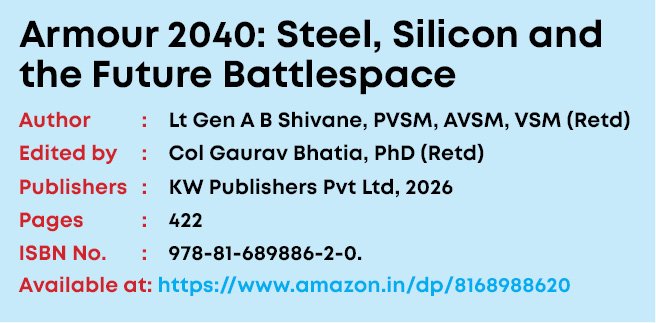
Every few years, someone announces that the tank is finished. The machine gun was expected to make frontal manoeuvre impossible. Air power was expected to render mass armies redundant. Now drones and algorithms get the same treatment. Lt Gen A B Shivane opens Armour 2040 with exactly this pattern, and then does something more useful than defending the tank. He asks what armour must become to stay decisive. That change of question, from “will it survive” to “what must it turn into”, carries the whole book, and it is the reason the book earns its place on a serious reader’s bookshelf.
The argument is simple and hard to dodge. Armour is not obsolete. Recent wars have exposed any force that fights platform by platform, without air defence, electronic cover, infantry, and timely intelligence around it. A tank left alone will burn. A tank inside a proper combined arms team still decides battles. From there the author builds his central idea, the Integrated Armoured Multidomain Battle System, in which sensors, shooters, autonomous systems and commanders act as one. He sums it up in a line that stays with you: “Armour 2040 is not a new tank. It is a new way of fighting.”

A Book Built Like a Campaign
The structure helps the reader at every step. Part I explains how the battlespace has changed and tests the headlines against Nagorno-Karabakh, Ukraine, Gaza and Operation Sindoor, distinguishing headline imagery from operational context. Part II then turns the mirror on India with an audit of the Armoured Corps that doesn’t flatter anyone, covering the two-front problem, the Siliguri Corridor, and Pakistan, increasingly equipped along Chinese lines. Part III sets out the vision and a doctrine for both the western and northern fronts. Part IV explains the digital battlespace, what artificial intelligence really adds, and how Germany’s CAPINT, the American M1E3 Abrams and Russia’s Armata compare with India’s Future Ready Combat Vehicle. Part V closes with a modernisation pathway and a case for rethinking professional military education. Each chapter leads naturally into the next, so the eleven chapters read as one argument rather than eleven essays.
A tank inside a proper combined arms team still decides battles. From there, the author builds his central idea, the Integrated Armoured Multidomain Battle System, in which sensors, shooters, autonomous systems and commanders act as one. He sums it up in a line that stays with you: “Armour 2040 is not a new tank. It is a new way of fighting”
What Makes it Convincing
The first strength is evidence. The author does not wave away the losses. The open-source tank loss tables in the appendix to Chapter 2, and the discussion of how active protection and crew survivability shaped the Merkava’s experience in Gaza, give the argument weight that opinion alone could not. He is also fair to the sceptics. The Preface says plainly that the book is neither a defence of tradition nor an act of faith in technology.
The second is its practicality. The recommendation tables turn analysis into action. Drones are placed at specific levels: reconnaissance at squadron, targeting at regiment, long-endurance surveillance at brigade, and coordinated operations at division. Layered counter-drone defence, active protection, electronic warfare, urban armoured capability and logistics resilience each get a focus area and a desired outcome. A planner can pick these up and use them. Chapter 9 emphasises that modernisation is a continuous process of spiral upgrades, which is more honest about procurement than most writing on the subject.
Young officers who will command troops and squadrons in a very different battlespace should read this book first. Senior commanders, defence planners, industry partners working on mechanised programmes, and students of strategy will each find something useful. Civilians and strategists will get an answer to the tank debate question
The third is the language. Technical subjects can become opaque in the wrong hands. Here, the images are clear and memorable: armour moving from sledgehammer to scalpel, time replacing terrain as the key variable in war, a corps-level formation degraded by a malware implant in logistics software without a single shot fired. The chapter on the digital battlespace is especially good at giving non-specialists the working knowledge of command, control, communications, computers, cyber, intelligence, surveillance and reconnaissance (C5ISR) they need for everything that follows.

The Human Core
 What sets the book apart from a competent staff study is its conviction that machines alone do not win wars. Chapter 10 argues for the scholar-warrior, an officer with gunnery and manoeuvre skills, technological fluency and strategic judgement, and it names ACC&S Ahmednagar as the institution that must lead this change. The dedication to the tankmen of the Corps, the verse tribute to his mentors and the Epilogue about a boy staring up at a tank in a cantonment give the book warmth. They are never sentimental for show. They explain why a man with four decades in the Corps ends a book about silicon by returning to character, trust and courage.
Scholarship and Presentation
The apparatus is solid. The bibliography ranges from Clausewitz, Boyd, Fuller, Guderian and Simpkin to recent CLAWS and RUSI work, and the chapter endnotes include full citations, many with links. A glossary, lists of tables and figures, and a chapter-by-chapter overview at the front make a 400-plus-page book easy to navigate. Col Gaurav Bhatia’s editing is evident in the consistent voice across chapters.

This book is a landmark contribution to Indian military thought and an essential read for anyone who cares about how India will fight. It includes a foreword by the Chief of the Army Staff and a special message from the DG Mechanised Forces. It is certainly a global bestseller in the making
A Fair Word on Limits
A book this wide cannot address every subject with the depth a specialist might expect, and a reader hoping for detailed costings for each programme will find the vision stronger than the budget lines. The book is also stronger on operational vision than on the cost, industrial, training and sustainment implications of implementing its recommendations. The author seems to recognise this. In the Epilogue, he accepts that some assessments will change and some predictions will prove wrong and says what should endure is the habit of adapting and staying curious. That candour is itself a mark of the book’s quality.
Who Should Read it
Young officers who will command troops and squadrons in a very different battlespace should read it first. Senior commanders, defence planners, industry partners working on mechanised programmes, and students of strategy will each find something useful. Civilian readers and strategists who follow the tank debate in the news will finally get an informed answer to the question they keep asking.
Verdict
Armour 2040 is a comprehensive and constructive treatment of the future of Indian armour. It is grounded in evidence, honest about the present, clear about the way forward, and written by someone who plainly loves the subject without being blinded by it. It does not tell the Armoured Corps to hold on to the past or to bet everything on the next gadget. It tells the Corps to build a force that senses first, decides first and acts first, with steel, silicon and human judgement working as one. The book is a landmark contribution to Indian military thought and an essential read for anyone who cares about how India will fight. It includes a foreword by the Chief of the Army Staff, a special message from the DG Mechanised Forces, and blurbs from two Army Commanders, which speak volumes about the recognition this seminal work has received. It is certainly a global bestseller in the making.







