


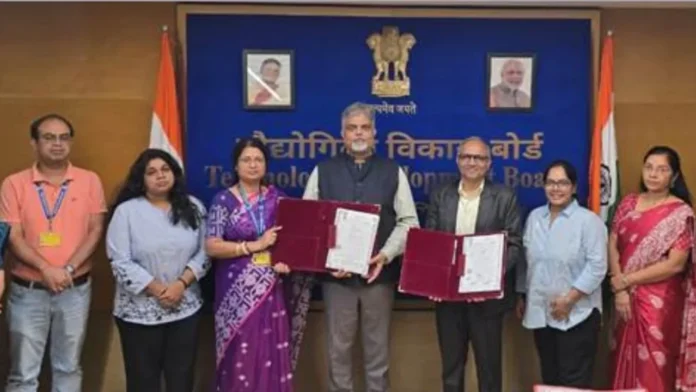
The project to develop an indigenous AI-enabled satellite network for electronic intelligence has a total estimated cost of ₹128.11 crore, with the government support being provided through the Research, Development and Innovation (RDI) Fund as optionally convertible debt. The programme aims to develop a sovereign space-based electronic intelligence, or AI-ELINT, constellation for national security applications. It will combine satellite payloads, artificial intelligence-based ground processing and links that allow satellites to communicate with one another.
The agreement was signed by the Technology Development Board (TDB), under the Department of Science and Technology and Astrome Technologies Pvt Ltd. The project is intended to advance key technologies from Technology Readiness Level (TRL)-4 to TRL-9 through development, engineering, integration, testing and validation. TRL-9 is the highest level on the scale, indicating a technology demonstrated in its operational environment; the target describes the programme’s objective, not its present status.

Astrome plans to develop microsatellites in the 50-kilograme class for progressive deployment in low Earth orbit. The government release does not specify the planned number of satellites, launch dates, operational timelines or an initial service area. It says the constellation is designed to increase geographical coverage and observation frequency as additional spacecraft are deployed.
The satellites are expected to carry electronic intelligence payloads designed to detect and analyse signals across a broad frequency range. Ground-based AI software would process and interpret information generated by the constellation. The project also includes inter-satellite communication links, which would enable spacecraft to exchange information and function as a connected network. Together, those components are intended to support a system for monitoring identified areas of interest.
The initiative arrives as government places greater emphasis on space-based intelligence and communications. Satellite constellations can provide repeated observations over wide areas, while onboard or ground-based processing can help manage large volumes of data. The Astrome programme’s stated focus is electronic intelligence: collecting and analysing signals, rather than simply taking optical images. The release does not detail what signals the system will monitor, how data will be used or what safeguards will govern its operation.
TDB Secretary Rajesh Kumar Pathak said the project would combine indigenous engineering with artificial intelligence and next-generation communications, and described it as an example of Indian deep-tech capabilities serving strategic needs. An authorised Astrome representative said the financial support would accelerate development and integration of the payload, processing software and communication links as the programme moves towards TRL-9.

Astrome, founded in 2015, is a Bengaluru deep-tech company working on wireless and satellite communications products. Its company profile lists technology including phased-array antennas, software-defined modems and satellite communication systems. The new project represents a move into a national-security-oriented satellite constellation, building on that communications expertise.
The TDB support is being provided under India’s RDI Scheme, a government initiative designed to encourage private-sector research and development in strategic and emerging technologies. The scheme has an approved outlay of ₹1 lakh crore over six years and backs projects in areas including space technology and artificial intelligence. The Astrome agreement is therefore part of a broader effort to direct public financing towards Indian companies developing advanced technologies.

The government’s announcement leaves several milestones to come. The companies must develop and validate the satellite payload, AI processing system and inter-satellite links, then integrate them into working spacecraft. The release does not give a schedule for those steps or state when the first satellite might be launched. Until testing and deployment take place, the constellation remains a development programme rather than an operational intelligence service.







