


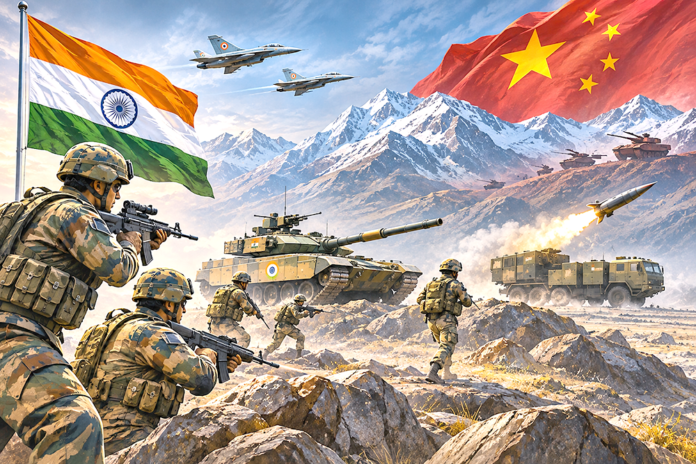
The defining feature of future warfare will be the convergence of operational domains. Land, sea and air operations increasingly depend on capabilities in cyberspace, outer space and the electromagnetic spectrum and a formation’s effectiveness may depend as much on keeping digital connectivity and reliable intelligence as on its conventional combat strength. India therefore needs a comprehensive multi-domain framework.
Six Domains, One Architecture
- Land: greater mobility, precision, battlefield transparency and integrated surveillance, with unmanned ground systems, autonomous logistics, smart ammunition and networked vehicles supplementing conventional formations.
- Air: air superiority, air defence, precision strike and aerial surveillance remain essential, but drones, loitering munitions and advanced missiles demand layered defences.
- Maritime: the Indian Ocean stays central, and submarines, patrol aircraft, unmanned underwater vehicles, surveillance networks and coastal defences will extend awareness and reach.
- Cyber: attacks may target command systems, communications, financial infrastructure and essential services, so India needs resilient networks, constant monitoring and rapid recovery.
- Space: communications, navigation, weather data and surveillance all depend on satellites, so protecting them and developing alternatives, must become a priority.
- Electromagnetic: electronic warfare can disrupt communications, navigation and precision-guided weapons, so forces must operate in contested spectrum while protecting their own networks.
These domains cannot be treated as separate technical compartments. Their value lies in integration. A satellite spots a developing threat, artificial intelligence helps process the data, secure networks carry the orders and precision systems respond. The speed of that cycle from information to action may decide the engagement, so India needs a unified architecture linking sensors, command centres, decision-makers and platforms across all three services.

Artificial Intelligence and Autonomy
AI is likely to be among the most consequential force multipliers of the coming decades. It can support intelligence analysis, threat assessment, predictive maintenance, surveillance, logistics planning, cyber defence, battlefield simulation and the identification of weaknesses in adversary systems, while drones, autonomous underwater platforms, robotic ground systems and loitering munitions reshape operational concepts.
AI may be the most consequential force multiplier of the coming decades, but human judgement must stay in command of lethal force
Early investment in indigenous autonomous systems, secure AI platforms and interoperable command networks is needed urgently. So that autonomy operates within clear legal, ethical and command frameworks and that human responsibility stay central to any decision on lethal force. AI should strengthen the commander’s judgement, not replace it with an unaccountable substitute.
Air Power: Finite Aircraft, Infinite Demands
In a multi-front war, air power may be the most critical instrument of national military capability. It must support simultaneous operations in different theatres while maintaining air defence, deterrence, mobility and precision strike, and its role now extends to integrated air and missile defence, suppression of enemy air defences, intelligence and electronic warfare. The main difficulty is balancing competing theatre demands with a finite combat fleet, which calls for streamlined and precise integration of air operations at national and theatre level.
Long-term capability should rest on indigenous platforms: the Tejas family, advanced combat aircraft programmes, airborne early-warning systems, indigenous radars and modern missiles, with the Akashteer air-defence control system anchoring a more comprehensive architecture.

Air power, land warfare and maritime strength each face distinct demands, from finite combat aircraft to Himalayan altitude to the sea lanes of the Indian Ocean
Future air warfare will also demand unmanned combat aircraft, collaborative combat aircraft, directed-energy weapons and counter-drone systems, as well as the stocks of ammunition, spares and dispersed infrastructure needed to sustain operations through prolonged hostilities.
Land Warfare: Altitude, Sand and Hybrid Threats
India’s land forces work in some of the world’s hardest environments. The northern borders mean extreme altitude, severe weather and thin infrastructure, while the Western Front calls for conventional operations in plains, desert and semi-desert.

Drones, satellite imagery, secure communications and precision weapons can sharpen awareness in the mountains, and mechanised formations in the desert need better mobility, protection, long-range surveillance and close coordination with air power.
Yet, technology alone will not decide land warfare. Leadership, training, endurance, morale and discipline remain decisive. India must strengthen joint training between land, air and maritime components, and the Army must be able to fight in a contested digital environment where communications may be jammed. That puts a premium on decentralised decision-making, mission-oriented command and individual initiative.
Maritime Power: India’s Strategic Depth
India’s maritime geography offers opportunity and exposure. It connects major energy suppliers, markets and strategic waterways, and the security of those routes underpins economic stability. A land war would add maritime burdens, since adversaries could apply pressure through naval deployments, submarine activity, disruption of shipping or threats to sea lines of communication.
In future wars, information superiority may count for more than numbers. Thus, intelligence fusion and the race for decision superiority is also required
Indigenous aircraft carriers, nuclear and conventional submarines, destroyers, frigates, patrol aircraft and naval unmanned systems will build the necessary capability, but maritime domain awareness is equally vital: coastal radars, satellites, aircraft, ships and unmanned platforms must feed one comprehensive picture.
The Andaman and Nicobar Islands, under the Andaman & Nicobar Command, sit near the approaches to the Malacca Strait and can become a surveillance and support hub for the eastern Indian Ocean. Cooperation with friendly navies, through information sharing, exercises and logistics arrangements, should deepen. The Navy’s role in multi-front deterrence, is central to national strategy, not a separate maritime concern.
Information, Cyber and the Drone Problem
In future warfare, information superiority may matter more than numerical superiority. India needs a stronger intelligence-fusion framework joining military and national intelligence agencies with technical intelligence, satellite imagery, cyber information and open sources, so that commanders receive timely, actionable information.
AI can help process the volume and shorten the time from detection to assessment, but fusion must be accompanied by scrutiny, since information overload, misinformation and deliberate deception can distort understanding. The aim is decision superiority: understanding a situation, weighing options and acting faster and more accurately than the adversary.
Cheap drones can exhaust expensive defences. Precisely why India needs layered air and missile defence and a domestic industry to feed it
The most dangerous dimensions of a future conflict may lie beyond the conventional battlefield. Cyberattacks on energy, finance, transport and command systems could cause national disruption, and interference with satellite navigation and communications would affect operations in every theatre.
India needs secure architectures, encryption, redundancy and rapid recovery, with critical infrastructure protected through cooperation among government, private operators and technical institutions, along with indigenous electronic-warfare equipment, resilient navigation and space capabilities built for redundancy, since dependence on a few satellites is itself a vulnerability. The goal is not merely to possess advanced systems but to keep fighting effectively when they are contested.
Cheap drones and sophisticated missiles have also changed the economics of war, because an adversary can use low-cost platforms to exhaust expensive defences. India needs layered air and missile defence combining radars, airborne warning, ground sensors, interceptors, electronic warfare and, as they mature, directed-energy weapons.
Counter-drone protection must cover military formations, airbases, ammunition depots, communication centres and critical civilian infrastructure, and India should manufacture drones, sensors, propulsion, batteries and electronics at home, since such items may be consumed rapidly in a long war. The sensible balance is high-end interception paired with cost-effective countermeasures.
Next, in Part Three: What sustains a long war, and what secures the nation.

Lt Gen S K Gadeock is a distinguished military leader, global strategist, and scholar who served as the Commandant of the Defence Services Staff College. A decorated veteran and former Logistics Advisor to the Botswana Defence Force, he has held numerous high-ranking appointments including Director General of the Amity Institute of Defence & Strategic Studies. Serving on the Advisory Board of Raksha Anirveda, he is a prolific writer and motivational speaker.






