


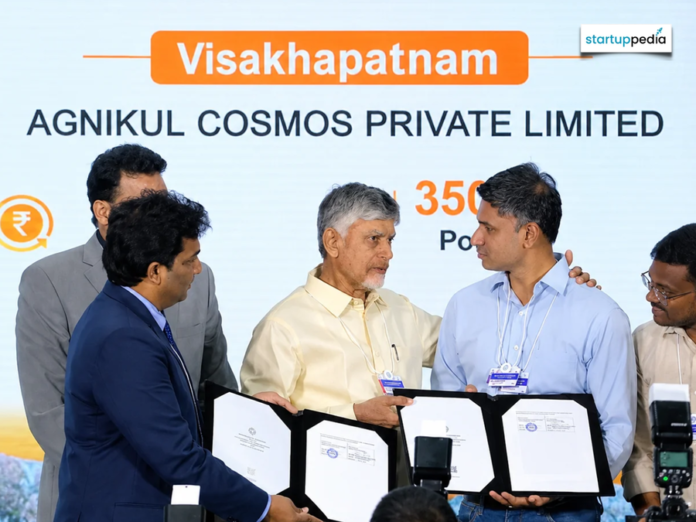
Agnikul Cosmos has signed an agreement with the Andhra Pradesh government to establish a facility in Tirupati district for manufacturing orbital data-centre units and rocket components. The company plans an initial investment of ₹510 crore, with the project expected to create about 350 jobs, according to reports from the CII Partnership Summit in Visakhapatnam. The proposal places the Chennai-based space startup at the intersection of launch services and the emerging market for computing infrastructure in orbit.
The facility is intended to integrate graphics processing unit (GPU) hardware with Agnikul’s rocket upper-stage technology. The company’s concept is to adapt an extendable upper stage into a platform capable of hosting computing equipment after a launch, rather than treating the stage solely as discarded launch hardware. Agnikul co-founder and chief executive Srinath Ravichandran said the new site would provide a dedicated place to build orbital data-centre units and integrate semiconductor companies’ GPU stacks with the launch vehicle.

Agnikul has identified Bengaluru-based NeevCloud as its first customer for the effort. Under an earlier agreement, NeevCloud plans to supply an AI data-centre module for launch and operation in orbit. The companies have presented the proposed system as infrastructure for AI inference, the process of running trained models to generate outputs, rather than a conventional terrestrial data centre moved wholesale into space. The first demonstration has been discussed as a planned mission, not a completed deployment.
The Andhra Pradesh investment is part of a wider set of commitments announced at the summit. The state said that 12 agreements signed on the second day involved proposed investments of ₹1,41,585 crore and could generate 10,919 jobs. Agnikul’s ₹510-crore project is comparatively small beside the largest commitments, but it adds a specialised aerospace and space-infrastructure component to the state’s investment push. These are announced commitments; their realisation will depend on projects moving from agreements to implementation.
The proposal follows a series of developments at Agnikul. The company’s Agnibaan SOrTeD mission flew in May 2024 from a privately operated launchpad at Sriharikota, demonstrating, among other technologies, a 3D-printed semi-cryogenic engine. In September 2026, it opened additional assembly and testing units in Chennai. Ravichandran said the company expected its next launch in the first half of 2027, with a focus on reusable launch-vehicle and upper-stage technologies.
Agnikul is entering a field that other Indian companies are also exploring. Pixxel has announced a partnership with AI company Sarvam to develop an orbital data-centre satellite, while Hyderabad-based TakeMe2Space has described plans for a networked orbital computing mission. Internationally, companies including Google, SpaceX, Axiom Space and Blue Origin are also pursuing space-based computing concepts. The projects differ in architecture and maturity, but together indicate growing interest in processing some data closer to satellites and other space-based systems.

The commercial case, however, remains unproven at scale. Orbital systems could draw on solar power and avoid using land or water for on-site cooling, but they face engineering and cost constraints. In the vacuum of space, heat must be dissipated through radiation, requiring specialised thermal systems; electronics also need to withstand radiation, and repairing equipment in orbit is difficult. Industry analysis identifies cooling, maintenance, launch costs and reliability as significant hurdles, even as it sees potential for specialised workloads.
For Agnikul, the Tirupati facility is therefore both a manufacturing expansion and a wager on a new category of space services. Its success will depend on building the units, securing launches and demonstrating that orbital computing can work reliably and economically. The investment agreement marks a concrete step toward those goals, but the data centre itself remains a plan, not yet an operating service in space.








