


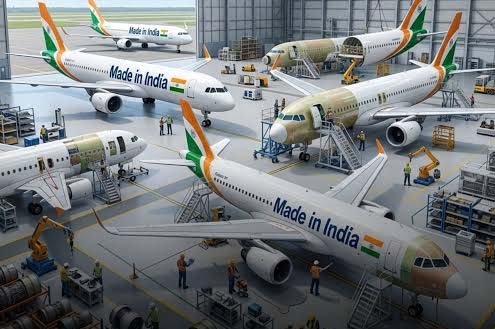
Visakhapatnam. Aviation Minister K Rammohan Naidu made the announcement on November 12 at the 31st CII Partnership Summit in Visakhapatnam, Andhra Pradesh. He said the ambition went beyond assembling aircraft to developing the capacity to design them in India. His remarks did not identify a specific aircraft model or establish that a new, wholly Indian-designed passenger aircraft would be flying within the two-year timeframe.
The distinction matters because India’s current initiatives include partnerships to manufacture or assemble aircraft designed elsewhere. At the summit, Naidu said Brazilian manufacturer Embraer had agreed to partner with the Adani Group in a joint venture and was looking to establish an Indian presence. He said a final assembly line for Embraer aircraft was expected within two years of the company’s establishment in India.

That timetable offers one possible route to the minister’s broader target, but the details of the aircraft programme, including the model, production schedule and the division between imported and locally made components, remain unclear.
India is also exploring other avenues for domestic production. Hindustan Aeronautics Limited has been working with Russia’s United Aircraft Corporation on plans to manufacture the SJ-100 regional jet in India. The aircraft seats about 100 passengers. Brazil’s Embraer has separately partnered with Adani Defence & Aerospace to explore a regional-aircraft ecosystem, although the precise manufacturing programme has not been announced.
The Embraer partnership has been associated with the E175 regional jet, but no final production plan has been confirmed. These discussions illustrate the range of possibilities behind the phrase “Made in India”, local assembly of an existing foreign design, a broader domestic supply chain, or eventually the development of aircraft designed in the country. Those are distinct industrial steps, and the minister’s announcement did not clarify which would count toward the two-year goal.
The scale of India’s aviation market is a major reason for the push. Naidu told an earlier symposium that Indian airlines had more than 1,600 aircraft on order, worth an estimated $100 billion, while the domestic fleet stood at around 850 aircraft. These orders are expected to be met largely by overseas production lines for now.

The market is expected to expand further. Airbus projected in January that India’s commercial aircraft fleet would reach 2,250 by 2035, driven by passenger growth and airline expansion. The manufacturer also forecast rising demand for pilots, technicians and maintenance services. As an industry supplier, Airbus has a commercial interest in the market, but its forecast points to the scale of the supply chain and workforce India would need to support a larger fleet.
Naidu also highlighted the role of component makers. He said more than 400 micro, small and medium enterprises were supplying components to Boeing and Airbus, with exports or supplies valued at $4.2 billion. Building on that base could help Indian companies move further into aerospace production, though making aircraft components is not the same as certifying and producing a complete passenger aircraft.

The government is pairing manufacturing ambitions with plans to expand aviation infrastructure. Naidu reiterated a proposal to develop 100 airports under the regional connectivity programme, UDAN. More airports could support routes to smaller cities and increase demand for regional aircraft, although airport construction alone does not guarantee that local aircraft production will be commercially viable.
For now, the two-year pledge sets a political and industrial deadline, not a fully defined aircraft programme. Whether it results in an aircraft assembled in India, a locally manufactured regional model or a design-led domestic project will depend on partnerships, investment, certification and the development of suppliers. The next concrete milestones will be the formalisation of manufacturing plans and confirmation of the aircraft and production line involved.







