


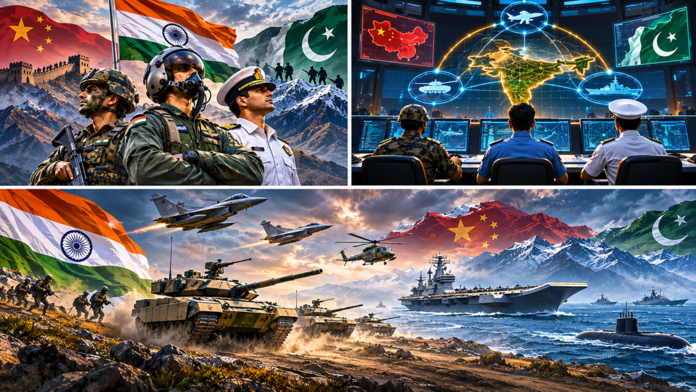
Amulti-front conflict will test not only military capability but the industrial and technological strength of the nation. No armed force can sustain prolonged hostilities without dependable supplies of ammunition, missiles, spares, fuel, communications equipment and replacement platforms.
Industry as Security
Excessive dependence on foreign suppliers is a serious vulnerability when global supply chains are disrupted or major powers pursue competing interests, thus an Aatmanirbhar Bharat is a strategic security imperative.

Wars are won by the side that can keep fighting. And its industry, supply chains and self-reliance remain productive
India’s defence industrial output reached a record ₹1.78 lakh crore in FY 2025-26, a 15.6 per cent rise on the previous year. Defence exports reached ₹38,424 crore, to more than 80 countries. Public-sector enterprises account for roughly 76 per cent of production and the private sector 24 per cent, and 159 of 175 ammunition variants have been indigenised, about 91 per cent self-sufficiency.
Indigenous effort should focus on critical technologies: aircraft engines, semiconductors and electronic components, radar and electronic-warfare equipment, missiles and precision munitions, unmanned platforms, secure communications and navigation, cybersecurity and AI and advanced materials and energy storage.
The private sector, public-sector undertakings, start-ups, universities and laboratories must work as one innovation ecosystem, with procurement that favours domestic design while holding to rigorous quality standards.
A credible wartime industrial base also needs surge capacity, strategic reserves and multiple suppliers. In this regard DRDO must take-up the gauntlet to produce lasers and masers, directed-energy weapons able to destroy drones, missiles and other projectiles with precision. “Technological sovereignty will increasingly become an essential component of military sovereignty”.

Defence output of ₹1.78 lakh crore, exports of ₹38,424 crore and 91 per cent ammunition self-sufficiency show real progress. But is it enough to sustain a long war?
Logistics: The Decisive Enabler
Military history shows that success depends on the ability to sustain forces, and in a multi-front war, logistics matters more because needs arise simultaneously in separated theatres. India needs an integrated architecture connecting formations, transport networks, ammunition depots, maintenance facilities, medical services and industrial supply chains.
Strategic roads, tunnels, bridges, rail links, airfields and logistics hubs along vulnerable borders must stay a priority, especially in the north and east, where terrain and weather complicate the movement of heavy equipment.

Digital logistics management, predictive maintenance and real-time inventory tracking can improve efficiency, while strategic reserves and alternative routes guard against cyber disruption, attacks on transport and fuel interruptions. The future battlefield will not reward a force merely because it has advanced weapons. It will reward the force that can keep fighting as long as the strategic situation demands.
Nuclear Shadows and the Cognitive Battlefield
Nuclear weapons shape every possible multi-front scenario. India must maintain credible minimum deterrence and a survivable posture while keeping conventional operations aligned with national objectives.
Roads, tunnels, rail links and strategic reserves may decide a campaign as surely as any weapon, making logistics is the decisive enabler
A two-front contingency against nuclear-armed adversaries would demand exceptional political and military coordination, so escalation management belongs inside operational planning. Conventional preparedness should give the government credible options without creating incentives for uncontrolled escalation. The aim is not to seek escalation but to deny adversaries the belief that nuclear threats can constrain India’s legitimate defensive options.
Future conflicts will also be fought over perception. Social media, AI-generated content, deepfakes and coordinated disinformation can manipulate opinion, sap confidence and divide society, and the targets may include soldiers, institutions, civilians and international audiences.
India needs a coordinated strategic communication capability that is timely, credible and verifiable. Information warfare is not mere publicity: it protects national credibility and morale and denies adversaries the chance to manipulate perceptions.
Partners, People and Resilience
Military readiness must also be backed by diplomacy. India should preserve strategic autonomy while expanding defence cooperation with partners in the Indo-Pacific, the Indian Ocean Region, Europe and West Asia.
Two nuclear-armed adversaries, a battle for public perception and the need to prevent escalation calls for deterrence in the shadow of the bomb
Joint exercises, technology cooperation, logistics agreements and maritime information-sharing improve interoperability and deterrence, help in this, provided partnerships remain consistent with an independent foreign policy. Military diplomacy, the author says, is a genuine force multiplier for national defence capabilities.
Technology cannot compensate for weak leadership or institutional discord. Joint exercises must move beyond ceremonial interoperability to realistic scenarios involving cyber disruption, electronic warfare, unmanned systems and logistical stress, and military education should incorporate AI, space operations, cybersecurity and information warfare.
A joint military culture must grow through joint training, appointments and command assignments, supported by institutions such as the proposed National Defence University. The future commander, in the author’s phrase, must be a joint warfighter, a technologically informed leader and a strategic decision-maker.
Nor can armed forces manage such a conflict alone. The nation’s staying power depends on its economy, infrastructure, industry, energy, financial institutions and civil administration. Critical infrastructure must be protected against physical and cyber threats, and energy, food, telecommunications and transport security belong in national contingency planning, with states, private industry and research institutions joining coordinated preparedness exercises and arrangements for rapid industrial mobilisation. National resilience, will matter as much as military strength in a prolonged confrontation.
Technology cannot replace leadership, and armies cannot win alone. A long confrontation demands joint military culture and the national resilience
Seven Priorities for the Road Ahead
These seven priorities, must be pursued through a phased, funded and measurable programme that favours operational effectiveness over organisational expansion, acquisition without integration or duplication.
- Integrated theatre commands and a unified joint doctrine, phased in, covering multi-front contingencies, multi-domain operations and escalation management.
- Intelligence and decision superiority, through an integrated fusion architecture, AI and secure networks.
- Multi-domain and technological capabilities: cyber, electronic warfare, space resilience, AI, autonomy, precision weapons and air and missile defence, interoperable across the services.
- Indigenous production and technological sovereignty in semiconductors, engines, sensors, missiles, ammunition, unmanned platforms and secure communications.
- Integrated logistics and sustained combat capability, with common standards, strategic reserves and digitally managed supply chains.
- Strategic deterrence, maritime security and military diplomacy, without compromising strategic autonomy.
- Joint military leadership and national resilience, through joint education, cross-service appointments and a coordinated civil-military preparedness framework.
The seven priorities for transformation are needed to build strength so credible that adversaries never attempt a multi-front war
From Readiness to Strategic Superiority
Overall, the next decade will bring rapid change as AI, autonomous platforms, quantum technologies, hypersonic systems, cyber operations and space capabilities reshape strategic competition.
India must anticipate these developments rather than merely react, and must avoid an unsustainable arms race by concentrating on the capabilities that give the greatest operational advantage. The future of joint warfighting will depend not on the number of platforms or formations but on the ability to combine intelligence, technology, leadership and combat power into a coherent national response.
Jointness must also go beyond restructuring and become an operational culture in which each service understands its contribution to common objectives. India’s goal should not be to fight wars on multiple fronts, but to build such credible, integrated strength that adversaries are deterred from attempting them.
The ultimate test is whether three powerful services can become one coherent instrument, capable of preserving strategic autonomy, protecting sovereignty and prevailing in every domain.
“The future battlefield will reward the speed of decision, precision of action, technological adaptability and the ability to sustain combat power under prolonged pressure”.

Lt Gen S K Gadeock is a distinguished military leader, global strategist, and scholar who served as the Commandant of the Defence Services Staff College. A decorated veteran and former Logistics Advisor to the Botswana Defence Force, he has held numerous high-ranking appointments including Director General of the Amity Institute of Defence & Strategic Studies. Serving on the Advisory Board of Raksha Anirveda, he is a prolific writer and motivational speaker.






