



The next war may begin long before the first shot is fired. A satellite could be blinded, a communication network compromised, a power grid disrupted or a fabricated narrative unleashed to fracture public confidence. By the time conventional military operations commence, the adversary may already have spent considerable effort weakening the foundations upon which a nation fights. The battlefield is no longer confined to geographical boundaries; it encompasses the physical, technological, informational and psychological spaces that sustain national power.
The Battlefield has no Boundaries
The Russia-Ukraine conflict, tensions in West Asia and the increasing militarisation of technology have demonstrated how drones, precision weapons, satellite imagery, cyber operations and information campaigns can converge during conflict. Warfare is moving beyond platform-centric engagements towards integrated operations in which intelligence, speed, connectivity and decision superiority can determine outcomes. The six domains – land, sea, air, space, cyber and cognitive – are no longer independent theatres. They are interconnected dimensions of a single battlespace.

The strategic implication is profound. A nation may retain conventional military superiority and yet become vulnerable if its communications, infrastructure, decision-making systems or public confidence are compromised.
The next war may be decided not by who fires the first shot, but by who creates the first strategic paralysis.
Traditional Three: Still Relevant, But Not Sufficient
Land, sea and air remain the physical foundations of military power, but their character is changing rapidly. On land, drones, loitering munitions, precision artillery, autonomous systems and electronic warfare are transforming battlefield transparency and the relationship between firepower and manoeuvre. Concealment is becoming difficult, while the ability to detect, decide and strike faster is increasingly decisive.
The six domains now form a single, interconnected battlespace, where the next war may be decided by who first creates strategic paralysis
At sea, the battlespace extends from the ocean surface to the seabed. Unmanned underwater vehicles, maritime surveillance, long-range missiles and threats to critical shipping routes are altering naval calculations. In the air, stealth platforms, integrated air defence, swarm drones and networked weapons systems are challenging conventional assumptions about air superiority. Expensive platforms increasingly face the prospect of being threatened by comparatively inexpensive weapons.

The lesson is not that conventional military power is losing relevance. It is that its effectiveness increasingly depends on integration with sensors, communications, intelligence and precision systems operating beyond the immediate battlefield. Numbers and platforms remain important, but connectivity and coordination increasingly determine how effectively they can be employed.
The three traditional domains have not become obsolete; they have become dependent on capabilities beyond themselves.

Space: The New High Ground
Modern military operations increasingly depend on assets that operate hundreds or thousands of kilometres above the earth. Satellites provide navigation, secure communications, intelligence, surveillance, reconnaissance, weather information and early warning. Precision targeting and real-time battlefield awareness are becoming increasingly dependent on space-based infrastructure.
Land, sea and air power remain vital but now depend on sensors, connectivity and precision systems beyond the battlefield
Yet, space assets are vulnerable to jamming, spoofing, cyber intrusion, directed-energy systems and anti-satellite capabilities. Disruption of satellite communications or navigation could affect military operations, aviation, shipping, logistics and civilian infrastructure simultaneously. The dependence is not merely military; it extends into the economic and administrative functioning of modern states.
India has made significant progress in space technology and demonstrated anti-satellite capability through Mission Shakti in 2019. However, demonstration of capability must be complemented by resilience, redundancy, space situational awareness and the ability to restore disrupted services. The objective should not simply be to possess satellites, but to ensure that national operations can continue even when access to space-based services is contested.
A nation that loses its eyes and ears in space may find itself fighting a modern war with yesterday’s awareness.
Cyber: The Invisible Weapon
The most consequential attack on a nation may not produce an explosion. A coordinated cyber operation could target military networks, banking systems, telecommunications, electricity distribution, transport infrastructure and government databases. Its objective may be to delay mobilisation, disrupt logistics, compromise sensitive information or create confusion in command and control.
Satellites underpin navigation, communication and surveillance, making resilience and redundancy as important as owning space assets
The distinction between military and civilian cyber security is increasingly difficult to sustain. An attack on a civilian power grid or telecommunications network could directly affect military readiness. Similarly, compromised industrial control systems could interrupt essential supplies during a crisis. Cyber warfare therefore demands more than defensive software and specialist response teams. It requires continuous threat intelligence, secure networks, indigenous capabilities and clearly defined institutional responsibility.
India must treat critical information infrastructure as a national security asset. The armed forces, intelligence agencies, technology companies, financial institutions and infrastructure operators must operate within a coordinated framework. Cyber resilience must be measured not merely by the ability to prevent intrusion, but by the speed with which essential services can recover after disruption.
In a networked war, paralysing a nation’s systems can become as consequential as destroying its military assets.
Cognitive Warfare: Battle for the Human Mind
The most dangerous weapon in the next war may be a lie that millions begin to believe. Cognitive warfare seeks to influence perceptions, shape decisions, weaken morale and undermine trust in institutions. Disinformation, deepfakes, psychological operations, manipulated images and coordinated social media campaigns can create confusion on a scale previously difficult to imagine.
Attacks on grids, banks and networks can cripple military readiness, so India must treat critical information infrastructure as a national security asset
Artificial intelligence has made the production and distribution of fabricated content faster, cheaper and more convincing. A false report of military casualties, a fabricated statement attributed to national leadership or a manipulated video during a crisis could trigger public panic and complicate strategic decision-making. The intended target is not necessarily a military formation; it may be the confidence of an entire society.
India’s enormous digital population, linguistic diversity and complex social environment make this domain particularly consequential. Strategic communication must therefore become a core national security function. Credible public information, media literacy, rapid verification mechanisms and institutional transparency are essential. Equally important is the need to defend democratic freedoms while countering deliberate manipulation.
A country that loses confidence in itself may be strategically weakened without losing a single battle.
India’s Multi-Domain Test: Doctrine to Capability
India has recognised the changing character of warfare. The more difficult question is whether it is reorganising its national security architecture fast enough to fight and prevail in it. This is where the real strategic challenge lies. India’s geographical vulnerabilities, two-front security environment, maritime interests and technological dependencies demand a level of integration that conventional service-specific structures alone cannot provide.
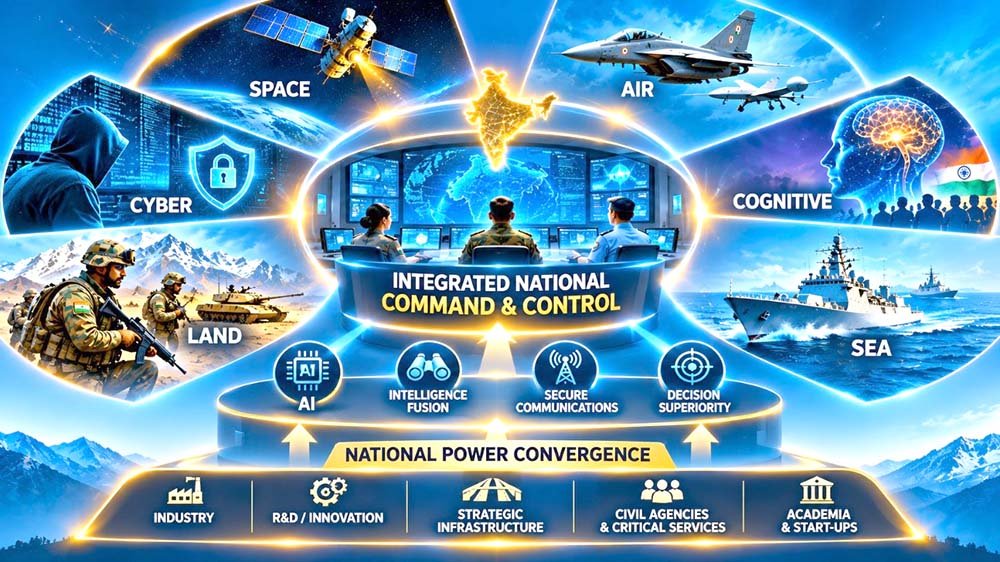
There has been meaningful progress. The release of the Joint Doctrine for Multi-Domain Operations on August 27, 2025 was an important milestone. It recognised the need to integrate all six domains and adopt a whole-of-nation approach. The Department of Military Affairs, the Chief of Defence Staff and Headquarters Integrated Defence Staff provide an institutional foundation for greater jointness. Exercises such as Prachand Prahar in March 2025, involving all three services in the high-altitude environment of Arunachal Pradesh, demonstrated the growing emphasis on integrated planning, surveillance, command and control and coordinated firepower.
AI-driven disinformation and deepfakes target public confidence, making strategic communication and media literacy core security functions
Operation Sindoor in May 2025 offered another important operational illustration. The intelligence-led identification of nine major terror camps, coordinated military action and India’s subsequent handling of retaliatory drone and aerial threats demonstrated the importance of intelligence fusion, precision capabilities, integrated air defence and inter-service coordination. It would, however, be premature to treat one operation as proof that India has mastered all six domains. The larger lesson is that operational success must become institutional capability rather than remain dependent on individual missions or exceptional circumstances. The four challenges to achieve integrated multi-domain operational preparedness are as follows:
- Genuine Jointness. India’s three services have distinct operational cultures, procurement priorities, command structures and institutional procedures. Coordination during an operation is not the same as integration before one. Theatre commands, common operational pictures, interoperable communications, joint intelligence fusion and unified operational planning must evolve into a coherent system. Integrated Theatre Commands should not become merely another layer of headquarters; they must deliver measurable improvements in decision speed, resource utilisation and operational effectiveness.
- Technological Self-reliance. India’s defence budget for 2025-26 was allocated Rs 6.81 lakh crore, including ₹80 lakh crore for capital expenditure on defence services. These are substantial resources, but expenditure must increasingly translate into capabilities that define future warfare: artificial intelligence, autonomous platforms, quantum technologies, advanced sensors, secure communications, electronic warfare and cyber defence. Dependence on foreign suppliers for critical components can become a strategic vulnerability during prolonged conflict. Indigenous development must therefore, be treated as a security imperative, not merely an industrial aspiration.
- Integration of Civilian and Military Capabilities. India’s power grids, telecommunications, ports, airports, financial networks, data centres and transport corridors are indispensable to national resilience. Strategic infrastructure deserves particular attention. Roads, bridges, tunnels and advanced landing grounds along the northern frontiers are not simply construction achievements; they determine reinforcement timelines, logistics sustainability and the ability to maintain operational momentum. The strategic value of infrastructure lies not only in reaching the battlefield but in sustaining forces once they arrive.
- Institutional Preparedness. Multi-domain warfare requires officers, scientists, technologists, cyber specialists, intelligence professionals and civilian administrators to understand each other’s operational requirements. Joint education, specialised career pathways, common exercises and permanent mechanisms for industry participation must become integral to defence planning. Exercises must test not merely combat capabilities but also the resilience of electricity, communications, logistics and information systems under simulated attack.
The April 2026 Ran Samwad discussions reinforced precisely this requirement: multi-domain operations are not six domains functioning independently but interacting dynamically, with the operational advantage shifting between them. India’s Land Warfare Doctrine 2026, released on October 23, 2026, has further underlined the importance of AI, autonomous systems, data analytics, cyber security and secure communications. The doctrinal direction is encouraging. The test will be its execution.
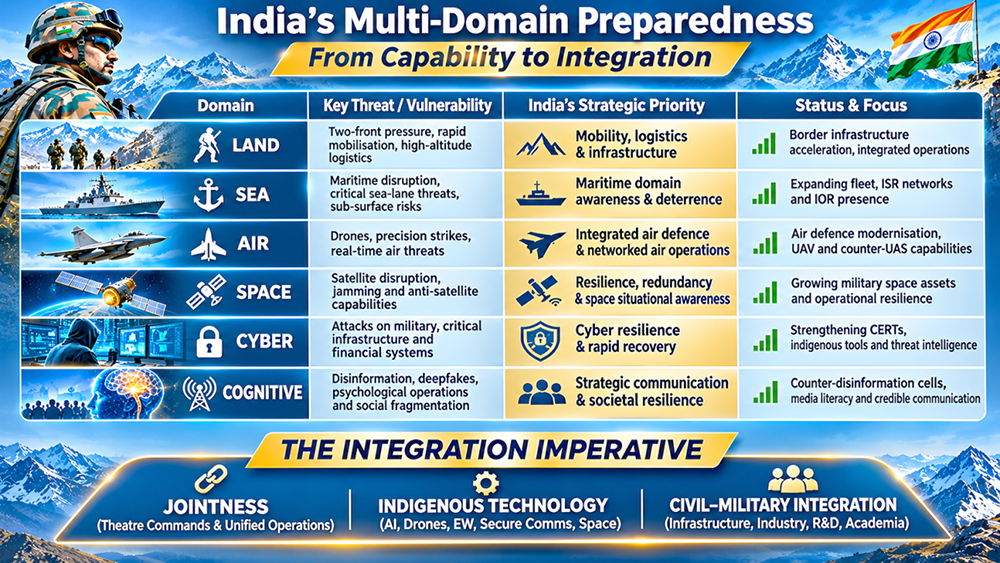
India has begun writing the doctrine of multi-domain warfare. It must now build the machinery, technological depth and institutional culture to execute it.
The Future Belongs to Those Who Integrate
The decisive advantage in tomorrow’s war will belong to the nation that integrates its capabilities before conflict begins. India needs a national multi-domain preparedness framework built around joint operational structures, resilient infrastructure, technological self-reliance and whole-of-nation participation. The armed forces must develop integrated command and control, while intelligence agencies, research institutions, industry and civilian infrastructure operators must become active participants in national security planning.
Doctrine is in place, but genuine jointness, self-reliance, civil-military integration and institutional preparedness will determine whether India can execute it
Equally important is the need to invest in people. Tomorrow’s military leadership must understand technology, data, information operations and the interconnected nature of national power. Realistic multi-domain exercises should test India’s ability to operate under conditions of disrupted communications, degraded satellite services, cyber-attacks and information manipulation. Defence modernisation must consequently be judged by operational integration and resilience, not merely by the number of platforms inducted or the money spent.
There is also a strategic choice to be made. India can continue to modernise individual services and capabilities in isolation, or it can build an integrated national security system in which military strength, technological innovation, industrial capacity and civilian resilience reinforce one another. The latter requires institutional courage, sustained investment and a willingness to transcend traditional organisational boundaries.
The next war will not necessarily be won by the nation possessing the largest army, the most powerful navy or the most advanced air force. It will be won by the nation that can combine its instruments of power, absorb disruption, make faster decisions and sustain operations across every domain.
Tomorrow’s wars will not be fought by six separate forces in six separate battles. They will be won by one nation fighting as one integrated strategic system.

Lt Gen Rajeev Chaudhry (Retd) writes on contemporary national and international issues, strategic implications of infrastructure development towards national power, geo-moral dimension of international relations, and leadership nuances in a changing social construct. The views expressed are of the author and do not necessarily reflect the views of Raksha Anirveda






