


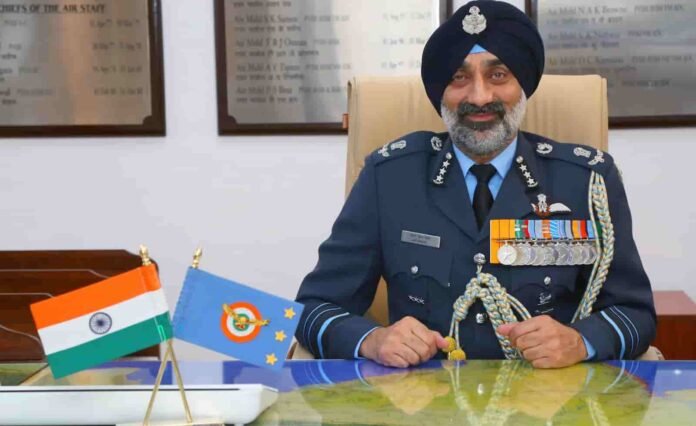
Air Chief Marshal Amar Preet Singh candidly shares his thoughts and vital insights into Indian Air Force affairs in an exclusive interview with Raksha Anirveda. He discusses multi-domain operations, indigenous aerospace manufacturing, advanced drone warfare doctrines, inventory depth and the comprehensive strategic roadmap for a fully integrated, future-ready service, as his tenure as the Chief of Air Staff concludes on October 31.
Raksha Anirveda (RA): You have stated that military power remains the ultimate arbiter of national security and that future wars cannot be fought in silos. How is the IAF translating this into a deeply integrated, digitally connected and AI-enabled architecture for Multi-Domain Operations across the three services?

Amar Preet Singh (APS): Future wars will not be fought in separate air, land, maritime, cyber and space compartments. Military power remains the ultimate arbiter of national security, but it will be decisive only when it is applied as one. Multi-Domain Operations is not simply about three Services executing missions’ side by side. It is about drawing on our distinct operational strengths within a unified network to generate a single, decisive strategic effect. In a conflict, the side that shares information faster, decides faster and acts faster will prevail. The IAF therefore views air power as a vital part of an integrated multi-domain combat system, and we are building the architecture to make that a reality.
The foundation of that architecture is a common, trusted and resilient digital backbone, through which information can be shared across Services and domains at the required speed and level of security. On that foundation, the IAF is strengthening joint planning, shared situational awareness, resilient communication networks, rapid sensor-to-shooter linkages and interoperable command-and-control structures. Our focus areas are data standardisation, interoperability, common operational pictures, AI-enabled decision support and resilient communications.
This integration is not a distant vision. It has already been proven in operations. The IAF’s Integrated Air Command and Control System is connected with the Army’s Akashteer air defence control and reporting system and the Navy’s Trigun. Together they create a clear, real-time picture of the air battle for all three Services. During Operation Sindoor, the IAF’s surface-to-air missile and counter-UAS units, ably supported by the Indian Army’s air defence units, operated effectively under the control of the IAF’s IACCS nodes. The adversary’s drones and stand-off weapons were met by a single, networked air defence shield, not by three separate ones. The operation as a whole reinforced the same lesson: the desired effect was created through the coordinated application of capabilities across the Defence Forces, not through individual Service actions in isolation.
Space is another domain where we are progressing at a good pace. Exercises such as Antariksha Abhyas, conducted with the Defence Space Agency, have brought the Services and national space organisations together to examine our dependence on space and the consequences of its denial. The goal across all of these is a force in which a target detected by a space-based sensor, a naval platform or an Army surveillance system can be engaged by an Air Force aircraft or a long-range weapon. Equally, an IAF sensor should be able to provide targeting data or situational awareness to a sister Service.

Artificial Intelligence will be the force multiplier in this architecture. A connected force generates enormous volumes of multi-source data. The real challenge is converting that data into actionable information for commanders, fast enough for them to act on it. The IAF’s AI Centre of Excellence, UDAAN, will collaborate with similar initiatives of the two sister Services to build indigenous solutions for AI-enabled decision support systems.
The aim is not simply to connect systems. It is to create a force in which information generated in one domain can rapidly create an operational effect in another. That is the integrated, digitally connected and AI-enabled force the IAF is committed to building, together with our sister Services, so that India fights its future wars as one.

RA: Your emphasis that “every brick should be Made in India” underscores the push for domestic aerospace and defence production. What are the most significant milestones achieved so far in the IAF’s partnership with DRDO on more than 60 indigenous programmes, and where do you see the next major breakthroughs?
APS: “Every brick should be Made in India” is a statement of intent about the kind of Air Force India must have. Perhaps the most significant milestone of all has been a change in the IAF itself. We have moved from being predominantly a technology recipient to an active participant in indigenous capability development. The IAF’s role goes well beyond placing requirements. We support DRDO’s projects with regular user inputs, trained test crew, programme management teams, testing facilities such as firing ranges, and air effort whenever it is needed. That sustained user-developer partnership is what has made success possible.
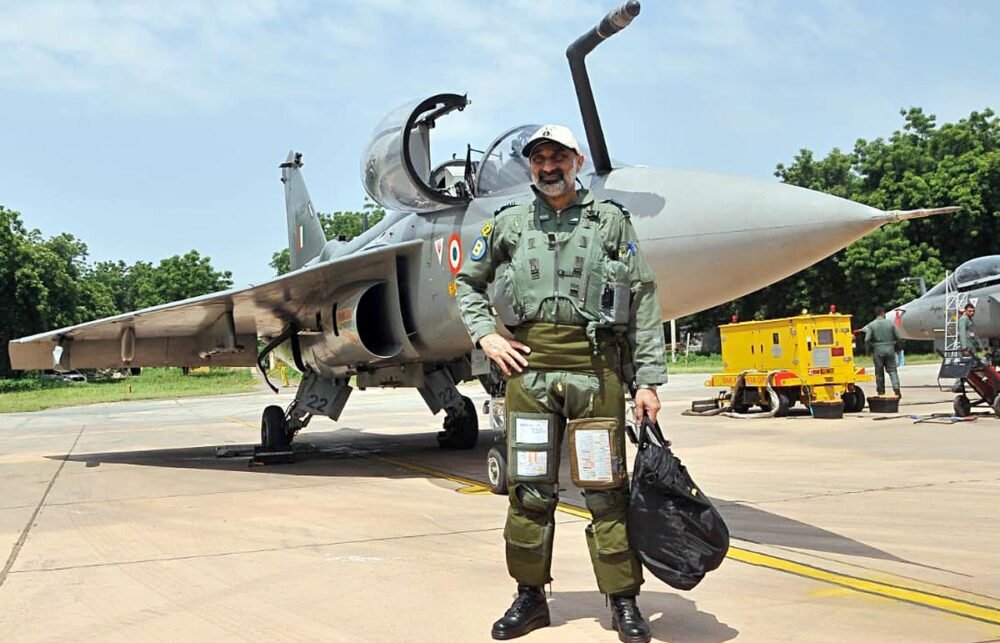
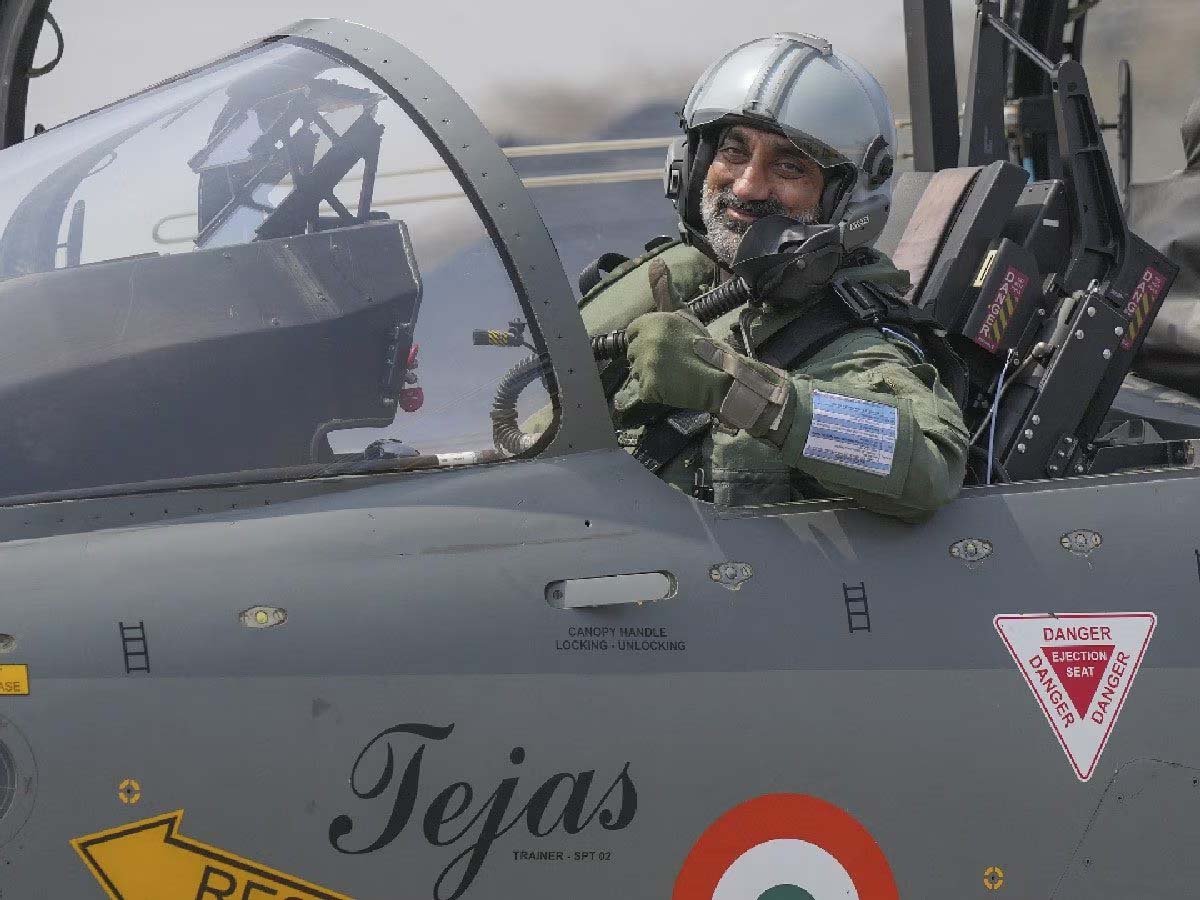
The results are visible across the Air Force. Programmes such as Tejas, Astra and Akash show what this partnership can achieve. Indigenous airborne surveillance has been operationalised with the Netra AEW&C. The induction of the LCH Prachand, BrahMos and loitering munitions have strengthened our combat and missile capability. DRDO-designed radars such as the Rohini, the Low-Level Transportable Radar-Ashwini and the Mountain Radars continue to flow into service. The C-295 programme has scaled-up private-sector aerospace manufacturing in India. Equally important are the many indigenous sub-systems, line-replaceable units, test equipment and software that rarely receive public attention but directly improve operational availability. Our indigenisation pipelines are steadily converting listed items into domestic production.
The coming years will be very exciting. The next major breakthroughs are likely to come where technology dependence has traditionally been hardest to overcome, such as:
- The AMCA and advanced propulsion
- Scramjet-based technologies and new-generation air-launched weapons
- AI-enabled unmanned platforms, collaborative combat platforms and Manned–Unmanned Teaming
- Battle management systems and advanced electronic warfare
- Next-generation AESA and electro-optical sensors
- Advanced materials and manufacturing
The partnership has an equally important role to play in maintenance, because operational availability is decided in the hangar and the repair depot as much as in the design office. We look to DRDO, DPSUs and industry for indigenous overhaul of aero-engines, module-level repair of radars and avionics, and indigenous test benches, diagnostics and mission-software support. AI-enabled predictive maintenance, additive manufacturing of spares and the reverse-engineering of obsolete components will raise fleet serviceability. New platforms such as the AMCA should have maintainability designed in from the start. Applying the same user-developer approach to sustainment will make our air power resilient in a prolonged contingency.
The real step change will come when these individual successes become a repeatable model, one in which indigenous subsystems, software and mission systems are routinely absorbed into mainstream IAF procurement. Our guiding principle is clear: Design in India, Develop in India, Manufacture in India, Maintain in India and Upgrade in India. That is what “every brick should be Made in India” truly means, and the IAF, with DRDO and Indian industry, will not rest until it becomes the norm.
RA: While AMCA and LCA Tejas continue to mature, the IAF is pursuing MRFA and other interim acquisitions. How is the Service balancing the need to bridge current capability gaps with the longer-term goal of a fully indigenous combat fleet?
APS: The IAF faces a real challenge: the draw-down of its legacy fighter squadrons. We are meeting it not with a single solution but with a phased, carefully balanced plan. The logic is simple. We must never allow a gap in the nation’s defence today, and at the same time every step we take, must move us closer to an Air Force, that is designed and built in India. The two objectives are not in tension; they are two halves of the same strategy.
Our capability has already been strengthened on both fronts. The IAF has inducted the Rafale and the indigenously developed Light Combat Aircraft. We have signed contracts with HAL for the upgrade of the Su-30MKI fleet, a design and development project with significant indigenous equipment. A contract for an additional 12 Su-30MKI aircraft, signed in December 2024, is under execution.
True integration unites the Army, Navy and Air Force across a resilient digital network to achieve a single, decisive strategic effect in modern warfare
The indigenous fleet is set for significant growth. The IAF has signed two contracts for the LCA Mk-1A, for 83 and 97 aircraft respectively. Deliveries are yet to commence, and we are maintaining close coordination with all stakeholders to ensure they proceed expeditiously.
To bridge the capability gap in an early timeframe, the IAF is pursuing the procurement of the Multi-Role Fighter Aircraft. In February 2026, the Defence Acquisition Council accorded Acceptance of Necessity for the MRFA, which will enhance the IAF’s ability to undertake air-dominance roles across the spectrum of conflict and strengthen deterrence through long-range offensive strikes. Even this interim acquisition is shaped by our long-term goal. The majority of the aircraft will be manufactured in India, and the case is being progressed to maximise technology transfer for local manufacturing and the use of indigenously developed weapons.
For the longer term, DRDO is developing the LCA Mk-II and the Advanced Medium Combat Aircraft, a fifth-generation fighter. The IAF is actively involved in both programmes, which will boost our capability significantly in the 2030s. We are also recognising that some global players, including our adversaries, have already progressed in fifth-generation combat programmes, so we are looking beyond the fifth generation as well. Sixth-generation fighter programmes are still in the design and development stage worldwide. The IAF is closely monitoring the emergence and evolution of sixth-generation combat aircraft technologies across the globe, with a view to assessing their operational relevance and potential integration into its future capability development roadmap.
Looking ahead, the LCA, the Su-30MKI, the MRFA and the AMCA will form the core of the IAF’s combat potential. The majority of these will be of indigenous design, and the others will carry significant indigenous contribution and be made in India. Our aim is to build-up, progressively, the number of combat squadrons that our operational requirements demand. With each step, the Indian Air Force is moving surely towards a combat fleet that is not only strong enough for today’s challenges, but increasingly Indian in its design, its manufacture and its future.
RA: The IAF is actively seeking new trainer aircraft and Medium Transport Aircraft, while also exploring the conversion of attack helicopters into specialised drone hunters. Could you please elaborate on the operational rationale behind these priorities and the timelines you are working towards?
APS: Every one of these priorities rests on a simple truth: combat power is only as strong as the people who fly it and the logistics that sustain it. Fighters and weapons capture the headlines, but it is the training pipeline and the transport fleet that make an air force ready, responsive and able to sustain operations. That is why they feature so prominently in our modernisation plans.
Trainer aircraft. Every IAF pilot’s journey begins on a basic trainer. A shortage of trainers is therefore a shortage of future pilots, and a constraint on the entire force. The HTT-40 Basic Trainer Aircraft was procured precisely to meet the shortage of basic trainers for our newly inducted pilots.
A contract for 70 HTT-40 aircraft and associated equipment, including simulators, was signed with HAL in March 2023. The aircraft has approximately 56 per cent indigenous content, which will progressively rise to over 60 per cent. HAL is engaging Indian private industry, including MSMEs, in its supply chain, and the aircraft is configurable for upgrades to meet future requirements.
Deliveries were originally scheduled to begin in September 2025, but were delayed, primarily by a delay in the supply of aero-engines. The first three aircraft were delivered on September 18, 2026, and we are working closely with HAL to maintain momentum on the rest. The IAF has also issued a Request for Information for an Advanced Jet Trainer for the next stage of training.
Medium Transport Aircraft: Transport aircraft give air power its strategic reach, its tactical flexibility and its ability to deliver timely logistics. They are also what allows India to respond in times of crisis, both within and beyond its borders.
When Cyclone Ditwah struck Sri Lanka in November 2025, IAF transport aircraft and helicopters formed a vital part of Operation Sagar Bandhu, evacuating 264 survivors, including foreign nationals.
The IAF has transitioned from a passive technology recipient to an active co-developer, championing the principle that every brick of aerospace power should be “Made in India”
The MTA programme will strengthen that capability. Earlier this year, a Request for Proposal was issued to suitable industries for 60 Medium Transport Aircraft under the Buy and Make (Indian) category. Of these, 12 aircraft are planned to be acquired in
fly-away condition and 48 are to be manufactured in India. This programme is expected to create a domestic manufacturing ecosystem for aircraft of this class.
Countering drones. Recent conflicts, and our own experience, have shown how extensively drones are now used. As I described earlier, the drones and stand-off weapons launched against us during Operation Sindoor were defeated by our networked air defence. Countering unmanned systems is therefore a clear priority. Every option that adds speed, reach and flexibility to the IAF’s counter-drone capability is being examined against that operational requirement.
Taken together, these initiatives address the foundations of air power: the pilots we train, the reach we sustain and the new threats we must defeat. The IAF will pursue each of them with urgency, so that the force of tomorrow is as well trained, as well supported and as well protected as it is well armed.
RA: Initiatives such as iDEX, ADITI and the Meher Baba competition, along with broader collaboration with academia and industry, are central to the IAF’s modernisation. What key takeaways have emerged from these programmes, and how is the impact being measured on the ground?
APS: The most important lesson from these initiatives is that innovation cannot be created through procurement alone. For the Indian Air Force, they mark a clear departure from traditional procurement towards an agile, open-innovation model.
Instead of asking industry to build generic products, we now ask industry, academia, MSMEs and start-ups to solve specific operational challenges. The response has shown that India has a substantial pool of technological talent outside the traditional defence ecosystem, and that this talent is eager to work with the IAF.
We have built the institutions to harness it. The Directorate of Aerospace Design at Air Headquarters is the nodal directorate for Make, iDEX and DRDO’s Technology Development Fund projects. It conveys our requirements to industry, assesses industry potential and hand-holds participating firms.
Two units of the Regional Aerospace and Innovation Division have been commissioned, at Gandhinagar and Bengaluru. At the Tri-Services Academia Technology Symposium in 2025, the IAF released a compendium of “Technological Challenges and Opportunities” and signed nine MoUs with academic institutions.
The Directorate of Indigenisation and the Base Repair Depots in the IAF drive the modernisation agenda. The Directorate formulates policies, steers indigenous development of spares for new and legacy aircraft, maintains a service‑wide database, and coordinates with HAL, DPSUs, private industry, CEMILAC, DRDO and academia to generate short and long‑term self‑reliance plans.
The service is actively managing legacy draw-downs by blending interim acquisitions like the MRFA with indigenous platforms such as the LCA Tejas and AMCA
Complementing this, the BRDs identify emerging technologies, conduct feasibility studies and translate concepts into indigenous solutions. Their combined effort ensures a seamless flow from research to field‑ready components, reducing foreign dependence and upgrading the IAF’s capability.
The results are tangible. More than 175 projects under Make, iDEX and TDF are in progress, creating business opportunities worth more than ₹30,000 crore for Indian private industry. Several Make and iDEX projects, including those under ADITI, have prototypes ready for bulk production.
The Mehar Baba competition series has generated orders worth about ₹2,000 crore for the unmanned and counter-UAS sector. Together with Dronathon-2026, it has shown that commercial off-the-shelf technology, ruggedised for military use, can offer a cost-effective and scalable alternative to bespoke military hardware.
The broader shift is visible in our budget too. The domestic share of the IAF’s capital expenditure in FY 2024-25 and FY 2025-26 was approximately 90 per cent, well above the Ministry of Defence guideline of 70 per cent.
As this is the first tranche of such projects, we have also drawn important lessons. With the Department of Defence Production, we are refining processes to enable faster processing without compromising quality or oversight. We have also learned that new indigenous technologies must integrate seamlessly with the IAF’s existing digital ecosystem, including e-MMS, IMMOLS and AFNET.
How do we measure impact on the ground? Not merely by the number of challenges floated or prototypes demonstrated. The real metrics are:-
- the number of technologies progressing from prototype to induction,
- the number of technologies scaled across platforms,
- reductions in dependence on imported components,
- reductions in downtime, life-cycle cost and development timelines, and
- improvements in operational availability.
Nowhere are these metrics more visible than in maintenance, where innovation meets the daily reality of keeping aircraft and weapons combat-ready.
We are opening up sustainment challenges to start-ups, MSMEs and academia, from predictive maintenance and AI-based fault diagnosis to indigenous repair of obsolete components and additive manufacturing of spares.
We are prepared to test their solutions in live maintenance conditions, within the bounds of flight safety and airworthiness. Because these solutions plug into our own digital maintenance systems, their impact can be measured with hard numbers. Those numbers include faster repair turnaround, fewer unscheduled removals, better spares availability, higher fleet serviceability and a lower share of imported spares. A technology succeeds in our eyes when it shows up in these numbers on the flight line and in the repair depot.
Modernisation extends to critical pipelines, highlighted by the induction of HTT-40 trainers and the procurement of Medium Transport Aircraft to secure logistics and reach
Ultimately, the true measure of success is simple. It is when an innovation that began in an Indian start-up, MSME or academic laboratory becomes a dependable capability in the hands of an air warrior. We are now seeing that happen, and the IAF is committed to making it the norm.
RA: With Unmanned Aerial Systems evolving into offensive strike platforms, how is the IAF’s Drone Warfare Doctrine taking shape? Concurrently, what lessons from regional and global drone or missile engagements are informing the creation of a layered, impenetrable air-defence matrix integrated with C5ISR?
APS: Few developments have changed the character of air warfare as quickly as the rise of unmanned systems. In a remarkably short time, drones have moved from the margins of the battlefield to its centre. As I have often said, they have evolved from eyes in the sky to claws in the sky. They no longer only watch; they strike, decoy, jam and saturate. Recent engagements across the world, from Nagorno-Karabakh and Russia-Ukraine to West Asia and the Red Sea, together with our own operations last year, have fundamentally altered how modern forces approach both offensive operations and air defence. The IAF is learning from all of them and from its own operational experience.
Shaping our approach to drone warfare: For the IAF, unmanned systems are progressively moving beyond their traditional ISR role to become integral components of air power. We foresee a mix of remotely piloted, supervised-autonomous and increasingly autonomous platforms performing ISR, electronic warfare, decoy, communications-relay and strike functions.
Their advantages in persistence, risk tolerance, scalability and potentially lower operating cost make them particularly relevant in contested environments. They will not operate alone. Our approach places them within a larger human-machine combat system, in which unmanned platforms take on the high-risk, high-attrition roles while manned aircraft increasingly act as mission commanders.
Programmes like iDEX, ADITI and the Mehar Baba competition have harnessed domestic start-up talent and academia to deliver over 175 actionable defence projects
Operation Sindoor demonstrated this integrated approach, with unmanned systems and loitering munitions contributing alongside ISR, combat aircraft, precision weapons, electronic warfare and networked command and control. To shape this capability with Indian industry, the IAF released ‘The Indian Air Force Unmanned & Autonomous Roadmap’ at Dronathon-2026 in September, where unmanned and counter-unmanned systems were assessed under realistic operational conditions.
Lessons for air defence: The same conflicts have taught hard lessons about defending against drones and missiles. Three stand out.
The first is cost. Cost of defending cannot be quantified. Even a drone can cause excessive damage and hence need to be neutralised using any means necessary. Even though cost has to be measured against the importance and value of the target, using an expensive interceptor missile to shoot down an inexpensive, mass-produced loitering munition is economically unsustainable over any prolonged conflict.
Layering is therefore equally about cost-efficiency. Our focus is on integrating low-cost hard-kill solutions as the primary layer against drones, preserving our high-end surface-to-air missiles for cruise missiles and aircraft. At the lowest layer, we are pursuing directed-energy options such as high-power microwaves and lasers, alongside soft-kill measures such as jamming.
The second is saturation. Adversaries now launch waves of cheap drones to exhaust interceptors or distract radars. No air defence can rely on a few high-value systems; it must have depth, numbers and the ability to discriminate quickly between threats.
The third is survivability of sensors. A single, massive radar installation is a single point of failure. We are therefore moving towards a distributed mesh of passive sensors and smaller radars. A target detected by one sensor is correlated by another and tracked by the fused network.
To meet the threat of massed, low-cost UAVs, the IAF is deploying layered, cost-effective air defence networks supported by directed-energy and AI-driven weapon-target pairing
Integration with C5ISR. What binds these layers into a single shield is the network. This is the tri-Service integration of IACCS with Akashteer and Trigun that I described earlier, and it proved itself against the adversary’s drones and stand-off weapons during Operation Sindoor. The next step is AI-driven weapon-target pairing, in which the system automatically assigns the most cost-effective interceptor to each target.
This reduces the cognitive load on the human operator during a saturation attack, while the human remains in control of the decision. The IAF’s indigenous Unmanned Traffic Management system, Vayu UTtaM, adds another dimension, helping to separate friendly drones from hostile ones in increasingly crowded airspace.
The drone and missile threat will continue to evolve, and so will we. By combining low-cost layers, distributed sensors, AI-enabled command and control and the integration of all three Services, the IAF is building an air defence matrix that is layered, resilient and economically sustainable. Our aim is that whatever an adversary sends, in whatever numbers, India’s skies and critical assets remain protected.
RA: Looking ahead, the M-UMT approach, robust domestic supply lines and the protection of space-based C5ISR networks are critical. How is the IAF ensuring both inventory depth and resilience against a multi-front threat architecture while continuously evaluating neighbouring space capabilities?
APS: As ongoing conflicts around the world have shown, resilience has become a form of combat power. Wars today are no longer decided only in the opening exchanges. They are decided by which side can keep its forces armed, connected and fighting the longest.
A force that runs short of weapons, loses its networks or depends on supply lines it does not control, will find its combat power ebbing, however capable its platforms be. Against a multi-front threat, the IAF is therefore building resilient military capabilities that enhance deterrence, reduce vulnerabilities and enable India to sustain high-intensity operations through a prolonged conflict.
Sustaining high-intensity operations across a multi-front threat requires robust domestic supply chains, expanded munitions stock and hardened space-based C5ISR architectures
Inventory depth and domestic supply lines. We are progressively strengthening inventory depth through diversified sourcing, accelerated indigenous production, assured weapons stocking and resilient supply chains. The most secure supply line is the one that begins in India. That is why indigenous production sits at the heart of this effort, and why the rise in the domestic share of our capital expenditure, which I mentioned earlier, matters as much operationally as it does industrially.
Manned-Unmanned Teaming. Unmanned systems add affordable mass and depth to the force. Within the human-machine approach, I have already described, we are pursuing unmanned capability through acquisition, indigenous development and start-up innovation.
The direction is towards swarms, collaborative systems and autonomous sensing, leading eventually to teaming between manned and unmanned combat platforms. The IAF has been articulating its operational requirements for Manned-Unmanned Teaming to HAL since 2019, and the Indian Air Force Unmanned and Autonomous Roadmap I referred to earlier, gives Indian industry clarity on our priorities.
Fighting across multiple fronts. Inventory alone does not win a multi-front conflict; the ability to shift combat power does. Networked operations allow us to deploy combat capabilities dynamically across multiple fronts, concentrating effort where it is needed most. The tri-Service air picture created by IACCS, Akashteer and Trigun, which I described at the outset, is what makes this possible.
Protecting space-enabled C5ISR. Our dependence on space will only grow, and with it the need to protect what space provides. On space and C5ISR architectures, our priorities are redundancy, operational survivability and the ability to fight through contested or degraded networks.
The establishment of AI centres like UDAAN aims to convert massive streams of battlefield data into rapid, actionable decision support for commanders
Protecting space-enabled networks means looking beyond the satellites themselves. Ground stations, communication links, processing systems and user equipment all matter. Our design priorities therefore include alternative communication paths, cybersecurity and the ability to continue essential functions with reduced connectivity.
Redundancy also comes from diversity. We are working on Air-Ship Based High Altitude Pseudo Satellite to provide persistent ISR, electronic intelligence, telecommunication and remote sensing from the stratosphere. It adds another layer between our airborne and space-based assets. We are also preparing for the worst case. Antariksha Abhyas, which I mentioned earlier, specifically addresses the consequences of losing space services and the measures to mitigate them.
Watching the neighbourhood. We continuously track developments in space, surveillance and counter-space capabilities in our region. These inputs are integrated directly into our force structure, our doctrine and our multi-domain exercises, so that our plans keep pace with the threat.
Our goal is not simply numerical capability. It is to ensure that India’s combat power remains connected, survivable and decisive across a prolonged multi-front conflict. The IAF is committed to building exactly that: a force with the depth to endure, the networks to fight as one and the resilience to prevail.






