


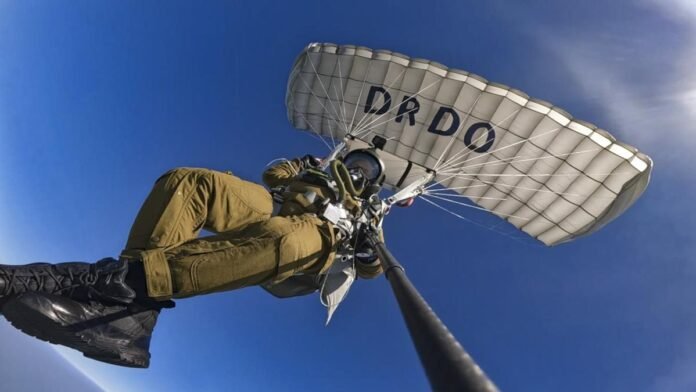
New Delhi. The Defence Research and Development Organisation (DRDO) has achieved a significant milestone in aerial delivery systems with the successful development of the indigenously designed Military Combat Parachute System (MCPS). This breakthrough underscores India’s growing capability in self-reliant defence technologies and operational equipment for airborne forces.
Union Defence Minister Rajnath Singh hailed the achievement as a “remarkable milestone towards self-reliance”. He commended DRDO for enabling a combat free-fall jump from an altitude of 32,000 feet using the indigenous system, calling it a proud moment for the nation. The Defence Minister highlighted that the development strengthens India’s preparedness in high-altitude operations and enhances special forces’ tactical independence.

The high-altitude jump was successfully executed by test jumpers from the Indian Air Force, including Wg Cdr Vishal Lakhesh, VM (G), MWO R J Singh, and MWO Vivek Tiwari.
The MCPS was deployed from an altitude of 30,000 feet during the test, marking a record for indigenous systems. The demonstration proved the parachute’s reliability, stability, and precision in deployment under extreme conditions.
The MCPS project was developed through collaboration between two DRDO laboratories — the Aerial Delivery Research and Development Establishment (ADRDE) in Agra and the Defence Bioengineering and Electromedical Laboratory (DEBEL) in Bengaluru. ADRDE focused on aerodynamic and deployment mechanisms, while DEBEL worked on ensuring bioengineering and wearer safety aspects crucial for high-altitude jumps.
The indigenous parachute system features a lower rate of descent, enhanced manoeuvrability, and superior steering capabilities. These improvements enable paratroopers to deploy safely from aircraft at predetermined altitudes, navigate precisely using onboard systems, and land accurately within designated zones. Such attributes are vital for covert and high-risk insertions during special operations.

A key innovative feature of the MCPS is its integration with India’s Navigation with Indian Constellation (NavIC) satellite system. This compatibility ensures that Indian paratroopers can conduct operations independently of foreign navigation systems. It provides immunity against potential interference or denial of service by adversarial nations, offering secure and reliable positioning even under contested electronic warfare environments.
The introduction of the MCPS will significantly enhance India’s high-altitude airborne capabilities, enabling deployment above 25,000 feet. This gives Indian special forces greater access to mountainous and remote regions for strategic missions, particularly in challenging terrain such as the Himalayas. The system’s indigenous nature ensures uninterrupted serviceability and support during wartime, eliminating reliance on imported parachute technologies.

According to the Ministry of Defence, the MCPS is designed for high durability and efficient turnaround maintenance. Indigenous production allows for rapid repairs and lifecycle support, ensuring extended operational utility. By reducing dependence on foreign systems, the parachute guarantees India’s autonomy in sustaining combat readiness even during supply chain disruptions or geopolitical contingencies.
The successful test of DRDO’s Military Combat Parachute System represents a leap forward in India’s aerospace and defence technology capability. It not only boosts the confidence of the Indian Armed Forces in locally developed equipment but also strengthens the vision of Aatmanirbhar Bharat — achieving self-reliance in cutting-edge defence technologies essential for national security.






