


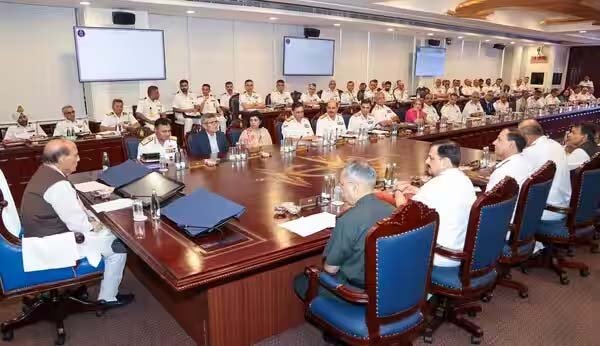
India’s planned induction of 18 warships will include frontline combat platforms and specialised support vessels, Defence Minister Rajnath Singh said while addressing the Indian Navy’s second biannual Commanders’ Conference of 2026 in New Delhi on September 29. He described the development as the largest single-year force accretion in the Navy’s history.
The vessels are being built at Indian shipyards, reflecting the government’s drive to reduce dependence on foreign suppliers and strengthen domestic naval manufacturing. The planned additions include modern stealth frigates capable of conducting surface warfare, air-defence and anti-submarine operations, according to reports.

Singh said the expansion demonstrated the increasing maturity of India’s warship-building ecosystem. Recently commissioned naval vessels contain more than 75% indigenous content, he said, calling on the country to move beyond meeting its own requirements and begin exporting warships to friendly nations.
The announcement comes as the Navy seeks to expand its fleet beyond 200 ships by 2035. Navy Chief Admiral Krishna Swaminathan has separately said that the service is planning a fleet of approximately 230 ships by 2040 or 2045, while maintaining a balanced force capable of operating across a wide range of maritime missions.
The government’s naval modernisation plans are being shaped by a more contested maritime environment. Singh said the Navy’s presence in the South China Sea, the Mediterranean and the Atlantic demonstrated its growing blue-water capability – the ability to sustain operations far from the country’s coastline and home ports. India has also sought to position itself as a first responder and preferred security partner in the Indian Ocean Region.
The minister called for a major upgrade of India’s maritime surveillance architecture. Increasing traffic, congestion, deception and grey-zone activity have made the maritime domain more difficult to monitor, he said. Existing systems, he added, must be supported by stronger analytical capabilities and faster response mechanisms.

The emphasis on surveillance reflects the Navy’s expanding responsibilities. Maritime security is directly tied to India’s energy and economic interests because the country imports approximately 85-90% of its crude oil and about half its natural gas through sea routes. Singh highlighted the Navy’s role in ensuring the safe passage of Indian-flagged merchant vessels, including liquefied petroleum gas carriers, through the Strait of Hormuz under Operation Urja Suraksha.
The operation has underscored the importance of naval forces in protecting commercial shipping during regional crises. Indian warships have also been deployed for evacuation, surveillance, humanitarian assistance and maritime security missions, increasing pressure on the service to maintain readiness across multiple theatres.

Singh praised the Navy’s assumption of command of Combined Task Force-154 under the multinational Combined Maritime Forces. During India’s command, the Navy conducted Operation Southern Readiness in Kochi, involving 276 personnel from 27 countries, 76 facilitators and subject-matter experts, and four international organisations.
The minister also highlighted the Navy’s “All Ranks, All Roles” approach, under which women officers are serving on frontline warships and aircraft. Women personnel have additionally participated in navigational expeditions, including the Navika Sagar Parikrama voyage.
The three-day Commanders’ Conference, running from September 29 to October 1, is reviewing operational preparedness, maritime security challenges and future capability requirements. Singh urged the Navy to maintain its modernisation momentum and become a future-ready, combat-ready and globally respected force.
The 18-warship target will test India’s ability to coordinate design, construction, trials and commissioning at an unprecedented pace. If achieved, it would strengthen fleet capacity while providing a visible measure of progress in the country’s effort to become a self-reliant naval power and a potential exporter of warships.






