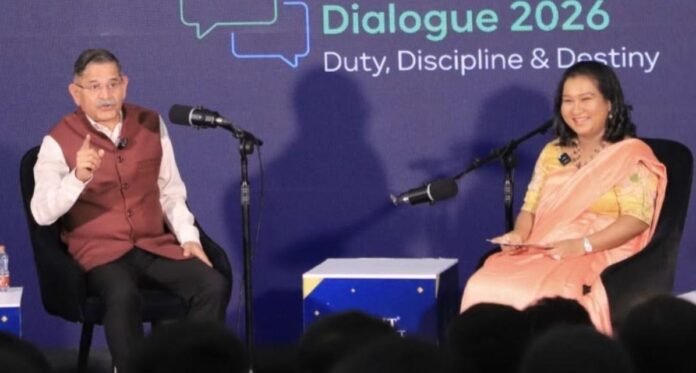
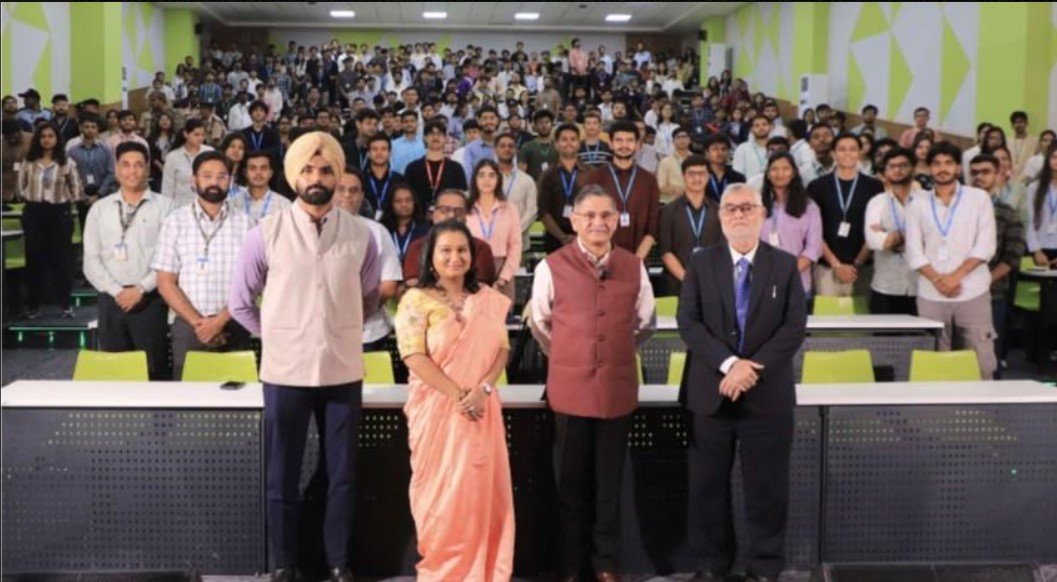
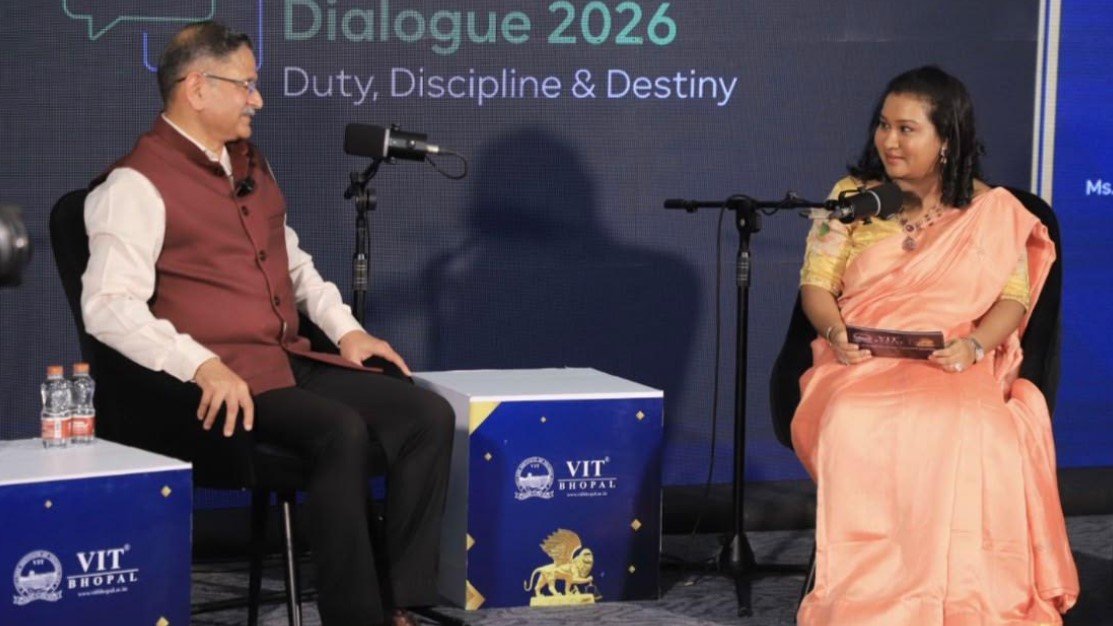
Bhopal: General Upendra Dwivedi, PVSM, AVSM (Retd.), former Chief of the Army Staff, Indian Army, joined Kadhambari S Viswanathan, Assistant Vice President, VIT, for a Fireside Chat titled “The Convocation Dialogue 2026: Duty, Discipline & Destiny” during the 7th Convocation of VIT Bhopal University.
Speaking about the potential of young minds, he said that the current generation is creative, digitally connected and capable of taking on the challenges India will face in the future. The conversation covered the skills students need to succeed in a changing professional landscape, the role of artificial intelligence in decision-making, collaboration between academia and industry, the evolving role of teachers, and the importance of character, resilience and purpose.

Recalling Operation Sindoor, he said discipline’s value is practical rather than ceremonial. “We were under maximum stress. But since we were disciplined to take decisions during the stress, all the decisions which we took were rational ones.” That capacity is built long before any crisis — through routine, drill and the small daily habit he calls digital discipline: setting the phone aside for ten minutes each morning, expressing gratitude and visualising the day ahead.
On the skills students need to succeed in a changing professional landscape, Gen Dwivedi, speaking about cognitive overload and the pressure to keep up with the constant flow of information, said, “This generation is wired, but tired.”
He advised students to identify three short-term, three mid-term and three long-term achievements, and to focus on their goals rather than trying to learn everything at once. He also highlighted the importance of developing different forms of thinking to address challenges.

Explaining critical and creative thinking, he said, “When you have the resources and you have to manage the resources, then it’s critical thinking. When you do not have the resources, but you have to meet the same target, then you take the risk. When you take the risk, you come out with creative ideas.”
He further spoke about systems thinking and imaginative thinking, emphasising the importance of understanding how systems work and visualising possibilities. He said that students need to make time for themselves and reduce their digital engagement periodically. “You have to roll back. Wired but tired. So now cut down the wire for some time and rewire in your brain.”

General Dwivedi also highlighted the importance of emotional quotient, spiritual quotient and adversity quotient, alongside intelligence, in helping young people manage challenges and avoid cognitive overload.
Speaking about the increasing role of artificial intelligence in decision-making, General Dwivedi emphasised that while AI can support the execution of tasks, human judgement must remain central.
He said, “The task can be done by computer, by the artificial intelligence. Judgment remains yours.”
Explaining how AI can be used as a support system, he said, “What you give to the artificial intelligence is called as decision support system.”
He stressed that human oversight is essential, particularly when decisions have significant consequences. “Human in the loop, human on the loop – it is important for all major decisions. We will not allow artificial intelligence to ride us.” Indians, he added, are “the best adopters of technology” and of human-AI collaboration alike.
General Dwivedi, speaking about the role of young engineers in strengthening India’s self-reliance in defence technology, highlighted the importance of collaboration between the armed forces and academic institutions.
He said that the opportunities available to students through research and development programmes, collaborations with the armed forces, and organisations such as ISRO and DRDO. He also pointed to the role of private-sector companies in developing talent and technologies for India’s defence ecosystem.
Emphasising that students can contribute to national security through multiple career paths, he said, “Even if you are not joining the army, you will still remain a warrior for nation.” He added that in their own capacity, young professionals can contribute by supporting critical infrastructure, including financial systems, communications, railways, aviation, medical services and healthcare.
Talking about the impact of AI on the teaching profession, General Dwivedi acknowledged that teaching requires continuous learning and adaptation. “You have to continuously keep evolving. Continuously keep adapting.” He emphasised that the qualifications teachers earn at the beginning of their careers should serve as a starting point for further learning and development.
During the student interaction, General Dwivedi spoke about resilience, character and aligning individual ambitions with a larger cause and how setbacks can become opportunities for learning.
Advising students on dealing with failure, he said, “Whenever there is a failure, identify why it has failed. Causation. Start with why.” He encouraged them to understand the reasons behind setbacks and prepare more thoroughly for future challenges. “If you have to do, let’s say 100, your preparation level has to be 200.”
He also emphasised that technical skills alone are not enough to build a lasting professional reputation. Explaining the difference between skill and character, he said, “It’s not a big deal. It’s a tactical thing. It is part of disruptive learning. Learn, unlearn, relearn. But character is compound interest. And skill is a simple interest.”
He advised students to identify what they want to achieve in life, work backwards from that end goal and anticipate the obstacles they may encounter along the way.
Concluding his advice to young people, General Dwivedi emphasised their role in shaping India’s future. He said, “Gen Z is ten times more capable than our generation.” He encouraged students to use their ability to question established practices constructively, work hard and take responsibility for the country’s progress. He also highlighted the importance of giving young people the freedom to make choices and learn from their experiences, with guidance from those who can help shape their future.