


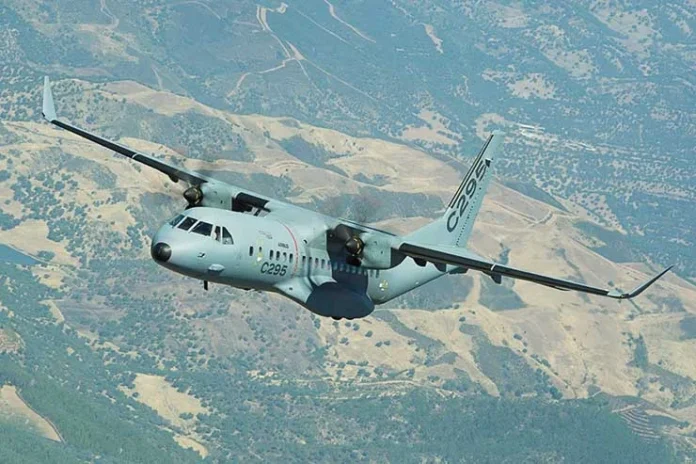
New Delhi: Airbus and Tata have built a complete industrial ecosystem around the C295 programme in India, the first aircraft manufacturing contract for the private sector in the country.
“Aircraft are critical to nation-building,” says Samatha Bikumalla, senior manufacturing engineer, Airbus. “This is a dream come true.” The inauguration of the Indian C295 final assembly line (FAL) in Vadodara, in Gujarat, India, on October 28, 2024, was a special moment for Samatha and her colleagues.

Airbus operates assembly lines and production sites around the world, but the Indian C295 programme is the first time the company has deployed the entire production system for an aircraft outside its home nations. The programme is being developed in partnership with Tata Advanced Systems Limited (TASL), a subsidiary of the Tata Group. It will be a major boost to the Government of India’s ‘Aatmanirbhar Bharat‘ (Self-Reliant India) programme. The programme involves the delivery of 56 C295 aircraft to the Indian Air Force (IAF), soon to be the largest C295 operator. The aircraft will replace the IAF’s Avro fleet to operate across India’s vast territory.
A key feature of the C295’s military transport configuration is the integration of an indigenous self-protection suite that includes radar warning systems, missile warning sensors and countermeasure dispenser systems.
“We are delivering critical capabilities to the IAF,” says Udbhav Sharma, C295 Make in India Programme manager, Airbus Defence and Space. “At the same time, Airbus is building up the skills and the industrial ecosystem to deliver an aircraft end-to-end, from component manufacturing to delivery. This places India in the select group of countries with private aircraft manufacturing capabilities.
The industrial ecosystem created in India begins with the sourcing of raw materials and the manufacture of up to 13,000 detailed parts at three main locations: Nagpur, Bangalore and Hyderabad. The parts are then assembled into larger components at the Main Component Assembly (MCA) site in Hyderabad, and then shipped to the FAL in Vadodara.

“We have all MCAs built under one roof,” explains Udbhav. “This improves the efficiency of the industrial process. Contrary to the perception that large defence programmes have long lead times, we have achieved the MCA industrialisation phase in 36 months. We expect to make similar progress and complete the remaining industrialisation of detail parts and FAL over the next two years.”
Airbus has already delivered six C295s from the planned initial batch of 16 aircraft to IAF from Airbus’ San Pablo site in Seville, Spain. The remaining 40 units will be delivered from Vadodara. Airbus teams have created a full digital model of the C295, and all engineering models and tools have been digitised to ensure that production in India meets the highest quality standards of all Airbus assembly lines.

Following the best practice approach of the San Pablo FAL, the Vadodara FAL has adopted a Pulse Line set-up, where the assembly process is broken down into sequential, fixed steps. Each workstation is dedicated to a specific set of assembly tasks, and the aircraft ‘pulses’ from one station to the next. This is similar to an automotive assembly line, but adapted to the larger scale and greater complexity of aircraft manufacturing.
The first IAF crews have been trained at the San Pablo site, while an additional 150 personnel will be trained in a new flight simulator to be installed at the Airbus training centre in Agra, in northern India, before the end of 2024.
The establishment of the FAL in India will further expand the C295 footprint, and ensure long-term sustainable growth. Airbus’ forecasts indicate the potential for hundreds of C295 aircraft to be produced from our facilities in Europe and India.

Raksha Anirveda's editorial desk team brings in the collective experience of creative professionals - a fine mix of senior copy editors, writers, proofreaders and designers. Working as a team, they continuously create, manage, and curate content to sustain the magazine's profile and reputation in line with market trends and achieve magazine's goal.





