


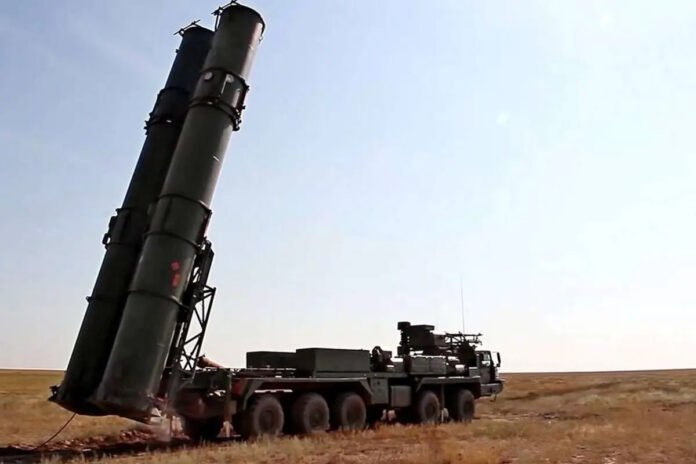
New Delhi: Russia has put forward a landmark proposal to offer its most advanced S-500 “Prometey” air defence system to India under a government-to-government (G2G) arrangement that includes both technology transfer and co-production on Indian soil.
This initiative is seen as a direct response to the mounting pressure of Western sanctions, which have significantly limited Russia’s ability to directly export high-technology defence systems to international buyers since the escalation of the Ukraine conflict.

A unique and transformative aspect of this proposal is the clause allowing India to re-export the jointly produced S-500 systems to third countries.
This would effectively enable Russian-origin technology to reach buyers globally through Indian channels, thus bypassing the current sanctions regime.
Russia’s strategic calculus hinges on leveraging India’s growing defence industrial base and robust export credentials—recently demonstrated by exports of BRAHMOS missiles and Pinaka rocket systems—to maintain access to lucrative markets in Southeast Asia, the Middle East, and Africa.
The S-500 Prometey, developed by Russia’s Almaz-Antey, represents one of the most formidable air and missile defence platforms in the world, capable of countering a highly diverse set of threats ranging from hypersonic missiles, stealth aircraft, and UAVs to low-Earth orbit satellites.

With engagement ranges up to 600km and altitude coverage approaching 200km, the S-500 vastly outperforms legacy systems like the S-400, which India actively deployed during Operation Sindoor in 2025 to neutralise aerial threats from Pakistan and China.
For Russia, it is a lifeline to keep its defence industry globally relevant despite direct trade restrictions with many Western-aligned states. It also deepens ties with one of Moscow’s most reliable long-term customers and defence partners.

For India, the technological transfer and co-production proposal align with the “Make in India” campaign, boosting indigenous defence manufacturing, technological advancement, and jobs. It would also considerably broaden India’s defence export portfolio and position the country as a pivotal node in the global arms trade.
Operationally, acquiring the S-500 would allow India to build a robust, multi-layered air defence architecture, countering the rapid modernisation of Chinese and Pakistani missile and air combat fleets.
The discussions are not without challenges. High costs, potential downgrades in the exported system, and the persistent risk of CAATSA-related secondary sanctions from the United States and its partners require careful navigation by Indian negotiators.
Past experience with S-400 deliveries, where sanctions and supply chain bottlenecks caused delays, highlights the complexity of such deals in the present geopolitical environment.
This proposal is seen as a strategic move by Russia to circumvent Western sanctions and maintain its access to the global arms market through India as a manufacturing hub and export channel. The deal could further solidify the long-standing defence partnership between India and Russia.






