


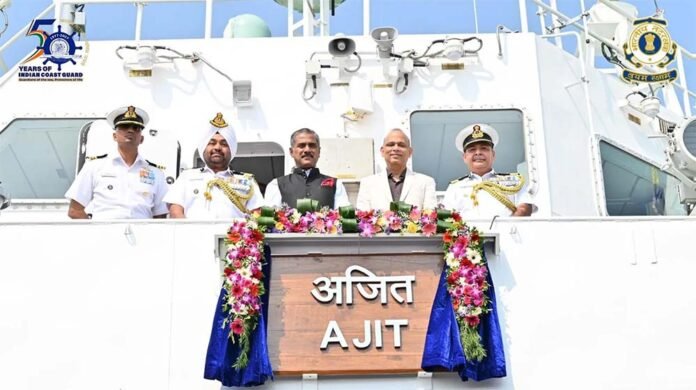
The ICGS Ajit’s commissioning marks the latest stage in the vessel’s entry into service. Goa Shipyard Limited handed over ICGS Ajit, Yard 1277, to the Coast Guard on August 25. Its formal commissioning took place at the shipyard on October 9, with Dr Sirish Choudhary, Principal Integrated Financial Adviser to the Coast Guard, presiding over the ceremony. The vessel will be based at Okha, a strategic location on India’s western seaboard.
From Okha, ICGS Ajit is expected to support surveillance and patrols along the Gujarat coast and in the Arabian Sea. The Coast Guard has identified its duties as including search and rescue, anti-smuggling operations and response to marine pollution. The platform is also designed for fisheries protection, coastal patrols, anti-piracy missions and surveillance of India’s Exclusive Economic Zone, the maritime area in which the country exercises specified economic rights.

The vessel is 51.43 metres long and displaces 330 tonnes. It is powered by twin marine diesel engines connected to controllable-pitch propellers, which allow propeller blade angles to be adjusted to suit operating conditions. Goa Shipyard says the arrangement is a first for this class of fast patrol vessel in India. The ship can exceed 27 knots and has an endurance of 1,500 nautical miles, according to details published at its handover.
ICGS Ajit is built with more than 65 per cent indigenous content and is configured for six officers and 35 sailors. An integrated machinery control system is intended to support monitoring and management of onboard equipment. The combination of speed, endurance and a relatively compact crew is suited to patrol duties that require a vessel to respond quickly, remain at sea and operate across several law-enforcement and safety roles.
Its commissioning also highlights the role of Goa Shipyard Limited in India’s domestic shipbuilding effort. The shipyard builds vessels for the Coast Guard and other defence customers; in this case, the Ajit is part of an eight-vessel fast patrol vessel series. Its sister vessel, ICGS Aparajit, was launched alongside Ajit in October 2025, according to reporting on the programme. Delivery of an indigenously built ship strengthens local production capacity, though the percentage of domestic content alone does not indicate how much control India has over every component or technology
Fast patrol vessels contribute to maritime security through persistent presence and the ability to intercept or assist other vessels. For the Coast Guard, their work is distinct from the Navy’s primary combat role: it includes enforcing maritime laws, protecting fishing activity, responding to distress calls and supporting pollution response. The Coast Guard’s responsibilities span India’s coastal waters and offshore zones, making surveillance and coordination essential alongside the acquisition of new ships.

The Okha deployment gives Ajit a base near busy sea lanes, fishing grounds and international maritime boundaries. Its presence can add to patrol coverage and provide another platform for responding to incidents in the region. The vessel’s effectiveness will depend not just on its specifications, but also on deployment patterns, coordination with other agencies, crew readiness and the availability of maintenance and support.
The handover in August and commissioning in October are separate milestones: the first transferred the completed vessel to the Coast Guard, while the second formally inducted it into operational service. With ICGS Ajit now commissioned, the service gains a new platform for coastal vigilance and maritime response, while Goa Shipyard’s delivery adds to India’s effort to expand indigenous shipbuilding.







