


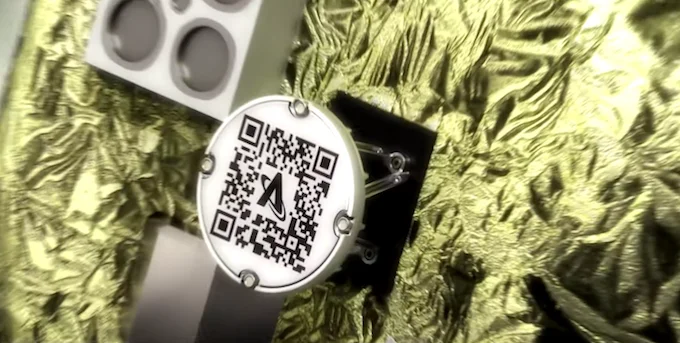
Tel Aviv: Astroscale Holdings Inc., the market leader in satellite servicing and long-term orbital sustainability across all orbits, revealed a universal docking device that the company hopes will become standard fitment on all future Low Earth Orbit (LEO) satellites. Astroscale calls on operators to prepare their spacecraft with a Docking Plate to prepare for future removal and to help safeguard the space environment.
There are an unprecedented number of satellites due to launch over the next decade, the majority into LEO (250 km to 2000 km above Earth). The US Federal Communications Commission has approved 16,447 satellites within constellations to date and has applications pending for an additional 64,816 satellites. The potential for high-velocity, high impact collisions is likely to increase unless disposal of satellites becomes part of everyday space operations.

“Over the last 6 decades more than 12,000 satellites have been launched, and this number could more than quadruple in a single decade,” said Nobu Okada, Founder & CEO of Astroscale. “This phenomenal growth shows how important space has become — to our economies, our way of life and to our fight against the climate change crisis. We urge the space community to demonstrate real commitment to protect the space environment by preparing satellites with a Docking Plate for future removal.”
Astroscale’s Docking Plate can be compared to a car ‘tow hook’ — a standardized interface that enables future servicing. Docking plates are designed to be discrete during satellite operations but robust and reliable if required. They’re customizable for different satellite designs and will enable both robotic or magnetic capture mechanisms to securely attach a servicer to a satellite.
The End-of-Life Services by Astroscale-demonstration (ELSA-d), currently undergoing testing in LEO, is the first spacecraft service of its kind to demonstrate the technology and commercial viability of removing defunct satellites. The ELSA-d mission uses the first prototype of the new docking mechanism, preparing the way for this first commercially available Astroscale Docking Plate for all satellite operators in LEO.
COP26 focused attention on the importance of proper environmental stewardship and highlighted our day-to-day reliance on satellites, both for communications and for monitoring the health of the planet. Future-proofing space missions with Astroscale’s universal docking technology will not only keep orbital highways clear and safe by enabling future debris removal, it will also support the development of a dynamic on-orbit ecosystem, powered by the emerging on-orbit services and manufacturing market, which is conservatively estimated to be worth $ 4 billion globally by 2030.

“The Astroscale Docking Plate is designed to be lightweight and easy to fit onto low Earth orbit satellites,” said John Auburn, Managing Director of Astroscale Ltd. “As a low-cost solution it enables satellites to be captured and removed from space, keeping our orbital highways clear. We all value satellite communications supporting our global connectivity and economy, and monitoring our environment on Earth. By preparing our spacecraft today we will ensure space is sustainable tomorrow, for future generations.”
Astroscale’s Docking Plate was recently launched at the Space Tech Expo Europe Conference, Bremen, Germany. The Astroscale team will also present the new Docking Plate in the US at a conference in the spring.

The Astroscale satellite, ELSA-d, currently in the experimental phase of LEO, is the first space service of its kind to demonstrate the technology and commercial viability of removing faulty satellites. According to Arie Helzband, one of the pioneers of the Israeli aerospace industry and CEO of Astroscale Israel, Mission ELSA-d uses the first prototype of the new docking mechanism, paving the way for the first commercially available docking device from Astroscale for all LEO satellite operators.

-The writer is an Israel-based freelance journalist. The views expressed are of the writer and do not necessarily reflect the views of Raksha Anirveda





