


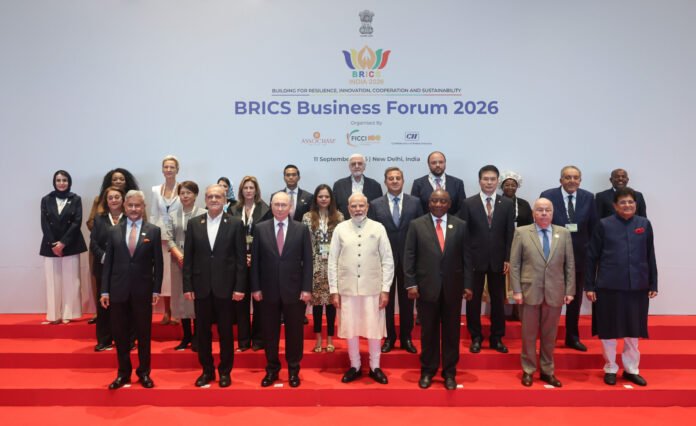
The 18th BRICS Summit, held in New Delhi on September 12-13, 2026, concluded successfully with the participation of 11 countries and 10 dialogue countries. However, the importance of the New Delhi Summit can be gauged from the geopolitical developments occurring over the years. Some of the major factors which shaped the dynamics of the summit are: a) the ongoing US-Iran war and Russia-Ukraine war; b) issues relating to the weaponisation of energy and corridors; c) the need for an Open Sea which will ensure supply securitisation and smooth flow of food and other essential commodities; d) growing tendencies of unilateralism being pursued by the West; e) Issues relating to climate change and energy transition and the vulnerability of the Global South countries; f) democratisation of transfer of technology to the Global South countries. These issues can be examined in the following context.
India’s Normative Engagement with BRICS through the Global South Prism
The issues mentioned above are pertinent to both global and regional security, and affect India’s strategic development. As the ‘voice of Global South countries’, India has an added responsibility. Thus, the summit gave India a perfect opportunity to highlight issues confronting BRICS Plus countries in particular and Global South countries in general to forge a grand strategy. The significance of India’s BRICS leadership lies in the fact that it provided a new normative framework for the functioning of the BRICS Movement.

One may add that during the heyday of Cold War geopolitics, India provided leadership to the Non-Aligned Movement, which used to act as a coherent voice for Global South countries. This helped India to chart out a course of action amid the ideological rivalries between two blocs. To contextualise the above strategic nuances, three important elements need to be redefined in the present circumstances. These are: a) India is providing a normative basis to the BRICS forum. India’s age-old principles of ‘Vasudhaiva Kutumbakam’ and ‘Panchsheel’ provide a normative basis and a unifying voice to Global South countries. The same can apply to BRICS countries. b) The aspirations of BRICS countries in general and the Global South are similar to what was there during the Cold War period. c) Accessibility to resources and technology is a key concern of the Global South.
The significance of India’s BRICS leadership lies in the fact that it provided a new normative framework for the functioning of the BRICS Movement. India’s age-old principles of ‘Vasudhaiva Kutumbakam’ and ‘Panchsheel’ provide a normative basis and a unifying voice to Global South countries
This theoretical context provides India with an opportunity to redefine and broaden the BRICS agenda and make it more effective. This is evident from the New Delhi Declaration. The New Delhi Declaration and its relevance can be understood in the context of its synergisation with the needs of the present global order. As one is witnessing the recent war between Iran and the US, and subsequent obstruction by the latter around the Strait of Hormuz. This is one such example of unipolar tendencies. The consequences were immense, with repercussions on the global supply securitisation process. Thus, the BRICS Summit under India’s leadership provided an opportunity to address these concerns and, at the same time, redefine the relevance of BRICS as a forum of the Global South in global geopolitics.
Another important aspect that needs to be underlined is that BRICS, as a forum with an inclusive agenda, aiming at promoting global peace and harmony, is generating a sense of curiosity in the international arena, especially in the Global North. Similarly, the BRICS Summit provided an opportunity to augment bilateral relations on a new footing. For instance, Russian President Vladimir Putin’s visit to India provided an opportunity to discuss different dimensions of India-Russia relations. Thus, one should examine the relevance of the New Delhi BRICS Summit in the context of India’s strategic interaction with participating countries. As the Summit Declaration was adopted unanimously, it reflects India’s prowess in global geopolitics. To look at some of the issues discussed in the BRICS Summit, it is necessary to examine the declaration.
BRICS and the Global Order
To gauge the relevance of the BRICS Summit, it is important to examine the Summit Declaration and how it reflects the spirit of the member countries. The theme of the New Delhi Summit was “Building for Resilience, Innovation, Cooperation and Sustainability”, which succinctly reflects India’s approach to the global normative order. At the same time, the theme itself reflects the inclusive approach which India has adopted in various multilateral forums over the years. In this context, the Declaration and its contemporary relevance in global geopolitics need comprehensive analysis.

The theme of the summit was “Building for Resilience, Innovation, Cooperation and Sustainability”, which succinctly reflects India’s approach to the global normative order. At the same time, the theme reflects the inclusive approach that India has adopted in various multilateral forums over the years
The second paragraph of the BRICS Summit Declaration states, “We reaffirm our commitment to the BRICS spirit of mutual respect and understanding, sovereign equality, solidarity, democracy, openness, inclusiveness, collaboration and consensus.” This is a core point of global geopolitical discourse. Over the years, the West has used critical and classical geopolitical phraseology to articulate its unilateralism and expand its sphere of influence in the turbulent global geopolitics. In this context, it is necessary to highlight that the West, led by the US, is trying to topple democratically elected governments, whether it is in the post-Soviet space or the West Asian region, by using democracy as a tool. Even the toppling of regimes in Bangladesh and Nepal raised serious issues relating to regime change and, as alleged, the deep state of the US, like the Soros Foundation, has a role there.
Given the need to revisit the concept of democracy the West has promoted over the years, it is also necessary to understand ‘civilisational democracy’, which India nurtures to address contemporary geopolitical challenges. The Global South countries, particularly the BRICS grouping, should study the normative framework of the Indian democratic model as an alternative to promote cohesiveness in their political systems.

At the same time, the BRICS Declaration highlights the need for multipolarity through respecting “sovereignty, equality, openness, and inclusiveness, collaboration, solidarity, etc.,” which are necessary to promote multipolarity. One may recall that even China tries to promote its unilateral policy through its imperial OBOR project. At the last SCO Summit in Bishkek, India criticised China for promoting a hegemonic policy. In this context, it is time to see how China can also align with the New Delhi BRICS Resolution. Thus, the BRICS approach to multipolarity depends on China, which is also pursuing a hegemonic policy in the global order.
BRICS can rise as an alternative power centre to checkmate the West’s existing unilateral policy only if the Global South makes concrete efforts in this regard. As has been observed by Henry Kissinger, geopolitics is a discipline of ‘equilibrium’, and contextualising the same, it can be underlined here that the Global South should ensure parity with the West in the global decision-making process, as well as reform the multilateral institutions, which will give greater representation to the voice of the Global South.
The BRICS summit discussed the issues relating to ‘Sustainable Development’. This is gaining importance as more and more countries, especially from the Global South, face multiple challenges on their path to achieving the Sustainable Development Goals
The first step in this regard is giving permanent membership to India at the United Nations Security Council (UNSC). Similarly, the global multilateral institutions should take into account the Global South’s norms in their functioning. Another important point that needs to be added here is that the decision-making process in the respective global multilateral institutions needs to be more inclusive and democratic in its functioning. Hence, there is a need to ensure structural reform in the global decision-making body like the UNSC to ensure global democratisation. One may add here that the New Delhi BRICS Summit highlighted the need for reform in the UN in changing circumstances.
Prime Minister Narendra Modi spoke at length about the need for a multipolar world order at the summit. He called the present international order a ‘pyramid of privilege’ and emphasised the need to transform it into a ‘platform of partnership’. He said this is the only way to strengthen a multipolar world order. He also spoke at length about reforming global institutions to be more democratic. He said transforming the ‘pyramid of privilege’ into a ‘platform of partnership’ can ensure parity in the global order. This also reflects India’s concern for the Global South countries. India believes that without strengthening the Global South’s bargaining position on the international platform, democratisation of international institutions is not possible.
BRICS and Sustainable Security
The BRICS summit also discussed the issues relating to ‘Sustainable Development’. This is gaining importance as more and more countries, especially from the Global South, face multiple challenges on their path to achieving the Sustainable Development Goals. These include climate hazards, lack of access to technology, and rising issues of energy poverty and a crisis of energy security due to the rise in the prices of oil and gas in the international market. These issues are adversely affecting both human security and societal security. This also has a bearing on aggravating inequality between Global North and Global South countries. Though international regimes came up to address these issues, the voice of the Global South was hardly heard. Take the case of climate change. Historically, the Global North has been the polluter, but the Global South is facing the challenges.
Prime Minister Modi’s statement provided the bedrock to the BRICS approach to Sustainability. The summit adopted a comprehensive mechanism for the “key role of critical minerals for the development of zero- and low- emission energy technologies, energy security, and resilience of energy supply chains”
Hence, the New Delhi BRICS Summit sent a powerful message about the need to “strengthen coordination among BRICS members to make international financial institutions more representative, transparent and accountable.” While putting forward India’s position on sustainability, Prime Minister Modi highlighted the “need to strike a balance between human development and the environment… This is the foundation of Sustainability.” This statement provides the bedrock to the BRICS approach to Sustainability. In this context, the BRICS Summit adopted a comprehensive mechanism for the “key role of critical minerals for the development of zero- and low- emission energy technologies, energy security, and resilience of energy supply chains.” At the same time, the summit also called for a ‘New Industrial Revolution’, which takes into account the interests of Global South countries.
Closely related to reforming multilateral financial institutions is the ‘weaponisation’ of trade and tariffs by Global North countries, which is further pushing the Global South countries from the mainstream of international relations, aggravating their hardship. The Summit Declaration rightly addressed this by saying, “We condemn the imposition of unilateral coercive measures that are contrary to international law,” and reiterating that such measures, inter alia, in the form of unilateral economic sanctions and secondary sanctions, have far-reaching negative implications.
For instance, in recent months the US and EU put huge pressure on India not to buy Russian oil. This is due to sanctions imposed by both the US and EU on Russia because of its war with Ukraine. Recently, the US Senate passed a bill imposing a 100 per cent tariff on Indian products. The moot point is that India still imports 85 per cent of its oil from the international market, and over the years Russia has become India’s major partner in energy trading. This has annoyed the West, particularly the US and European Union countries.
India’s Ministry of External Affairs rejected the US move to impose a 100% tariff on India and said, “India remains firmly committed to ensuring energy security for its 1.4 billion people. It will continue to do so through diversified sourcing and based on evolving market dynamics.” This shows India’s resilience in fighting back against the unilateral moves of the US
On the other hand, the US, which has emerged as a major oil producer in recent years, is interested in selling its energy to the international market, including India. This is the major bone of contention between India and the US. However, India requires oil at a lower price from the international market to meet its domestic demand. Along with India, many Global South countries are under the US scanner for importing oil from Russia. This includes China.
Besides the ‘weaponisation of energy’, the US is indulging in disrupting global trade. This is a cause of concern. Thus, BRICS has categorically rejected the US’s monopoly practices. In fact, India’s Ministry of External Affairs has also rejected the US move to impose a 100 per cent tariff on India because of buying Russian oil and said, “India remains firmly committed to ensuring energy security for its 1.4 billion people. It will continue to do so through diversified sourcing and based on evolving market dynamics.” This shows India’s resilience to fight back against the unilateral moves of the US Administration.
BRICS and Issues Relating to Regional Security
The New Delhi BRICS Declaration has also dwelt at length on the question of regional security and stability and called for cohesive and punitive measures against any form of terrorism as well as terrorist activities. One interesting aspect of the summit was that China, which has a soft corner for Pakistan, has also criticised cross-border terrorism. This is, in fact, an indictment of Pakistan, which has been promoting and patronising cross-border terrorism over the years as part of its foreign policy strategies.
The BRICS Declaration condemned the Pehalgam terror attack: “We condemn in the strongest terms the terrorist attack in Jammu and Kashmir on April 22, 2025, in which 26 people were killed and many more injured.” The Declaration has also further underlined, “We reaffirm our commitment to combating terrorism in all its forms and manifestations, including the cross-border movement of terrorists, terrorism financing and havens.”
One major achievement of the 18th BRICS Summit was the establishment of the BRICS Insurance Resilience Centre (BIRC). If the insurance sector comes up, it will help Global South countries by assisting them in insurance-related matters in shipping, which faces many complications
The BRICS Summit has also expressed its “concern over the situation with illicit drug production, trafficking and abuse worldwide.” A cohesive approach by BRICS countries in countering and combating radicalism, terrorism and proliferation of illicit substances is a major step in the direction of enhancing regional security and stability.
BRICS and Global Challenges
One major achievement of the 18th BRICS Summit was the establishment of the BRICS Insurance Resilience Centre (BIRC). If the insurance sector comes up, it will help Global South countries by assisting them in insurance-related matters in shipping, which faces many complications.
The summit also discussed the need to democratise technology transfer, which will benefit Global South countries most. In this regard, it has been observed that technology is being used by the Global North as a bargaining chip with Global South countries. The summit also discussed issues related to health, energy storage, smart grids, and agroecology.
Conclusion
The success of the New Delhi BRICS summit can be gauged by the fact that despite pressure from many quarters, the BRICS Declaration was passed unanimously. This demonstrates India’s leadership in BRICS. Given contemporary global developments and their consequences, the summit assured the Global South that their ‘voice’ counts in the international system. In this context, India has provided the necessary resilience to the Global South countries, thus adding new momentum to the BRICS process

The author teaches at the School of International Studies, JNU, New Delhi. The views expressed are personal and do not necessarily carry the views of Raksha Anirveda





