


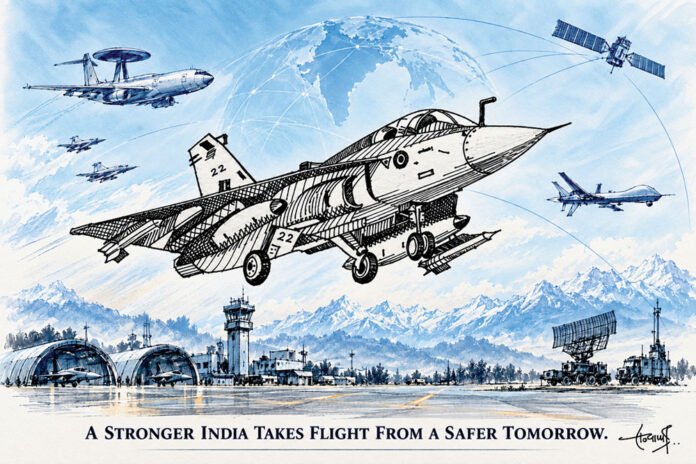
The eighth of October is more than an anniversary. It is an opportunity to ask whether the Indian Air Force that served India so effectively through the twentieth century is being prepared for the fundamentally different battlespace of the twenty-first. When the Indian Air Force was established in 1932, air power meant aircraft, pilots, airfields and weapons. Today, air power is an ecosystem of sensors, satellites, networks, algorithms, autonomous systems, precision weapons, electronic warfare and human judgement. The central question is not simply how many aircraft the nation possesses. It is what kind of aerospace combat power India must build as the boundaries between air, space, cyber and the electromagnetic spectrum disappear.
Sky Becomes a Battlespace
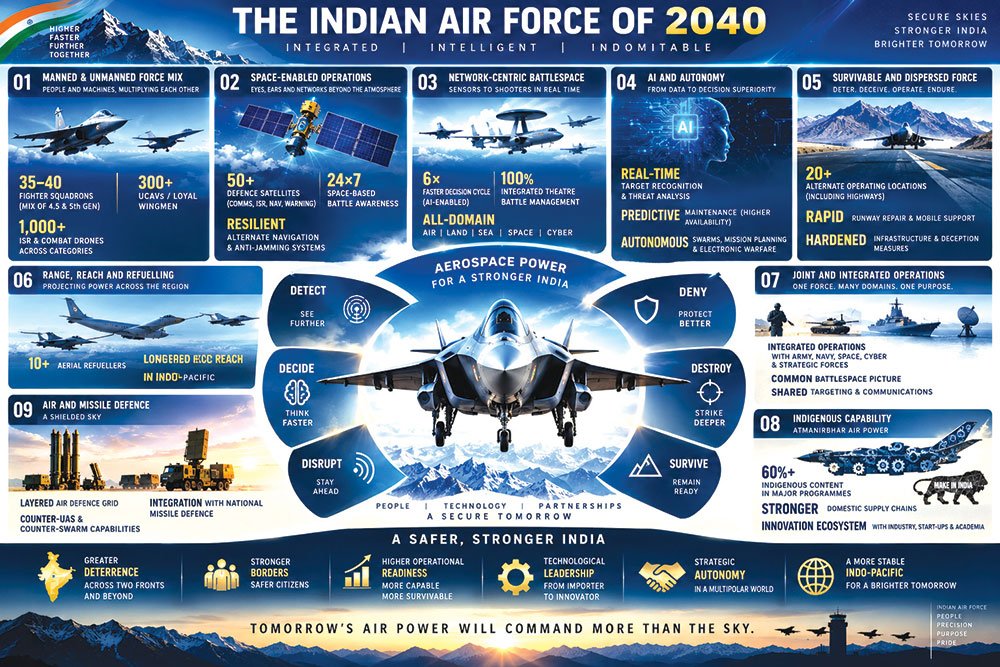
Air superiority can no longer be understood merely as controlling the air above a battlefield. Modern forces compete simultaneously for awareness, connectivity, spectrum access, precision and decision speed. An aircraft may possess formidable weapons, but its effectiveness increasingly depends on what it can see through a wider sensor network, how securely it can communicate, how rapidly its data can be fused, and how quickly another platform can act on that information. The future battlespace will therefore reward connected formations rather than isolated platforms. The IAF must evolve from a force that operates aircraft into a force that orchestrates an integrated battlespace, where every sensor can contribute to the common picture and every shooter can become part of a coordinated kill chain.

Beyond the Fighter
The fighter aircraft will remain central to air power. Air superiority, interception, escort, deep strike, and deterrence will continue to require highly capable manned platforms and highly trained aircrew. Yet the fighter-centric conception of an air force is becoming inadequate. Alongside conventional fighters will emerge unmanned combat aircraft, loyal wingmen, reconnaissance drones, electronic warfare platforms, decoys, loitering munitions and autonomous swarms. Their value will lie in extending the fighter’s reach, increasing awareness and multiplying options. The future combat aircraft should therefore be viewed less as an independent weapon and more as a node in a larger combat architecture. The decisive question will increasingly be how effectively manned and unmanned systems can cooperate under contested conditions.
Unmanned Revolution
The proliferation of drones has altered the economics of warfare. A relatively inexpensive unmanned system can force the expenditure of a vastly more expensive interceptor, reveal a defended position, saturate sensors, or impose operational caution. This has strategic implications for India. The IAF will need a layered unmanned ecosystem ranging from inexpensive attritable systems to sophisticated autonomous combat aircraft. Such systems can undertake surveillance, deception, electronic attack, target acquisition, and strike missions while reducing exposure of human crews. The objective should be operational choice, allowing commanders to select the appropriate combination of human and machine capability for each mission. In future air warfare, mass may return through machines.
AI and Decision Superiority
Artificial intelligence will transform air power most profoundly not because it will eliminate human commanders, but because it can compress the time between observation, understanding and action. Sensor fusion, target recognition, predictive maintenance, mission planning, route optimisation, electronic warfare and battle management can all benefit from machine-assisted analysis. In a saturated battlespace, however, data alone is not power. The advantage belongs to the force capable of converting enormous quantities of information into reliable decisions faster than an adversary can react. The IAF therefore needs an institutional culture in which data, software and algorithms are treated as operational capabilities rather than supporting technologies. Tomorrow’s air war may be decided not simply by who sees first, but by who understands first and acts first.

Space is the New High Ground
No modern air force can remain confined to the atmosphere. Satellite communications, navigation, intelligence, surveillance, reconnaissance and missile-warning systems increasingly underpin every major air operation. Air and space will therefore become inseparable. India needs resilient space-enabled networks capable of continuing to function when satellites are degraded, communications are contested, or navigation signals are disrupted. This requires redundancy, alternative navigation methods, hardened communications and close integration between military and civilian space capabilities. The IAF’s future identity may consequently extend from air power towards aerospace power, with operations conceived across altitude layers rather than within a single domain. The force that can connect air and space most effectively will possess an increasingly decisive informational advantage.
Survivability and the Dispersed Air Force
The future IAF must also rethink where and how it fights. Concentrated air bases provide efficiency, but they can also become lucrative targets for precision weapons, drones and ballistic or cruise missiles. Survivability will therefore demand a combination of hardened infrastructure, camouflage, deception, rapid runway repair, dispersed operating locations, alternate airstrips, mobile command centres and distributed logistics. India’s geography offers opportunities to develop a more resilient operating model, including the greater use of highway and alternate operating surfaces where feasible. Strategic infrastructure should be designed with military mobility in mind, while military infrastructure should increasingly possess redundancy. An adversary should never be able to paralyse air power by striking a few predictable nodes.

IAF Cannot Fight Alone
The next major conflict will not respect service boundaries. Air operations will interact continuously with Army long-range fires, naval aviation, maritime surveillance, integrated air and missile defence, cyber operations, space assets and strategic forces. The future IAF must therefore be part of a joint multi-domain force rather than a service operating beside others. Jointness should begin not merely with command structures, but with procurement, communications architecture, training, doctrine and operational planning. A common battlespace picture, interoperable networks and shared targeting processes will matter as much as individual platforms. The objective is one national military instrument able to generate effects across domains at modern-warfare speed.
Designing the IAF of 2040
India’s future air power should consequently be built around capabilities rather than inventories. The architecture must be able to detect, decide, disrupt, deny, destroy and survive. That requires a balanced combination of fifth-generation and advanced indigenous fighters, unmanned combat systems, airborne early-warning and control, tankers, long-range precision weapons, electronic warfare, counter-drone capabilities, integrated air and missile defence, space support, cyber resilience and artificial intelligence. Indigenous development must remain central because strategic autonomy cannot rest entirely upon foreign supply chains. At the same time, India should pursue carefully selected international partnerships where they accelerate technology absorption, industrial capacity and operational capability. The objective should be an ecosystem in which platforms can evolve rapidly while the underlying network remains coherent.
Air Force Day Test
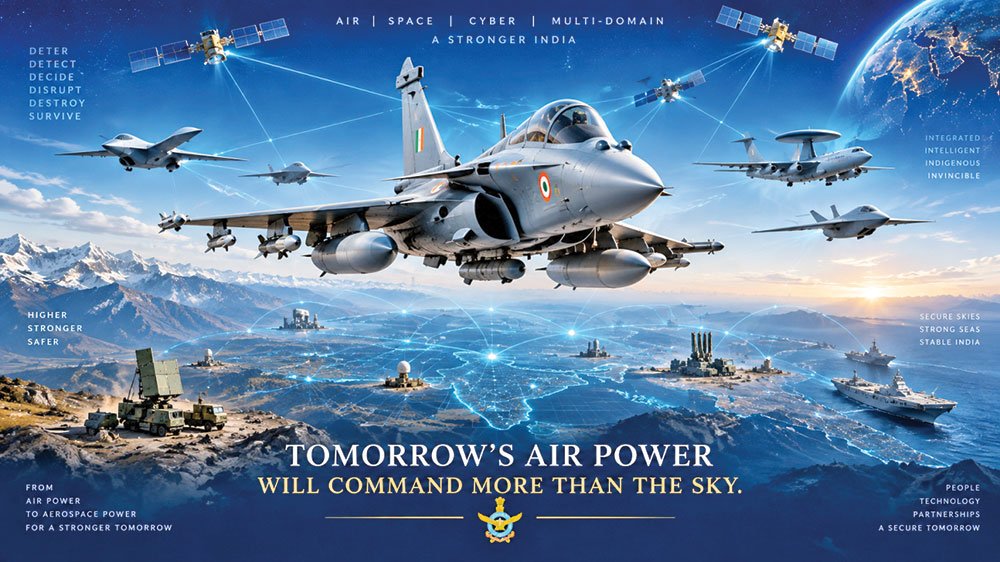
Air Force Day should therefore become more than a celebration of heritage and operational achievement. It should also become a moment of institutional imagination. The IAF has repeatedly adapted to changing technology, geography and strategic circumstances. Its next transformation will be more profound because the character of warfare itself is changing. The service will need new doctrines, new skills, new industrial partnerships and perhaps new organisational boundaries. It will need pilots who understand algorithms, engineers who understand operations, operators who understand space and commanders who can integrate machines without surrendering human judgement. The future will not belong automatically to the force with the largest inventory, but to the one creating the most resilient, intelligent and responsive combat system.
India’s strategic environment demands nothing less. The Himalayas, the Indian Ocean, the western frontier and the wider Indo-Pacific create a geography in which reach, mobility, surveillance and rapid response are indispensable. Yet geography alone cannot determine the future. Technology, doctrine, industrial depth and human capital will increasingly shape the balance of power. The IAF must therefore look beyond replacing ageing fleets and towards designing an entirely new architecture of air and aerospace power. Numbers will remain important, but numbers without networks, survivability, precision and decision superiority can become an expensive illusion.
Transformation must begin now, before crisis makes experimentation and institutional change impossible.
The question before India is larger than the future of one service. It is about whether the nation can build a military instrument suited to an age in which wars may begin with invisible signals, unfold through autonomous systems and be decided within minutes by those who control information and precision. The IAF of tomorrow must be capable of fighting alongside machines, through networks, across domains and under conditions of severe disruption. It must be simultaneously more distributed and more connected, more autonomous and more human-centred, more technologically sophisticated and more operationally adaptable, without losing the judgement, discipline and accountability that ultimately make military power credible.
On October 8, therefore, India should honour the men and women who have carried the nation’s tricolour into the skies, while also asking what those skies will demand from the generation that follows. The future IAF cannot simply be a larger version of today’s force. It must become a different kind of strategic instrument: an aerospace force capable of sensing first, deciding faster, striking precisely, surviving disruption and generating effects across the battlespace.
The Air Force of tomorrow will not be defined by how many aircraft India can fly, but by how intelligently India can command the sky, space and the battlespace beneath them.

Lt Gen Rajeev Chaudhry (Retd) writes on contemporary national and international issues, strategic implications of infrastructure development towards national power, geo-moral dimension of international relations, and leadership nuances in a changing social construct. The views expressed are of the author and do not necessarily reflect the views of Raksha Anirveda





