


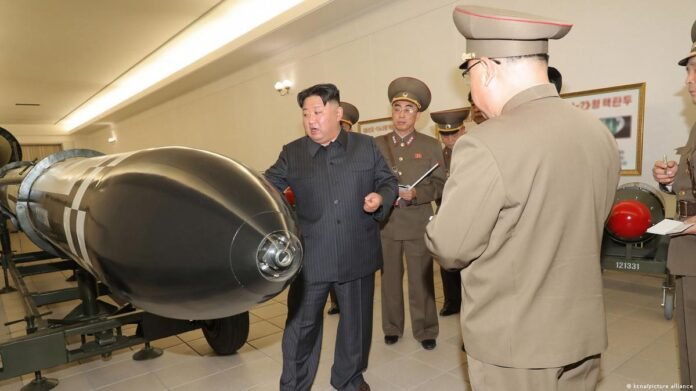
The central question facing the United States on North Korea is no longer simply how to persuade Kim Jong-un to abandon his nuclear weapons. After three decades of failed negotiations, it is whether Washington can manage the threat without legitimising the arsenal that has made Pyongyang difficult to contain. President Donald Trump may have an opportunity to revive diplomacy with Kim during his visit to China for the Asia-Pacific Economic Cooperation summit on November 18-19. But formally recognising North Korea as a legitimate nuclear-weapon state would be a strategic concession with consequences far beyond the Korean peninsula.
North Korea joined the Nuclear Non-Proliferation Treaty (NPT) in 1985. It subsequently pursued a clandestine weapons programme and withdrew from the treaty in 2003. It conducted six nuclear tests between 2006 and 2017
North Korea is estimated to have assembled around 60 nuclear warheads and possesses enough fissile material to produce at least 30 more, according to the Stockholm International Peace Research Institute. Its short-range missiles threaten South Korea, while its intercontinental ballistic missiles are designed to reach the United States. Six American presidents have failed to secure denuclearisation. This record makes the traditional demand for complete disarmament increasingly difficult to realise, but it does not make formal recognition of North Korea’s nuclear status a prudent alternative.

Kim’s strategic calculation is rooted in regime survival. The fate of Libya’s Muammar Gaddafi, who surrendered his country’s nuclear ambitions before being overthrown, reinforces Pyongyang’s belief that nuclear weapons provide insurance against external intervention. Trump’s personal rapport with Kim may facilitate dialogue, but it cannot resolve the underlying conflict between Pyongyang’s demand for security and Washington’s commitment to preventing proliferation. Their three meetings during Trump’s first term produced no durable agreement on denuclearisation. A renewed summit should not, therefore, be mistaken for progress in itself.
South Korea and Japan might question whether American security guarantees remain sufficient if Washington accommodates North Korea’s arsenal. Both could face stronger domestic pressure to reconsider their own nuclear options
South Korean President Lee Jae-Myung’s preference for a peace-first approach offers a more incremental alternative. Rather than making denuclearisation a precondition for dialogue, Washington and Seoul could pursue military hotlines, official visits, expanded trade and investment, and measures to reduce tensions along the border. Negotiations could eventually seek a verifiable freeze on fissile-material production, nuclear testing, and further expansion of the arsenal. Such measures would not eliminate the threat, but they could limit its growth and reduce the risk of miscalculation.
This distinction is fundamental. Negotiating with a nuclear-armed North Korea may be necessary; formally legitimising its arsenal is another matter. A cold peace sustained through arms control and deterrence may be more attainable than immediate denuclearisation. Any agreement, however, must secure measurable restraints in return for reciprocal concessions, rather than reward Pyongyang simply for acquiring weapons in defiance of international commitments.
Russia’s growing partnership with North Korea further complicates the calculation. Pyongyang has supplied Moscow with artillery ammunition and ballistic missiles and deployed troops in support of its war against Ukraine
A practical starting point would be a verifiable freeze on nuclear testing and fissile-material production, covering both plutonium and highly enriched uranium. Monitoring arrangements would need to cover declared facilities and address concerns about undeclared sites. Subsequent negotiations could impose limits on warhead production and delivery systems. Sanctions relief could be phased and reversible, linked to verified compliance rather than promises. This would give diplomacy concrete objectives without requiring Washington to recognise North Korea’s arsenal as legitimate.

The proliferation costs of recognition could be substantial. North Korea joined the Nuclear Non-Proliferation Treaty (NPT) in 1985, undertaking non-proliferation obligations in the context of assistance for civilian nuclear energy. It subsequently pursued a clandestine weapons programme and withdrew from the treaty in 2003. Six nuclear tests between 2006 and 2017, followed by successive sanctions, failed to reverse its course. If Washington formally accepts the outcome, other countries could conclude that persistent defiance eventually secures the recognition that compliance was intended to protect. Iran, which has not become a nuclear-weapon state, would be among those watching closely. The danger is not that every aspiring proliferator would follow Pyongyang, but that the perceived costs of violating non-proliferation commitments could diminish.
Russia’s accommodation of Pyongyang’s nuclear status, alongside China’s reluctance to press the issue decisively, does not give Washington a compelling reason to follow suit
The regional consequences could be equally serious. South Korea and Japan might question whether American security guarantees remain sufficient if Washington accommodates North Korea’s arsenal while weakening its military commitment to the peninsula. Both could face stronger domestic pressure to reconsider their own nuclear options. An agreement that reduced American troop deployments without securing meaningful North Korean restraints would aggravate these concerns. US forces have helped deter attacks since the 1953 armistice; their presence should not become a bargaining chip in pursuit of a diplomatic breakthrough.

Nor is there any guarantee that recognition would make Kim more cooperative. Pyongyang could sign an agreement and subsequently violate it, or use negotiations to gain time for further weapons development. Trump’s decision to curtail planned military exercises with South Korea in the hope of encouraging dialogue illustrates the difficulty of balancing diplomatic flexibility with credible deterrence. A summit that produces warm words but no verifiable limits would confer political value on Kim without materially reducing the threat.
Russia’s growing partnership with North Korea further complicates the calculation. Pyongyang has supplied Moscow with artillery ammunition and ballistic missiles and deployed troops in support of its war against Ukraine. In return, Kim seeks food, fuel, financial resources and advanced military technology. This cooperation has given North Korea greater room to withstand Western pressure, weakening the leverage that sanctions once provided. Russia’s accommodation of Pyongyang’s nuclear status, alongside China’s reluctance to press the issue decisively, does not give Washington a compelling reason to follow suit. Instead, it makes verifiable limits on North Korea’s weapons development and military cooperation more urgent.
For India, the issue concerns the credibility of the international nuclear order and the limits of great-power diplomacy. India has an interest in a Korean peninsula where deterrence remains credible, escalation is controlled, and nuclear competition does not spread
The comparison with Pakistan also requires care. Washington has accommodated Pakistan’s nuclear arsenal, although Islamabad is not a party to the NPT. But de facto acceptance of an existing arsenal is not equivalent to formal recognition as a legitimate nuclear-weapon state under the treaty. North Korea’s case is distinct: it joined the NPT, pursued a nuclear weapons programme, and subsequently withdrew. Treating these circumstances as interchangeable would blur the difference between managing an existing threat and legitimising proliferation.
For India, the issue concerns the credibility of the international nuclear order and the limits of great-power diplomacy. An accommodation with Pyongyang could reduce immediate tensions, but recognition without enforceable restraints could weaken non-proliferation norms and encourage regional nuclear hedging. New Delhi has an interest in a Korean peninsula where deterrence remains credible, escalation is controlled, and nuclear competition does not spread. The choice is not between insisting indefinitely on immediate denuclearisation and accepting North Korea’s arsenal without conditions. It is between a settlement that rewards possession and one that constrains its consequences. If Trump meets Kim, success should be measured not by whether Washington grants Pyongyang the recognition it seeks, but by whether an agreement demonstrably reduces the nuclear danger.

The writer commanded 15 Punjab in Lebanon under United Nations Flag, commanded 27 Sector as DIG in Churachandpur and was Brigadier Operational Logistics in HQ Western Command. He is currently an analyst on geopolitics, international and defence affairs. The views expressed are personal and do not necessarily carry the views of Raksha Anirveda





