


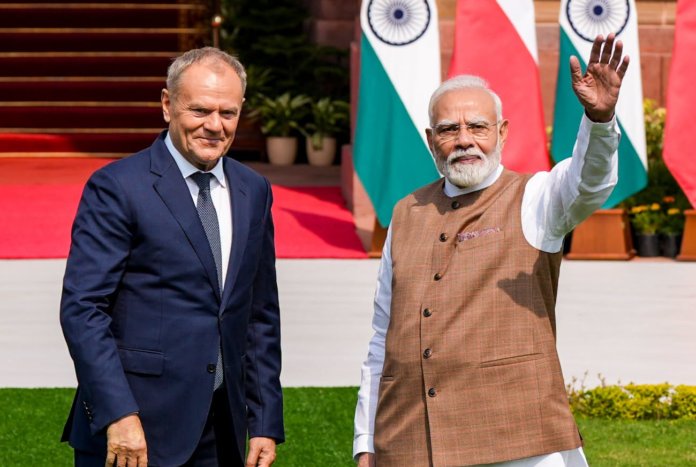
The Polish PM Donald Tusk’s visit to India marks an important next step in ties elevated to a Strategic Partnership in August 2024, during PM Modi’s visit to Poland. That upgrade was accompanied by an Action Plan for 2024–2028; in New Delhi, the leaders reviewed its progress and called for concrete, time-bound outcomes. Tusk’s three-day visit, accompanied by around 100 business leaders and industry representatives, gave the political reset an unusually strong commercial dimension.
PM Modi’s remarks framed the relationship as both an economic opportunity and a strategic choice. He described India and Poland as emerging centres of growth, technology and innovation, arguing that their expanding economic strengths create room for deeper cooperation. His invitation to Polish firms to co-develop and co-produce in defence, space and nuclear energy was especially significant: it points beyond conventional sales towards industrial partnerships that could build lasting connections between companies and research institutions.

PM Modi invited Polish firms to go beyond conventional trade by co-developing and co-producing in high-tech sectors, including defence, space, drones and nuclear energy
Defence is the most immediate test of that ambition. The two countries are considering a Defence Industry Dialogue to encourage business partnerships, technology transfer and joint development and production of military equipment. The joint statement also calls for stronger engagement in defence innovation and critical technologies, while noting that an agreement to protect and exchange classified information remains important and is expected to be signed soon. Such arrangements matter because defence cooperation depends on trusted information-sharing as well as political goodwill.
For India, collaboration with Poland could help diversify industrial partnerships and support domestic manufacturing. For Poland, it offers access to a large market and a potential partner with expanding defence production ambitions. Tusk’s emphasis on drones and satellites, alongside the delegation’s participation from the Polish space and technology sectors, suggests that both sides are looking for practical projects rather than limiting cooperation to declarations. But meaningful progress will require compatible procurement processes, clear rules for technology transfer and projects that make commercial sense to both partners.
Setting a goal to double bilateral trade by 2030, India and Poland are targeting cooperation across critical minerals, semiconductors, AI, green tech and the early conclusion of the India-EU FTA
Space cooperation is a promising complement. The joint statement calls the sector an important part of the Strategic Partnership and encourages institutional and industry-level engagement to identify mutually beneficial areas. Potential cooperation could link satellite and space technologies with applications such as communications, environmental monitoring and disaster resilience. The value lies not only in developing technology together, but also in creating opportunities for universities, start-ups and established firms to work across borders. The statement’s emphasis on identifying concrete areas, however, signals that the agenda still needs to move from broad promise to specific programmes.

Nuclear energy adds another layer, though it will demand careful, long-term work. PM Modi said the countries had agreed to deepen ties in nuclear energy, and welcomed Polish companies to pursue joint development and production in strategic sectors. Alongside this, the leaders identified cooperation in clean energy and sustainable technologies as part of their wider effort to strengthen energy security. Whether these ambitions translate into projects will depend on investment, regulation and technical feasibility-not simply the warmth of summit diplomacy.
Trade is the measure by which the partnership’s broader ambitions may be judged. Both governments set a target to double bilateral trade by 2030. Modi presented the India–European Union free trade agreement as a potential catalyst, calling for its early signing, ratification and implementation; the leaders see it as a way to open markets, support investment and strengthen supply chains. Their agenda also includes critical minerals, semiconductors, battery recycling, artificial intelligence, green technologies and coal gasification. This breadth could make the relationship more resilient, but it also risks scattering attention unless governments and businesses prioritise deliverable projects.

Rooted in WWII history and recent cooperation during the 2022 Ukraine evacuation, the Indo-Polish partnership relies on a strong human foundation to support expanding cultural, educational and commercial ties
The leaders also acknowledged that the partnership operates amid geopolitical differences. Tusk called India and Poland countries with “no conflicts of interest”, stressing the absence of historical grievances and the potential for cooperation. PM Modi, meanwhile, said India would support “every meaningful effort towards peace” in Ukraine and West Asia. The formulations show how the two governments seek common ground without implying identical positions on international conflicts. Their shared language on peace, democratic values, the rule of law and reform of global institutions offers a diplomatic framework, but it cannot erase differences in strategic outlook.
The relationship also has a human foundation. PM Modi recalled that Indian royal families sheltered Polish children and families during the Second World War, while Poland helped Indian students return safely from Ukraine in 2022. These memories give bilateral ties a distinct emotional resonance and provide a basis for expanding cultural, educational and youth exchanges. They are not a substitute for policy, but they help give strategic cooperation public meaning.
The central question is whether the 2026 agenda can be converted into regular dialogue, signed arrangements, joint projects and rising trade. PM Modi’s statements set a clear direction; the joint statement supplies a broad roadmap. Defence and space could become the partnership’s most visible new pillars, while trade and people-to-people links provide its foundation. The next phase will depend less on declarations of friendship than on whether both governments and their companies can turn shared intent into measurable results.

-The writer is a New Delhi-based senior commentator on international and strategic affairs, environmental issues, an interfaith practitioner, and a media consultant. The views expressed are personal and do not necessarily carry the views of Raksha Anirveda





