


The character of air warfare is changing rapidly. What began with unmanned systems primarily supporting Intelligence, Surveillance and Reconnaissance (ISR) missions has evolved into a new operational reality where drones are becoming an integral part of combat formations, force multiplication strategies and multi-domain operations.
This evolution is particularly relevant for India. As the Indian Armed Forces continue to modernise and prepare for increasingly complex operational scenarios, unmanned systems are transitioning from supporting assets to essential contributors across the battlefield. The Indian Air Force’s drone warfare strategy reflects this shift. The future is no longer about operating individual unmanned platforms. It is about integrating manned and unmanned assets into a coherent operational ecosystem.

In this context, Vertical Takeoff and Landing (VTOL) Unmanned Air Systems have a unique role to play.
Unlike conventional runway-dependent platforms, VTOL UAS combine mobility, operational flexibility and rapid deployment. They can operate from remote locations, austere environments, ships, mobile command posts and forward operating bases. This versatility makes them particularly valuable for a country like India, where operational requirements span mountains, deserts, coastlines, islands and dense urban environments.
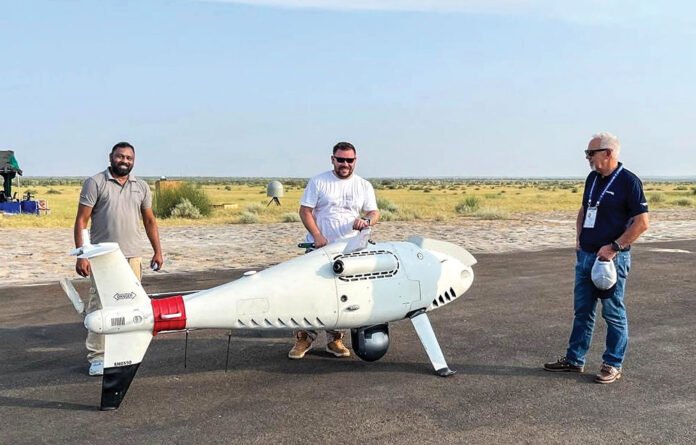
The CAMCOPTER® S-100 has long demonstrated the advantages of this concept. Operationally proven on multiple continents, it has accumulated extensive real-world experience across a broad spectrum of missions, including ISR, maritime surveillance, border security, search and rescue, environmental monitoring and disaster response. Its ability to operate without launch or recovery equipment and its compact logistical footprint have made it particularly attractive to operators seeking flexible airborne intelligence capabilities.
Drones are transitioning from standalone surveillance units into force multipliers, integrated directly into combat formations and multi-domain networks
As operational requirements continue to evolve, however, there is growing demand for systems that provide greater endurance, higher payload capacity and expanded mission flexibility. This development led to the introduction of the CAMCOPTER® S-300.

Building on the proven CAMCOPTER® heritage, the S-300 significantly expands what can be achieved with a VTOL UAS. With substantially increased payload capacity and endurance of up to 24 hours with a 50 kg payload, the platform allows operators to carry multiple mission systems simultaneously while maintaining persistent coverage over large operational areas.
This is especially relevant in the context of the modern battlespace, where decision superiority increasingly depends on the ability to collect, process and distribute information faster than potential adversaries. Multiple sensors operating simultaneously on a single platform provide commanders with a more comprehensive operational picture while reducing the complexity associated with deploying several separate assets.

For the Indian Air Force, this aligns closely with emerging concepts of multi-domain operations and network-centric warfare. Long-endurance VTOL UAS can support air operations by extending surveillance coverage, conducting reconnaissance missions in contested areas, acting as communication relays and contributing to targeting and battle damage assessment.
Perhaps even more significant is the growing importance of Manned-Unmanned Teaming (MUM-T).
Around the world, armed forces are investing heavily in concepts that allow unmanned platforms to operate alongside manned aircraft. Rather than viewing drones as separate systems, operators increasingly see them as extensions of manned platforms, providing additional sensors, greater reach, increased survivability and enhanced mission effectiveness.
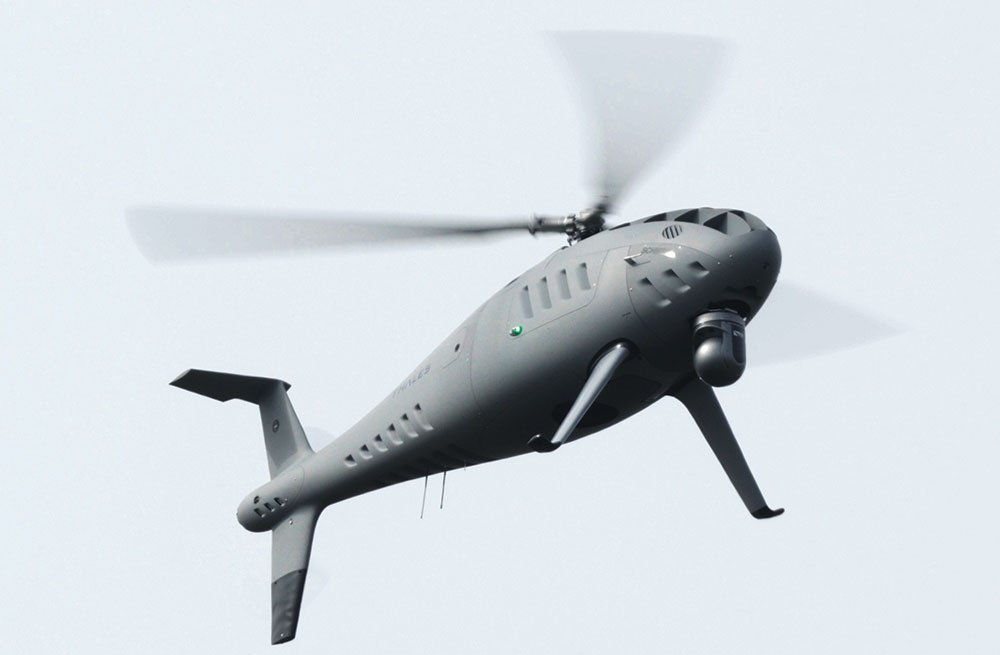
This trend is particularly visible in programmes built around the “loyal wingman” concept, where autonomous or semi-autonomous unmanned aircraft support helicopter and fixed-wing operations. For attack helicopters, transport helicopters and other airborne platforms, unmanned teammates can extend situational awareness, penetrate deeper into contested environments and reduce risk to aircrews.
Schiebel is actively involved in this evolution. Together with Thales, we are participating in the United Kingdom’s Project NYX, a programme exploring future loyal wingman capabilities for the British Army’s AH-64 Apache attack helicopters. The CAMCOPTER® S-300 was recently demonstrated successfully in the UK as part of this initiative and is currently among the final contenders being evaluated. Programmes such as Project NYX highlight the growing recognition that future battlefield success will depend on effective collaboration between manned and unmanned systems.
For India, where future air operations will require high levels of adaptability across diverse operational environments, MUM-T represents a significant force multiplier. The concepts being explored today in programmes such as Project NYX are likely to influence how air forces worldwide integrate unmanned systems into future operations.
The Indian Air Force’s Dronathon 2026 highlighted the increasing focus on precisely these capabilities. The event brought together leading industry participants to demonstrate technologies that will help shape the future of drone warfare and manned-unmanned integration.
Runway-independent VTOL platforms provide rapid deployment across high-altitude mountains, deserts and maritime environments without heavy infrastructure requirements
Schiebel was pleased to participate in Dronathon 2026, where the CAMCOPTER® S-100 delivered an outstanding performance throughout the demonstration activities. The event provided an excellent opportunity to showcase the platform’s operational maturity, flexibility and suitability for complex mission scenarios.
More importantly, Dronathon reinforced a broader industry trend. Discussions are increasingly moving beyond individual platforms and focusing on how unmanned systems can integrate into larger operational architectures. MUM-T is no longer a future concept. It is rapidly becoming an operational requirement for modern air forces.
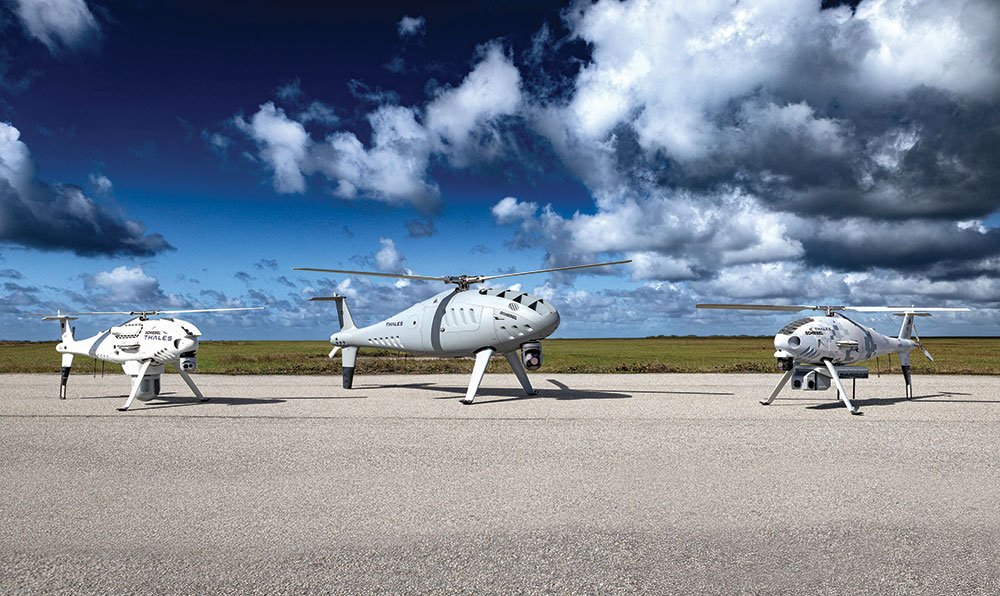
As these requirements continue to mature, the combination of the CAMCOPTER® S-100 and CAMCOPTER® S-300 provides a scalable capability framework. The operationally proven S-100 delivers tactical flexibility, rapid deployment and mission versatility, while the S-300 expands endurance, payload and mission scope.
Together, they offer a layered approach to unmanned aviation that supports both current and future operational requirements.
The story is not only about platforms. It is also about industrial capability.
India’s focus on Aatmanirbhar Bharat and Make in India is creating significant opportunities to build long-term indigenous capability across the defence and aerospace sectors. At Schiebel India, we see this as a strategic opportunity rather than simply a policy requirement.
Schiebel India is steadily expanding its local capabilities in areas including MRO, assembly, integration, maintenance, software development and advanced manufacturing technologies. Over time, these activities can contribute to a broader ecosystem supporting both domestic requirements and future export opportunities.
Drones act as autonomous “loyal wingmen”, expanding sensor range and survivability for crewed aircraft in contested airspace
The next phase of unmanned aviation will be defined by higher levels of autonomy, deeper collaboration between manned and unmanned platforms and greater integration across services and domains.
The future battlefield will not be shaped by individual systems operating independently. It will be defined by interconnected networks of sensors, platforms and operators working together to deliver information, awareness and operational advantage.
The Indian Air Force’s focus on drone warfare, the growing momentum behind MUM-T and international programmes such as Project NYX demonstrate that this future is already taking shape. The successful participation of the CAMCOPTER® S-100 at Dronathon 2026 further reinforced the value of operationally proven VTOL UAS in this evolving ecosystem.
VTOL UAS will be an important part of that journey. The question is no longer whether unmanned systems will transform air operations. The question is how quickly this transformation will occur.

The writer is a Chief Executive Officer, Schiebel Systems India Pvt Ltd. The views expressed are of the writer and do not necessarily reflect that of Raksha Anirveda





