


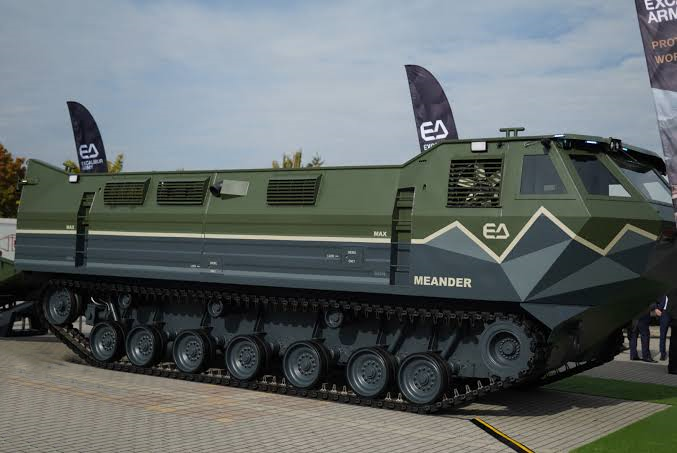
Meander’s first prototype was presented at the Future Forces Forum 2026 in Prague. Developed jointly by CSG’s Excalibur Army and New Space Technologies (NST), Meander is designed for military transport on land and water, including challenging terrain such as marshes and rivers. The companies say the vehicle addresses a market in which many armed forces still rely on ageing amphibious equipment.
Meander was shown in a basic transport configuration, but its design is intended to support specialised versions, including variants capable of carrying weapon systems. CSG says the vehicle could carry personnel, materiel, ground equipment or smaller vehicles across water obstacles, potentially avoiding the need to construct pontoon or engineer bridges for some crossings. The company has not announced orders or a delivery timetable.

At more than 11 metres long, the vehicle has a gross weight of up to 33 tonnes and a stated payload capacity of 13 tonnes. Its flat cargo deck can accommodate up to 70 standing troops, 12 stretchers, a medium-sized military truck or a standard 20-foot container. An electrically operated rear ramp is designed to ease loading and can support a load of up to 13 tonnes.
Power comes from a 12-cylinder, air-cooled Tatra engine rated at 440 kilowatts. CSG lists a maximum road speed of 48 kilometres per hour and a water speed of around 12 kilometres per hour. The vehicle runs on tracks on land and uses propellers for water propulsion. It is operated by a driver and an operator, with provision for a third crew member if required.
One unusual feature is that the driver uses a steering wheel and pedals both on land and in water. CSG says the electronic steer-by-wire system is intended to make the vehicle precise and comfortable to handle. A touchscreen display provides vehicle information, while cameras give the crew a view around the vehicle. These features are presented as part of the design; operational trials and military evaluations will determine how they perform in service conditions.
Meander builds on the KALAN amphibious vehicle, developed by NST and currently being tested by Czech firefighters. The military programme adapts that experience to defence requirements, including a different water-propulsion system. Under the division of work, Excalibur Army is responsible for military, operational and user requirements, while NST handles technical design and production development, including the prototype. The firms formalised their cooperation with a memorandum signed at Eurosatory 2026, before presenting the prototype a few months later.

The project combines the military-vehicle experience of Excalibur Army with NST’s development work. CSG describes Meander as a potential expansion of its land-systems portfolio in a specialist segment where it sees limited competition. Whether that translates into commercial success will depend on customer evaluations, procurement decisions and the vehicle’s performance in testing-not just its headline payload and amphibious specifications.
The announcement comes as armed forces continue to consider how to move personnel and supplies across natural obstacles while maintaining mobility. An amphibious transporter can offer one option where infrastructure is damaged, unavailable or unsuitable, but it does not replace every bridging or logistics capability. Meander’s proposed value lies in combining transport capacity with the ability to travel between land and water without changing vehicles.

CSG says future configurations could be tailored to customer requirements, including combat-oriented versions. The prototype debut, however, was of the transport variant, and the company has not detailed specific weapons, protection levels or performance testing results. For now, Meander represents a new development in Czech defence manufacturing, with its next milestones likely to be shaped by trials and prospective buyers’ requirements.






