


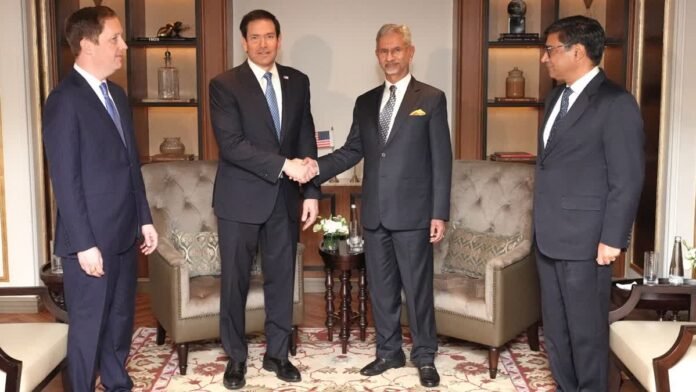
The US Secretary of State Marco Rubio while visiting Mumbai and Gujarat’s Jamnagar recently, to secure diesel supplies, whose rising prices in the US could impact the Republican party’s prospect in the mid-term elections in November, described India as a “big and important” country with a large economy and an enormous business class.
Obviously, one might be tempted to see it as Rubio’s sugar-coated statement, which the senior official of the Trump administration made in pursuance of his country’s transactional approach to international relations that is often deceptive and fraught with contradictions.

Yet, one thing is clear: hate or love India, it cannot be ignored because of its rising GDP, population and capacity to influence decision; Trump has not so far imposed 100% tariff on India despite the US President being armed with the Lindsey O Graham bill sanctioning five countries, including India for purchasing oil from Russia.
Consequential Global Player
In the fast-shifting international geopolitical situation, New Delhi is emerging as a consequential global power whose strategic autonomy, economic strength and diplomatic influence make it increasingly difficult for the US and other major powers to ignore its interests.
India continues to assert its independence by maintaining vital energy and defence partnerships on its own terms, recently becoming the top buyer of Russian crude
Still, Rishi Sunak, the former UK Prime Minister calls India a middle power. He has made such remarks either out of his ignorance about New Delhi’s growing stature as a power that shapes debates on global governance or out of usual angular Western views where India is belittled because New Delhi does not align more closely with it on issues such as Russia, China and the international order.
India insists on making decisions according to its own national interests. It has never condemned Russia despite its Ukraine invasion; it has continued defence and energy engagements with Moscow no matter how much the US and its European allies have tried to pressurise it.

For instance, in September, India imported an average of 1.82 million barrels per day of crude oil from Russia, making the South Asian country the world’s largest buyer of Russian crude oil. According to data analytics firm Kpler, India has even surpassed China as Beijing purchased 1.49 million barrels per day of crude oil from Moscow in September, while New Delhi bought an average of 1.82 million barrels per day of crude oil from Russia.
Efforts in global governance highlight India’s unique position, seamlessly participating in the Quad and G-7 while maintaining strong commitments to BRICS, the SCO and UN Security Council reforms
A middle power will never risk taking such steps, given the US President’s unbridled behaviour to punish harshly a non-follower of his dictates. Critics of India should not forget that New Delhi never lacks energy and dynamism to project and protect its interests.

Commensurate with this, India has today relationships with countries that have divergent strategic approaches. For instance, it is a member of the Quad and a regular invitee at the G-7 meeting, while simultaneously retaining its engagement with the BRICS and the SCO. It reflects India’s preference for a multipolar world in which international institutions better represent the interests of developing nations.
India has consistently argued for reforms in global institutions, including the UNSC, to reflect contemporary geopolitical and economic realities. Its understanding is that institutions claiming global legitimacy must accommodate the aspirations of countries which have a substantial share in the world’s population.
Technological Prowess
Besides, global population, India is a nuclear power and possesses capabilities to develop highly advanced missile and drone technologies. Two years ago, it joined the rank of select few countries that possess hypersonic missile technology. Except for the US, no Western country has developed such technologies so far.
Rapid advancements in hypersonic missiles, indigenous drone technology and domestic navigation networks demonstrate India’s transition into a technologically sophisticated, self-reliant defence power
From anti-drone systems to home grown navigation satellites, India’s defence ecosystem is rapidly evolving into a technologically sophisticated and increasingly self-reliant military-industrial complex capable of strengthening the country’s strategic autonomy, enhancing its deterrence capabilities and expanding its influence in the global balance of power.
Its growing emphasis on indigenous defence manufacturing, advanced surveillance systems, precision-guided weapons and space-based military assets reflects an ambition to reduce dependence on foreign suppliers and emerge as a major force in the development of next-generation warfare technologies.
Leave aside defence capabilities. The UK is a well recognised middle power. But does it have an advanced space programme? Not at all. It does not operate an independent, fully established orbital launch capability for placing satellites into space from its own territory.
Until three years ago, the UK did not put a satellite into orbit. In January 2023, it tried to launch its own satellite into space, but it failed, crashing its ambition to turn the country into a global player-from manufacturing satellites, to building rockets and creating new spaceports.
Building on the historic lunar south pole landing, India is aggressively advancing its Gaganyaan mission and building its own space station to expand its global space economy share
In contrast, India which became the first country in the world to land its spacecraft safely near the lunar south pole under Chandrayaan-3 mission on August 23, 2023, is gearing to operationalise Bhartiya Antariksha Station (BAS) by 2035.
Under its Gaganyaan Mission, India aims to send three Indian astronauts into a 400 km orbit for three days. When the Gaganyaan Mission will be carried out, no timeline has been fixed. However, preparations are underway in full swing with assembly, integration and testing of the crew module and service module nearing completion.
India’s space economy is currently valued at $8 billion with a share of 2-3% in the global space economy. It is projected to grow five-fold to $40-45 billion over the next decade, with its global share targeted at 8% by 2030.
Rapid growth across the semiconductor ecosystem and an ecosystem of over 2,000 startups solidify India’s status as a global hub for critical technology and artificial intelligence
In the area of critical technology too, India is rapidly developing domestic capabilities across the semiconductor value chain-from chip design and fabrication to advanced packaging, equipment and materials. Equipped with a substantial base, India has attracted major investments in the semiconductor field.
India is expected to commission its major silicon fab in 2028. Similarly, India is ranked among the top three AI nations in the world by Stanford. It is home to more than 2,000 AI-focused startups-the largest AI startup ecosystem globally.
Growing Attractiveness
For some India cannot replace China in terms of foreign investments. But facts on the ground show that in 2025-26, India received US$94.53 billion FDI, which was a 17% increase over the previous fiscal year.
During the first quarter (April-June) of 2026-27, India recorded US$19.82 billion FDI inflows, marking a 6.38% increase compared to US$18.63 billion in the first quarter of 2025-26, data from India’s Department for Promotion of Industry and Internal Trade (DPIIT) shows.
Driven by manufacturing expansions and major corporate investments in key industries, India’s steadily rising FDI highlights its growing appeal relative to traditional investment markets
On the other hand, foreign investment flows into China fell 4.3% year-on-year to 548.8 billion yuan (US$82.2 billion) in the first three quarters in the current financial year, China’s Commerce Ministry said.
India is attracting investment in chip making equipment, assembly, testing, packaging and semiconductor manufacturing. In September 2026, Applied Materials announced a planned US $5 billion investment in India over the next decade. In the recent past, Apple and its manufacturing partners have expanded iPhone production in India.
Overall, India may not possess the comprehensive power of the US or China, but it cannot be confined to the traditional definition of a middle power. Its growing economic weight, technological ambitions, military capabilities and diplomatic reach have already made it an indispensable player in an increasingly fragmented world.
For the US and other major powers, engaging with India is increasingly a strategic necessity rather than a diplomatic choice.

The writer is a senior journalist with wide experience in covering international affairs. The views expressed are of the writer and do not necessarily reflect the views of Raksha Anirveda





