


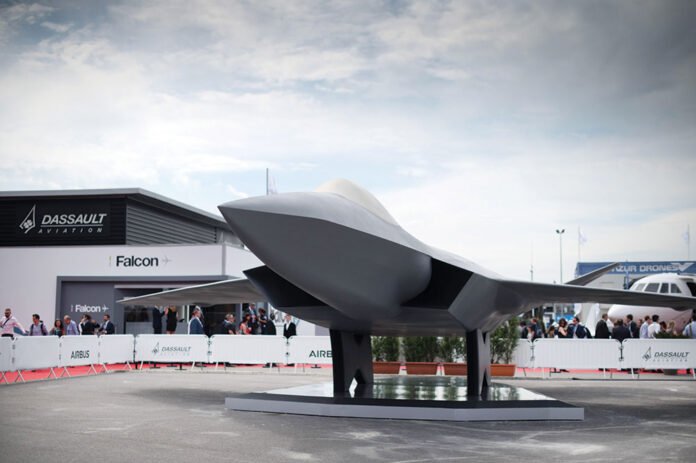
For decades, India’s fighter modernisation story has been one of chasing timelines set in Moscow, Paris or Washington — buying, licence-building, occasionally co-developing, but rarely sitting at the table where next-generation air power is actually designed. That may be changing. In its 25th report to Parliament, presented on August 7, 2026, India’s Ministry of Defence disclosed that it has started work on joining the French-led Future Combat Air System (FCAS), two months after the collapse of the Franco-German fighter that sat at the centre of the programme. It’s a short sentence in a dry parliamentary document — but it could mark the moment India stops being a customer of sixth-generation air power and starts becoming its co-author.
Why FCAS is Suddenly up for Grabs
To understand why this door has opened, rewind to June 8, 2026. France and Germany terminated their joint FCAS collaboration after Dassault Aviation and Airbus failed to resolve disputes over industrial authority, workshare and intellectual property. The friction wasn’t superficial — France required a future aircraft capable of carrier operations and supporting the nuclear mission, while Germany did not need those features, and the two nations simply could not reconcile that operational and industrial divergence. What survives is the digital backbone of the programme — Germany and France are reportedly still willing to co-develop the ‘Combat Cloud’, the AI-driven network meant to link fighters, drones and legacy jets.

Into this vacuum steps India. Unlike the deadlocked three-way European partnership, a France-India deal would have only two capitals to satisfy — a far simpler negotiating table. For France, an Indian partner offers something Dassault badly needs after Berlin’s exit: industrial depth and financial resilience. It’s a rare alignment of interests — a wounded European champion looking for a well-funded, ambitious partner, and an Indian Air Force staring at a widening capability gap.
Why India Can’t Afford to Wait
The urgency isn’t abstract. The Indian Air Force possesses a deficit of 13 fighter squadrons — 31% of its authorised 42 — even as it juggles ageing Jaguars, a modest Rafale fleet, expanding Tejas production, the highly capable Sukhoi Su-30MKI, the indigenous AMCA effort and a fresh 114-aircraft Rafale negotiation. Meanwhile, China’s own sixth-generation ambitions are advancing fast. Parliament’s own defence committee didn’t mince words: it flagged FCAS and the rival British-Italian-Japanese Global Combat Air Programme (GCAP) as the principal sixth-generation projects, warning that delayed participation could leave the Indian Air Force technologically disadvantaged. Notably, India appears to have made its choice between the two — selecting the French-led FCAS over GCAP — likely a reflection of the deep trust already built through decades of Mirage and Rafale operations, and the fact that France, unlike GCAP’s three-nation consortium, has historically shown more openness to genuine co-development with India (as seen in the Kaveri-Safran engine talks and Scorpene submarine programme).
Unlike the deadlocked three-way European partnership, a France-India deal would have only two capitals to satisfy — a far simpler negotiating table. For France, an Indian partner offers something Dassault badly needs after Berlin’s exit: industrial depth and financial resilience. It’s a rare alignment of interests
Not a Fighter Jet — A System of Systems
Here’s what makes FCAS fundamentally different from any fighter deal India has signed before: it was never conceived as ‘just’ an aircraft. Its objective is to build an entire combat-air ecosystem — a next-generation fighter, unmanned Remote Carrier drones, and a sophisticated digital network called the Combat Cloud — connecting assets across air, land, sea, space and cyber domains. In practical terms, this means sensors on one aircraft feed targeting data to a weapon on another, drones fly ahead as expendable ‘loyal wingmen’, and a resilient, jam-hardened network holds the entire mesh together under electronic attack.

This is precisely the kind of ‘system of systems’ thinking that Indian defence planning has talked about for years but rarely built at scale. Legacy platforms are engineered in isolation and networked as an afterthought; FCAS-style architecture designs the network from day one. For India’s air force — and by extension its navy and army aviation — genuine exposure to this discipline would be transformative, teaching Indian engineers not just how to build a better aircraft, but how to architect an entire warfighting ecosystem where humans, autonomous drones and AI-driven decision loops operate as one.
The Real Prize: Maturing India’s Aerospace Sector
Fighter programmes are, in the end, workforce-building programmes. What India stands to gain isn’t just hardware — it’s institutional muscle memory. A sixth-generation workshare with real strategic value would need Indian responsibility for airframe sections designed in India, flight-control or mission-software modules, low-observable materials, sensors, electronic-warfare subsystems and propulsion components. Each of those is a discipline where Indian aerospace — from HAL to DRDO labs to the private sector — has partial capability but has struggled to reach maturity independently.

Consider stealth shaping and radar-absorbent materials, composite airframe structures, AESA radar development, and sensor fusion software — areas where AMCA and FCAS already overlap significantly. Co-development exposes Indian design teams to French systems-engineering rigour, test protocols, certification standards and — critically — the discipline of managing a genuinely distributed, multi-node combat network. This is the kind of skill upgrade that no amount of domestic trial-and-error can substitute for, because it requires working alongside an industry (Dassault, Thales, Safran, Airbus) that has already solved many of these problems at production scale.
Parliament’s defence committee didn’t mince words: it flagged FCAS and the rival British-Italian-Japanese Global Combat Air Programme (GCAP) as the principal sixth-generation projects, warning that delayed participation could leave the Indian Air Force technologically disadvantaged
There’s also a maturity dividend beyond engineering: programme management. FCAS-style projects demand disciplined systems integration across multiple contractors, rigorous configuration control and long-horizon industrial planning — exactly the organisational capabilities Indian aerospace has historically lacked, as seen in the delays that have dogged indigenous programmes. Working inside a French-led framework, even as a junior partner, would force Indian industry to internalise these disciplines or risk being sidelined.
What it Means for Tejas
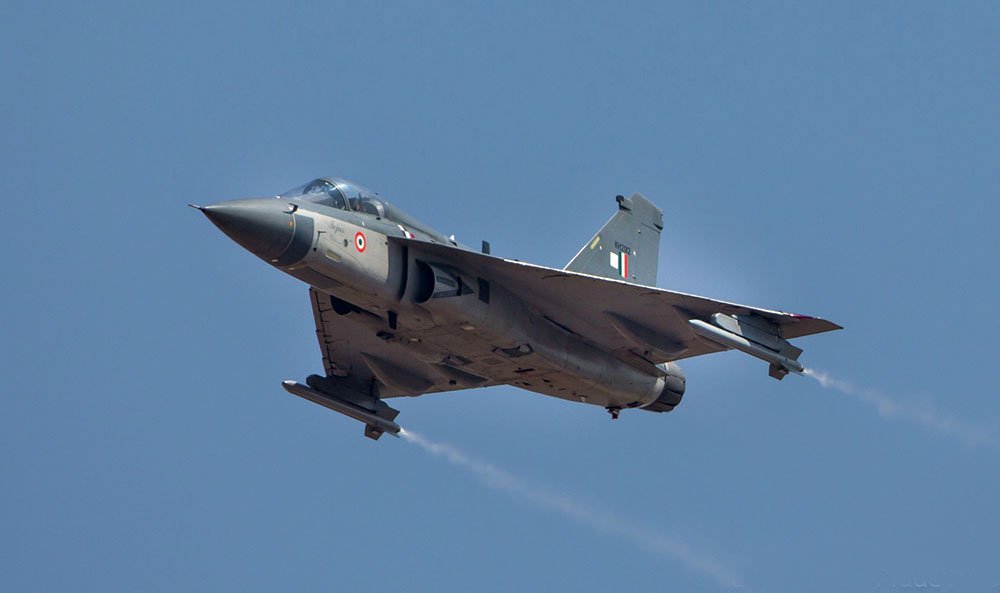
The immediate, tangible beneficiary could be the Tejas line. Officials in New Delhi have been unusually blunt about wanting engine sovereignty — Defence Minister Rajnath Singh, during a visit to the Gas Turbine Research Establishment in Bengaluru, made it clear that India cannot stop at merely powering the AMCA. Any FCAS-linked propulsion collaboration with Safran — which is already central to the engine debates around AMCA — carries a natural spillover: technologies matured for a sixth-generation power plant (better thermal management, advanced materials, digital engine control) tend to filter down into upgrades for existing platforms. A more indigenised, higher-thrust engine ecosystem born from FCAS-adjacent R&D would directly benefit the long-delayed Tejas Mk2 and future Tejas variants, reducing India’s chronic dependence on imported powerplants like the GE F404/F414.
Beyond propulsion, avionics and sensor-fusion software developed for a networked combat-cloud architecture could be scaled down and retrofitted into Tejas’s mission computers, giving the light fighter genuine networked-warfare capability — turning it from a standalone platform into a node that can share targeting data with AMCA, Rafales and even unmanned wingmen.
What India stands to gain isn’t just hardware — it’s institutional muscle memory. A sixth-generation workshare with real strategic value would need Indian responsibility for airframe sections designed in India
What it Means for AMCA
For AMCA, the calculus is more delicate but potentially more rewarding. India has been careful to stress that FCAS involvement is meant to support, not replace, the AMCA programme, which remains the central pillar of India’s fighter modernisation, with rollout targeted by the end of 2028, first flight in early 2029, and induction expected in the mid-2030s. Given that overlap in stealth shaping, composites, AESA radar and electronic warfare, participation in FCAS’s technology-maturation work could act as an accelerant — letting Indian design teams validate concepts, materials and subsystems years earlier than they could through solitary domestic effort, then feed those lessons straight into AMCA’s Mk1 and the more ambitious, unmanned-teaming-capable Mk2.
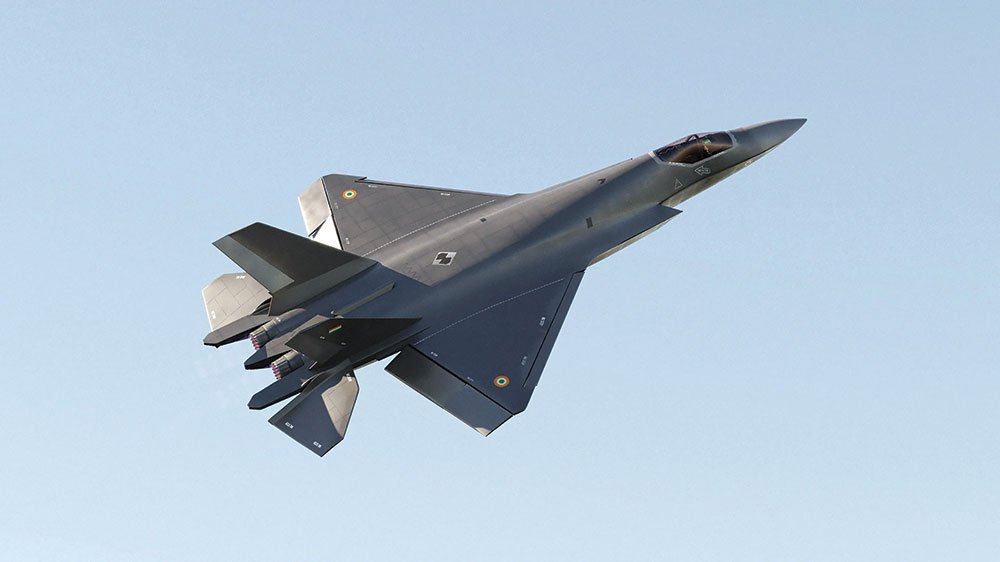
Perhaps the biggest single gift to AMCA would be exposure to combat cloud and manned-unmanned teaming architecture — the very technologies AMCA’s later increments are meant to carry but for which India currently has the least mature domestic base. FCAS combines a stealthy fighter with remote-carrier drones, loyal wingmen and a combat cloud linking distributed sensors, weapons and command nodes across a contested battlespace. If Indian engineers help build even a slice of that architecture for France, they walk away with blueprints for exactly the “drone swarm plus AI brain” capability AMCA will eventually need — potentially saving years and billions of rupees in independent R&D.
The Hard Caveats
None of this is guaranteed, and enthusiasm should be tempered with realism. No bilateral agreement, financial commitment, industrial workshare arrangement, or legally binding technology-transfer framework had been announced as of mid-August 2026 — what exists today is talks, not a treaty. France is highly unlikely to grant open access to its most guarded secrets — proprietary systems tied to nuclear payload delivery, sovereign mission software, and top-tier electronic warfare will almost certainly stay under strict French oversight.
Co-development exposes Indian design teams to French systems-engineering rigour, test protocols, certification standards and — critically — the discipline of managing a genuinely distributed, multi-node combat network
The tough questions that sank the Franco-German arrangement — who holds design authority, how technology is shared, whether Dassault remains undisputed design lead, and whether India gets genuine design ownership or mostly financing and production work — will resurface in any India-France negotiation too. India’s insistence on sovereignty and indigenous IP ownership, hard-won through years of frustrating experience with technology-transfer deals, means these talks could be slow and contentious.
A Calculated Bet on the Future
Still, the strategic logic is compelling. India is not abandoning AMCA to chase a European mirage; it is pursuing a deliberate dual-track strategy — build indigenously, learn internationally. If New Delhi can negotiate genuine design work rather than a subordinate role, FCAS could become the single biggest accelerant to Indian military aerospace maturity since the Su-30 MKI licence-production era — this time not just building someone else’s aircraft, but helping architect the network that will define air combat beyond 2040. The parliamentary disclosure is only the opening move. What happens at the negotiating table over the next year will determine whether India becomes a true co-architect of sixth-generation air power — or merely its newest financier.

The writer is a defence journalist specialising in military affairs, security policy and defence technology. He reports extensively on operation strategies, defence manufacturing initiatives and geopolitical developments across the Indo-Pacific region. The views expressed are personal and do not necessarily carry the views of Raksha Anirveda





