


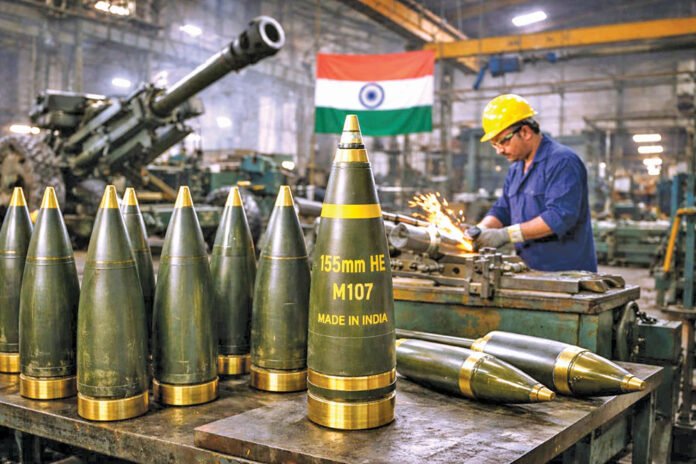
By the time a modern war reaches its second month, the opening salvos have long been fired, the pre-positioned inventories drawn down, and the outcome no longer turns on who struck first. It turns on who can still build. This is the uncomfortable question India’s strategic community has been slow to ask of itself: not whether our soldiers can fight – they can, and Operation Sindoor showed a fighting machine that is disciplined, precise, and lethal – but whether the factories behind them can keep the guns fed once the war stops being short.
India has never had to answer it. Every conflict in our history – 1962, 1965, 1971, Kargil – was fought and settled before industrial endurance became the deciding variable. Our war reserves, our doctrine, our planning assumptions all quietly presume a sharp, decisive campaign. The wars of this decade suggest that presumption is a luxury we may no longer be able to afford.

Consider the historical template most often invoked. In the Second World War, American shipyards replaced sunk tonnage faster than U-boats could sink it, launching Liberty Ships in days. But the United States performed that miracle behind an ocean, on soil no enemy bomber ever reached. India will enjoy no such sanctuary. Our defence corridors, shipyards and fabrication units sit well within range of missiles, drones and cyber intrusion. The relevant template is therefore not Detroit in 1943 but Ukraine and Iran today, nations forced to produce while being bombed, to disperse their lines, run on backup power, and reconstitute output after strikes. Industrial resilience has itself become a weapon.
None of this dismisses what India has built. The gains are real. The Army has crossed roughly 90% self-reliance in ammunition. We field one of the world’s most diversified indigenous missile families, viz. BrahMos, Akash, Astra, Pinaka, Pralay, and Agni. Our yards are building destroyers, frigates and carriers at a tempo few nations can match. Defence production touched a record ₹1.78 lakh crore in 2025-26, with the private sector’s share climbing to a quarter. This is not the fragile base of a decade ago.
And yet beneath the assembly lines lies a paradox that grows more serious the longer one looks. India has become good at the final act of manufacturing, integration, while remaining dangerously dependent on the first. We assemble platforms whose lifeblood is imported. Rare-earth magnets essential to precision munitions, radars and avionics come overwhelmingly from China, our most likely adversary. Advanced semiconductors, the nervous system of every modern weapon, are still largely brought in. The Tejas cannot fly without an American engine; the BrahMos cannot fire without Russian components. The millions of lines of software and combat waveforms that make network-centric warfare possible often belong to foreign vendors who will not share their source code. This is what a hollow autonomy looks like: sovereign in the showroom, dependent in the supply chain.
Every conflict in India’s history – 1962, 1965, 1971, Kargil – was fought and settled before industrial endurance became the deciding variable. Our war reserves, our doctrine, our planning assumptions all quietly presume a sharp, decisive campaign
Then there is the matter of credibility. Late last year, the Chief of Defence Staff, General Anil Chauhan, said aloud what serving officers had long muttered in private: that Indian firms had over-promised and failed to deliver, that some had branded imported kit as 70% indigenous when it was nothing of the sort, and that they were leaving the forces in a lurch. If industry cannot honour emergency procurement orders in peacetime, the belief that it will triple output under wartime attack is not optimism; it is fantasy. A record order book means little when execution backlogs already stretch across years.

Which brings us to the half of the question the country most avoids, meaning, what if our friends do not come forward? India has partners, not allies sans Russia. There is no Article 5, no treaty binding anyone to resupply us through a long war. Multi-alignment is a brilliant peacetime strategy and a fragile wartime one. The clear lesson of Ukraine and West Asia is that every arms-producing nation empties its own magazines first; exports slow, licences tighten, and stockpiles are hoarded the moment a supplier fears it may need them itself. Russia is consumed by its own war, France’s industrial scale is modest, Israel is overstretched, and Washington must weigh a Taiwan contingency before an Indian one. In a simultaneous Indo-Pacific crisis, India would not be receiving preferential supply; it would be competing for it.

Strip away the comforting numbers and the strategic problem reduces to a single equation, i.e., can replacement keep pace with attrition, unaided, while the country itself is under fire? On present evidence, for a short, high-intensity war, yes. For a prolonged, multi-theatre one against a peer adversary, not yet, and not with ease.
The answer cannot be the familiar refrain of ‘produce more’. Peacetime output is the wrong yardstick. What India needs is a doctrine of wartime industrial sovereignty, pursued with the seriousness we reserve for military mobilisation. That means a National Defence Industrial Mobilisation Plan with the force of law; mandatory continuity and dispersion plans for critical manufacturers, so no single strike halts a line; strategic reserves of the true chokepoints, semiconductors, rare-earth magnets, propellants, seekers; digital twins of key lines for rapid reconstitution; dual-use plants that can switch from civilian to military output; and annual industrial mobilisation exercises, as routine as our field manoeuvres, to expose the bottlenecks before an enemy does.
The armed forces have long war-gamed the battlefield. It is time we war-gamed the factory. In the clashes now shaping this century, national power is measured less by how huge the first salvo looks, and more by whether the final factory still standing can churn out the next armament on its own, in the dark, while getting struck. India has to earn that answer in quiet conditions, because nobody is going to grant it time to figure it out once war starts.

The writer is an expert on geopolitics, national security, and counter-terrorism; and he regularly contributes his subject thought-leadership and academic commentary with several publications in newspapers, journals, and periodicals. He works with investigative agencies, regulatory bodies, financial institutions and enterprises, providing strategic and regulatory advisory. The views expressed are personal and do not necessarily carry the views of Raksha Anirveda





