


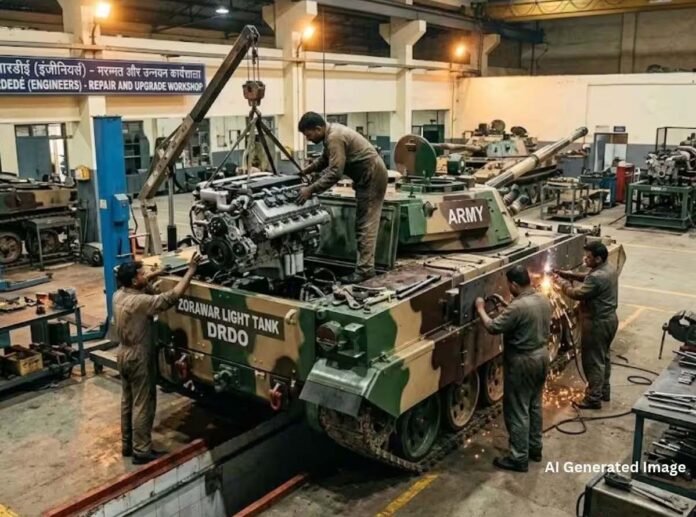
The case for a light tank was revived in 2017, during my tenure as Director General Mechanised Forces, and the 2020 standoff in eastern Ladakh made it urgent. The requirement was a 25-tonne-class, air-portable platform with a high power-to-weight ratio, capable of operating in the world’s harshest terrain.
Reports now say the Army wants stronger armour, and that induction, once expected in 2027, may slip to 2028-29. The Army Chief is reported to have acknowledged the delay. The Army is right to ask for survivability. What decides the outcome is how the programme addresses it.

The pace so far deserves credit. The prototype moved from sanction to trial in a fraction of the time such projects usually take, and firing has been conducted above 4,200 metres. Speed, however, cannot be a reason to compromise capability.
Estimates, Not Measurements
The prototype provides STANAG 4569 Level 4 frontal protection, which barely stops a 14.5 mm round. Level 6, which addresses 30 mm armour-piercing rounds, is not new. The programme’s original requirement was Level 6 within 25 tonnes, plus a 10 per cent tolerance.
The Army is therefore not moving the goalposts. The developers have not yet met them, especially with an imported turret constraint.
How much weight that costs is unresolved. Press estimates put combat weight at 30 to 32 tonnes. The Defence Metallurgical Research Laboratory has reportedly confirmed Level 5B and 6 in the 25-tonne class. One estimate adds two tonnes. Another adds up to seven.

Upgrading to STANAG Level 6 armour could push the 25-tonne Zorawar up to 32 tonnes, severely degrading high-altitude engine power and mobility
There is also a harder constraint. The imported turret is reportedly incapable of taking higher protection because of the original manufacturer’s restrictions. Level 6 within the weight limit is therefore partly a question about who controls the design. Even if the requirement cannot be met now, the user and the developer should agree to accept the best available prototype, with a recorded commitment that later prototypes close the gap.
Mobility is Lost Twice at Altitude
A 760 hp engine delivers about 30 hp per tonne at 25 tonnes. High altitude removes 20 to 25 per cent of that power due to derating, leaving an essential ratio of 25 and a desirable 30. On those figures, even the 25-tonne tank would sit near the floor, at about 23 to 24 hp per tonne, and a 32-tonne tank would fall to roughly 18 or 19.

Extra armour also increases fuel consumption with a weight penalty and burdens maintenance and recovery in sectors where all three are hard to move forward. The armour package and the powerpack therefore cannot be decided separately.
The Chinese Type 15 is reported to weigh 33 to 36 tonnes and to have a 1,000 hp engine. It shows that a heavier light tank can operate at altitude. It does not show that India can copy it. The Zorawar must be flown by a C-17 and must cross Indian bridges and tracks.
Survive the First Fight First
A tank must survive non-contact engagement before it can fight in direct contact. That fight is won by detecting first, hiding from sensors, defeating jamming, and countering drones and top-attack munitions.
Imported turret limitations prevent higher protection integration, emphasising that true self-reliance demands designing the platform domestically rather than just assembling foreign components
A STANAG level is threat-specific, and a higher level against one projectile does not make a vehicle safe from missiles or loitering munitions. Every tonne spent on frontal ceramics is a tonne not spent on roof protection, an active protection system, or electronic hardening, which are best integrated at the design stage.
The same holds for modular armour. It works only if attachment points, suspension margin, power, and cooling were planned from the start, since armour retrofitted to a hull never meant to carry it, creates new problems.
The Zorawar should also be built as a node in a kill web, sensing, sharing and shooting within a networked battle, with the human on the loop. Survivability is a system. Armour is its last layer. Seen this way, the tank also reinforces the deterrence concept of denial and domination along the Line of Actual Control, rather than simply sitting in a defensive position.
Lessons Arjun Already Wrote
The Arjun programme spanned three decades, marked by weight creep, cost escalation, delayed spares, unreliable ammunition, and indigenous content falling short of ambition. The Zorawar was meant to be the corrective, yet indigenous content is reported to be no more than 40 to 45 per cent by value.
The Zorawar must operate as a networked “kill web” node – detecting, sharing and engaging targets seamlessly to strengthen deterrence along the Line of Actual Control
The powerpack is American, as a German engine could not be procured due to export restrictions. The turret and gun are Belgian, and the optics are French. A domestic 700 hp engine and a 105 mm gun are in development.
My reading of the history is that India needs an indigenous tank with an Indian design, not only Indian content. The developing agency must graduate from system integrator to system designer, which means serious research and development, incubation of critical technology and a single point of accountability. A programme that imports its engine, turret, gun and sights cannot call the finished silhouette self-reliance.
What Should be Decided?
To achieve this purpose, I recommend five steps. First, build a programme management team that includes users and tank specialists from day one. A review body, that meets after design decisions are made, is too late.
Second, measure before arguing. Instrumented trials at altitude, with the armour fitted and weighed, should replace estimates. The Army must then state plainly whether the 25-tonne ceiling plus 10 per cent holds, or what it will trade off, whether altitude performance, air transportability or protection. All three cannot be had in full, and the choice should be documented before production begins.
Third, phase induction with accountability. Each lot must meet a stated minimum standard. Upgrade promises need dates, owners and accountability, because a phased path must not become a licence to accept a deficient baseline.
Success requires early user-developer integration, instrumented altitude testing, strict phased induction, clear critical-path planning and simultaneous development of crew training and logistics infrastructure
The design should follow a spiral, with upgrades planned before the first tank rolls out. A tank with a stated life of 40 years often serves up to 60, so the architecture must support it for that long. Without that planning, each upgrade becomes a fresh redesign and a fresh delay.
Fourth, map the critical path now: ammunition qualification, engine and turret integration, the supply chain, and environmental testing. Spares, ammunition, and repair capacity must be locked in alongside the tank, on a push model, so units never look over their shoulders for support.
The high-altitude ecosystem is part of this, including separate fuel and lubricants, gun-zeroing methods, heated garages, starter generators, antifreeze and battery preservation.
Fifth, bring in crews, simulators and training aids as the design takes shape. Plan the family of command, recovery, bridging, engineering and counter-drone variants on a common base, while limiting variation between batches to avoid burdening logistics.
Haste has real costs, since no unit trains on a tank that does not exist. Yet, a fast but flawed tank is worse than a right one a year later. The Army plans for 354 tanks, and a predictable procurement path will enable industry to invest in capacity, tooling and skilled people. The weight of the armour should follow a decision on what the Zorawar is meant for.
The writer, a PVSM, AVSM, VSM has had an illustrious career spanning nearly four decades. A distinguished Armoured Corps officer, he has served in various prestigious staff and command appointments including Commander Independent Armoured Brigade, ADG PP, GOC Armoured Division and GOC Strike 1. The officer retired as DG Mechanised Forces in December 2017 during which he was the architect to initiate process for reintroduction of Light Tank and Chairman on the study on C5ISR for Indian Army. Subsequently he was Consultant MoD/OFB from 2018 to 2020. He is also a reputed defence analyst, a motivational speaker and prolific writer on matters of military, defence technology and national security. The views expressed are personal and do not necessarily carry the views of Raksha Anirveda





