


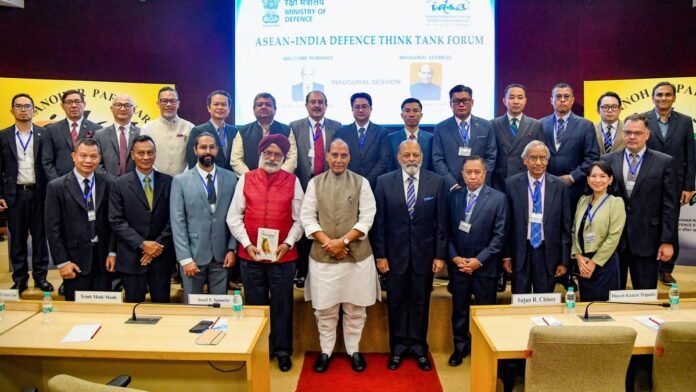
New Delhi. Defence Minister Rajnath Singh has called for deeper defence cooperation between India and the Association of Southeast Asian Nations (ASEAN), proposing joint work on military technologies and a broader partnership that extends beyond arms sales.
Speaking at the inaugural ASEAN-India Defence Think Tank Forum in New Delhi, on October 14, Singh said India was ready to explore cooperation on patrol vessels, radars, air-defence systems, helicopters, drones and other technologies, tailored to the needs of individual countries. He urged both sides to consider co-development and co-production, as well as maintenance, repair and overhaul, training and long-term technical support.

“Self-reliance does not mean working in isolation,” Singh said, according to reports of his remarks. He argued that India’s Aatmanirbhar Bharat initiative could create opportunities for trusted partners to design, build, maintain and improve equipment together. Such arrangements, he said, could develop local skills, support industry and make supply chains more reliable.
The proposal presents India not only as a potential supplier of military equipment, but also as a partner in building defence capabilities. Singh called for clear requirements, dependable after-sales support, appropriate technology safeguards and fair sharing of responsibilities and benefits. He said partnerships should create opportunities for local companies and skilled workers, with the aim of building lasting relationships rather than one-off transactions.
The forum also discussed cooperation in emerging technologies. Singh pointed to the changing character of conflict, including the challenge posed by relatively low-cost drones to more expensive defence systems. Reports said he advocated practical, affordable and adaptable responses, including collaboration on counter-drone capabilities, cyber defence and maritime surveillance. Start-ups, universities and research institutions could contribute through joint research, testing and innovation initiatives.
Maritime security was another central theme. Singh called for stronger maritime domain awareness, information-sharing and interoperability, as well as closer cooperation among navies and coast guards. He said regional partners should build their capacity to respond together to emergencies and tackle piracy, trafficking and illegal fishing, while respecting international law.

The minister framed the effort within India’s vision of an Indo-Pacific in which countries can make their own choices, protect their interests and pursue development peacefully. He urged governments to discuss differences early and through dialogue, and said regional cooperation should not force countries to choose sides.
The initiative comes amid heightened strategic competition in the Indo-Pacific, where Southeast Asia occupies a key position along major maritime trade routes. Several ASEAN members, including the Philippines, Vietnam and Malaysia, have overlapping claims with China in the South China Sea. India has regularly called for disputes to be resolved peacefully and in accordance with international law.

India’s defence engagement with Southeast Asia has also included exports. The Philippines signed a $375-million deal for BrahMos cruise missiles in 2022, while Vietnam and Indonesia have more recently moved towards acquiring the system, according to reporting on Singh’s proposal. Those transactions provide a backdrop to the minister’s push for a wider model based on industrial cooperation and local capacity-building.
Turning that offer into practical partnerships will require agreement on costs, technology protection, local participation and long-term support. Singh’s remarks placed those issues alongside the strategic case for closer ties, signalling that India wants cooperation to include research, production and maintenance-not simply the transfer of equipment.






