


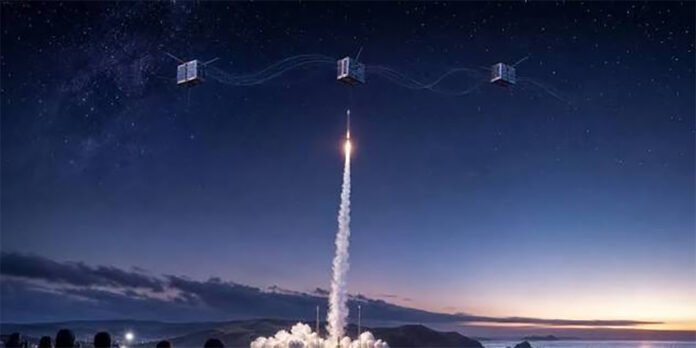
The Electron rocket lifted off at 3:11 a.m. EDT from Rocket Lab’s launch site in New Zealand, carrying the satellites on a mission named “We’re Not Hawking Around”. Rocket Lab said the spacecraft were deployed into an orbit 520 kilometres above Earth, at an inclination of 97 degrees.
The satellites are part of HawkEye 360’s commercial constellation, which detects and locates radio-frequency (RF) emissions. Flying in groups of three allows the company to compare signal measurements across spacecraft and estimate where transmissions originate. After commissioning, the new cluster is intended to collect signals across the RF spectrum.

Potential applications include tracking vessels, monitoring radar and communications and identifying interference with satellite navigation systems such as GNSS, which includes GPS. The company says its data supports maritime awareness, detection of jamming and other defence and security work.
HawkEye 360 sells its intelligence and analytics to government customers and allies. Its website describes services including identifying vessels that may be difficult to track, monitoring air-defence radar, and detecting GPS jamming or spoofing. Such capabilities can help users build a picture of activity without relying solely on signals that a vessel or other transmitter actively broadcasts for public tracking.
The launch came amid a busy stretch for the constellation. HawkEye 360 reported that Cluster 16 launched on October 23, while company announcements listed launches of Clusters 15 and 16 earlier in the month. The three satellites Rocket Lab carried are identified as Cluster 16; the company’s mission page confirms the payload and orbit.
That sequence underscores the growing pace of commercial RF satellite deployment. HawkEye 360’s first spacecraft launched in 2018, and the company has since expanded its network through dedicated and rideshare launches. Three additional Hawk satellites had flown on SpaceX’s Bandwagon-5 rideshare mission two days before Rocket Lab’s launch.

Rocket Lab’s Electron is a small launch vehicle designed to carry satellites to orbit. The company said the flight was its 98th launch overall and its 19th of 2026. Sixteen of its missions that year used Electron; three used HASTE, a suborbital version of the rocket used to test technologies in a hypersonic flight environment.
For HawkEye 360, adding satellites can increase the constellation’s capacity to collect and deliver RF data. The company presents its service as a way to provide governments with timely information for defence and security decisions. The satellites do not simply photograph the ground: they detect radio transmissions and use their measurements to characterise signals and locate their sources.

The system’s reach also comes with limits. Its usefulness depends on signals being detectable, the satellites’ ability to collect them, and the processing needed to turn measurements into actionable information. Public descriptions identify broad mission areas, but do not disclose the specific collection tasking or operational results from this newly launched cluster.
The launch adds another element to an increasingly active commercial space-based intelligence sector, where private operators provide data to public agencies. As the new satellites are commissioned, they are expected to join HawkEye 360’s wider network, extending its ability to monitor radio-frequency activity around the world.






