


India’s maritime connections have historically encompassed trade, religion and culture due to its peninsular location and extensive maritime geography. Post-Independence, Indian foreign outreach via the high seas lost relevance but in the last five years, New Delhi is not just going back to its maritime roots but reinforcing its journey with technological prowess in both the naval and civilian maritime domains.
As previously outlined for Raksha Anirveda, August and September 2024 itself had a slew of significant Indian maritime developments:

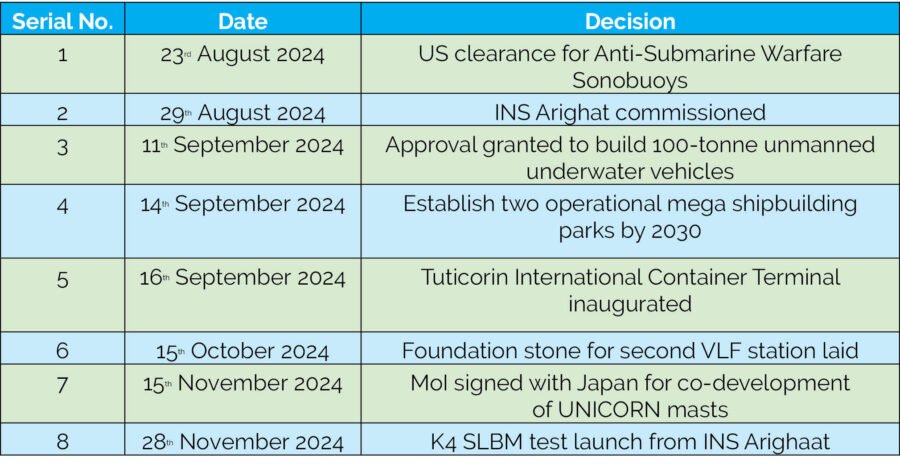
This article will shed some light on the above advancement from 14th September 2024 onwards as the previous ones have been covered already.
Inauguration of Tuticorin International Container Terminal: Indian Prime Minister Narendra Modi has described the terminal as the ‘new star of India’s marine infrastructure’. Through its deep draft of more than 14 metres, a berth over 300 metres long and spanning ten hectares, Tuticorin International Container Terminal will increase the capacity of Tamil Nadu’s VO Chidambaranar (VOC) Port.
Tuticorin International Container Terminal will increase the capacity of Tamil Nadu’s VO Chidambaranar Port. Prime Minister Narendra Modi described it as the ‘new star of India’s marine infrastructure’
The terminal will reduce logistics costs at the port and save foreign exchange for India as it is capable of handling 6TEUs (Twenty-foot Equivalent Units) of containers. India will also augment VOC Port’s capacity by investing over ₹7,000 crore to develop an Outer Harbour Container Terminal. The port is also being recognised as a green hydrogen hub and a nodal port for offshore wind energy.

Foundation stone for second VLF station laid: Spread across 2,900 acres, the Indian Navy will have its second Very-low Frequency (VLF) Station at Damagundam Reserve Forest site in Vikarabad, Telangana at Rs 3,200 crore. VLF refers to the 300 Hz-30 kHz range, essentially at a lower frequency than AM/FM signals. VLF signals have a range of 10 to 100 kilometres and are capable of penetrating seawater to just over 30 metres as well. Hence, they are used to communicate with submarines while still underwater. Therefore, it will enable Strategic Forces Command to employ submarines on patrol with great stealth, effectiveness and without detection. India’s second VLF station will ensure secure and real-time global communication between ships/submarines with command-and-control centres to safeguard maritime interests.
UNICORN Masts: The Governments of India and Japan have signed a Memorandum of Implementation (MoI) to co-develop Unified Complex Radio Antenna (UNICORN) masts for Indian Navy warships. These masts will have integrated communication systems, which will help improve the stealth characteristics of naval platforms. The UNICORN masts will be co-developed by India’s Bharat Electronics Limited with Japanese assistance – with the assistance likely to involve NEC, Sampa Kogyo, and Yokohama Rubber – the original developers. When the mast is developed and produced, it will be a first for India-Japan joint development/production in the defence sector.

With New Delhi testing the 3,500 km K-4 submarine-launched ballistic missile from INS Arighaat, India joined the nuclear triad capable of launching a nuclear strike from land, air and sea
INS Arighaat tests K-4 SLBM: With New Delhi testing the 3,500-kilometre K-4 submarine-launched ballistic missile (SLBM) from INS Arighaat, India joined the nuclear triad. It is now capable of launching a nuclear strike from land, air and sea. Previously, the SLBM had only been launched from submerged platforms and never from a submarine. The ballistic missile can cover all of China without leaving India’s territorial waters off its eastern seaboard. It is important to note that the INS Arighaat was commissioned on August 29, 2024, and served as the platform for a test launch of the K-4 just months later on November 28, 2024.

Anurag Bisen is Senior Fellow, VIF and is a veteran submariner of the Indian Navy with over 35 years of service, including the command of Sindhughosh (Kilo) Class missile submarine. The views expressed are personal and do not necessarily carry the views of Raksha Anirveda

The writer is a Member of the Team Grey-Zone and Influence at the Irregular Warfare Initiative (USA). He holds a Master’s degree in National Security Studies from the Department of War Studies at King’s College London, specialising in intelligence studies, irregular warfare, and the geopolitics of the Indo-Pacific region. The views expressed are personal and do not necessarily carry the views of Raksha Anirveda





