


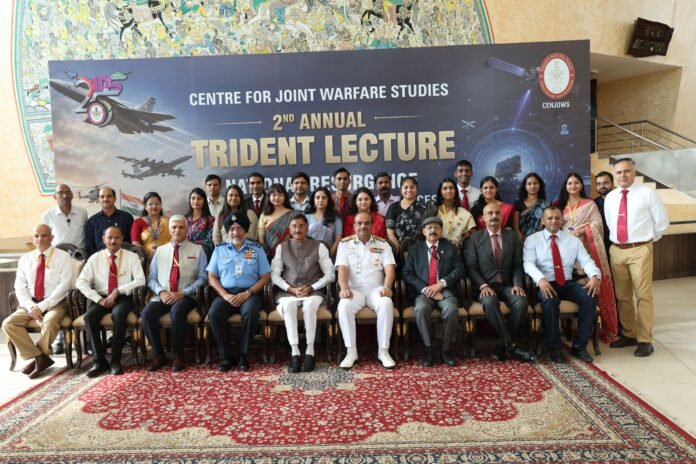
New Delhi. Minister of State for Defence Sanjay Seth said India must prepare for future wars through innovation, self-reliance and civil-military fusion. Speaking at the second annual Trident Lecture organised by the Centre for Joint Warfare Studies at the Manekshaw Centre, Seth stressed jointness, modern technology and coordination among the three Services. He also highlighted the role of young Indians, startups, industry and indigenous manufacturers in building a defence ecosystem capable of moving from “Make in India” to “Make for the World.”
Seth’s address set the tone for a discussion focused on how India should adapt its military institutions, operational concepts and defence-industrial base to a rapidly changing security environment. He underlined the importance of semiconductors, electronics and advanced technologies, saying stronger national capabilities would be essential to meet the demands of future conflict.

The minister said India’s young population was contributing across defence, technology, space, agriculture, manufacturing and sports. His remarks placed national security within a broader developmental framework, where civilian innovation, industrial capacity and military preparedness reinforce one another.
The message of jointness emerged and was reiterated at the second annual Trident Lecture organised by the Centre for Joint Warfare Studies in New Delhi
The Vice Chief of the Army Staff, Lt Gen Sandeep Jain, then called for a decisive shift from traditional combat approaches to what he described as “smart fighting”. His message was that modern warfare could no longer be understood as a contest fought by soldiers and conventional formations alone.
Future operations, Jain said, would require the Army to combine battlefield experience with technology, data, precision, autonomous systems and faster decision-making. The modern soldier would remain central to combat, but would operate within a wider network involving sensors, satellites, cyber capabilities, unmanned platforms, artificial intelligence and real-time intelligence.
Jain also argued for deeper multi-domain integration. Land forces, he indicated, must be able to operate as part of a coordinated campaign involving the air, maritime, cyber and space domains. Such integration would be necessary not only during open conflict but also in grey-zone situations, where adversaries use disinformation, cyberattacks, economic pressure and proxy forces without crossing the threshold of conventional war.

The Vice Chief’s remarks reflected a growing emphasis within India’s defence establishment on integrated planning and joint execution. In this approach, individual Services would retain their specialised capabilities while contributing to common operational objectives. The aim would be to reduce duplication, improve the use of scarce resources and create a unified response to complex threats.
Jain’s call for smart fighting also suggested a change in the meaning of military modernisation. Modernisation, in this context, would not be limited to acquiring newer weapons. It would include upgrading command structures, communications networks, training systems and logistics, while ensuring that technology is connected to operational needs.

Speakers linked India’s battlefield readiness to innovation, civil-military fusion, indigenous production and the priorities of Budget 2027
Chief of Integrated Defence Staff Air Marshal Tejinder Singh reinforced the importance of jointness, rejecting suggestions of differences among the three Services. He said the Services were united in their commitment to national security and recognised the necessity of working together in an era of multi-domain warfare.
Singh broadened the definition of national security beyond territorial defence. Economic security, technological competition, maritime resilience, critical infrastructure, supply chains and information integrity, he said, were now equally important elements of the security landscape.
The observation marked a shift from a narrow military understanding of defence preparedness. Disruptions to ports, communications networks, energy systems, financial infrastructure or supply chains can affect a country’s ability to sustain operations even when its borders remain intact. Similarly, manipulation of information can influence public confidence, military decision-making and diplomatic space.
Referring to recent operational experience, including Operation Sindoor, Singh underlined the importance of coordinated planning and integrated execution. The reference highlighted the need for military commands and national institutions to function with a common operational picture, shared intelligence and clearly defined responsibilities.
The CISC’s remarks also connected military integration with national resilience. A modern defence strategy, he suggested, must bring together the armed forces, industry, technology companies, research institutions and civilian agencies. This approach would allow India to respond more effectively to threats that move rapidly across domains.
The military leadership confirmed operational harmony across land, sea, and air domains. Speakers were of the view that modern combat has moved past hardware dominance to data, AI and edge compute integration
Former General Officer Commanding of the Army Training Command and military strategist Lt Gen Raj Shukla (Retd) brought the discussion to the question of resources and defence budgeting. He described Budget 2027 as a litmus test for India’s preparedness for future warfare.
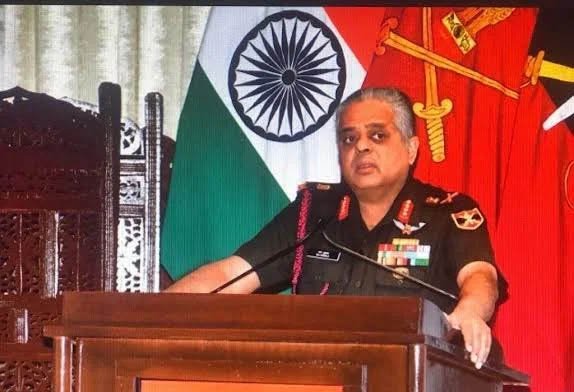
Shukla warned that India’s defence procurement system remained “ill-equipped” for an age dominated by artificial intelligence. He argued that the modernisation budget must give greater priority to cloud infrastructure, edge computing, data networks and other enabling technologies rather than focusing overwhelmingly on conventional platforms.
“If Budget 27 is about traditional tanks, guns-I have no quarrel with tanks, guns, I’m a gunner myself – but if one lakh crore out of two lakh crore for modernisation are not for cloud infrastructure, edge will be lost…” Shukla said, pointing to the scale of investment required for technology-intensive warfare.
His argument was not a rejection of tanks, artillery or other established capabilities. Instead, it was a warning against treating conventional equipment as sufficient for conflicts in which information, algorithms, connectivity and speed may determine battlefield outcomes.
At the Trident Lecture Series, the consensus was that future defence allocations must prioritise software infrastructure over traditional mass
The discussion at the lecture therefore moved beyond the familiar debate between manpower and machines. The speakers presented preparedness as a combination of capable personnel, reliable platforms, secure networks, domestic manufacturing and institutions able to absorb innovation quickly.
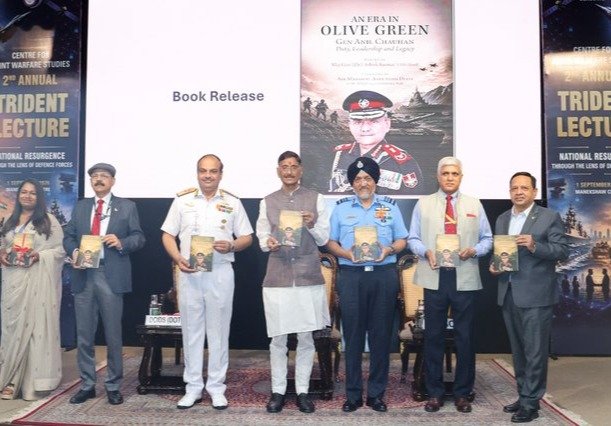 The event also featured the launch of the book, An Era in Olive Green: Gen Anil Chauhan, Duty, Leadership and Legacy. It concluded with a closing address by Vice Admiral Rajesh Dhankhar, Deputy Chief of Integrated Defence Staff for Doctrine, Organisation and Training.
Together, the speakers outlined a common direction for India’s defence policy: stronger jointness, faster technological adoption, wider civil-military cooperation and a procurement system aligned with the character of future war.
Jain’s “smart fighting” formulation provided the sharpest summary of that direction. For India, the next military advantage may depend not only on possessing more weapons, but on connecting people, platforms, data and decisions more intelligently.






