


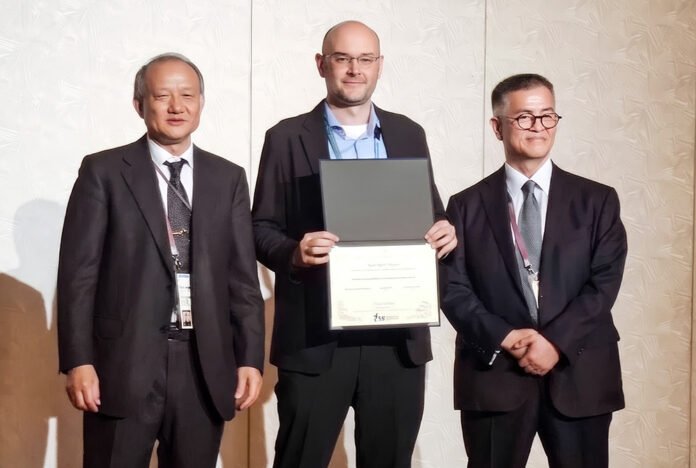
Toyota City, Japan. SkyDrive Inc. (SkyDrive), a leading compact eVTOL aircraft developer based in Japan, announced that a technical paper presented by its Aeronautics Development Department won the prestigious Best Paper Award at the 12th Asian / Australian Rotorcraft Forum / Heli Japan 2026, held in Gifu, Japan, and organised by the Vertical Flight Society (VFS), the world’s leading technical community dedicated to vertical flight.
SkyDrive aims “to take the lead in the once-in-a-century mobility revolution” and realise a future where air mobility becomes part of daily transportation. At the 2025 World Expo in Osaka, Kansai, the company conducted successful demonstration flights of its commercial eVTOL aircraft, “SKYDRIVE (SD-05 type)”.

Background and Paper Overview
The Vertical Flight Society (VFS) is the world’s foremost professional authority on helicopters and advanced air mobility (AAM / eVTOL). At Heli Japan 2026, SkyDrive’s engineering team presented their paper titled “SkyDrive Developing and Certifying an eVTOL Aircraft in Japan,” which was awarded the Best Paper Award following a rigorous technical evaluation.
The paper highlights the development strategy, engineering solutions, and official certification roadmap for SkyDrive’s three-seat commercial aircraft, “SKYDRIVE SD-05”. The review committee praised SkyDrive’s practical approach—grounded in real-world flight data rather than theoretical concepts alone. Key technical achievements featured in the paper include:
Aircraft Architecture Optimised for City Travel: Designed specifically for short-distance urban trips (within a 30 km radius), the SD-05 uses a multicopter configuration that flies solely on propeller thrust without traditional wings. By keeping the vehicle light relative to its total rotor area (a low “disk loading” design), power consumption during hover is reduced by one-half to one-third compared to tilt-rotor aircraft, while also minimising downward wind blast (downwash) when landing in city centres.
Mastering Aerodynamics and Rotor Wake Interference: With 12 rotors operating in close proximity, managing overlapping airflow and turbulent wind interference is essential. SkyDrive modelled this complex aerodynamics using advanced computer simulations (CFD) and validated the results through physical scale-model testing at wind tunnel facilities operated by the Japan Aerospace Exploration Agency (JAXA).

Smart Flight Controls that Keep Flying Even if a Motor Fails: SkyDrive developed proprietary fly-by-wire (computer-controlled) flight software that instantly calculates and distributes optimal power to all 12 electric motors. If a single motor encounters an issue in mid-air, the system immediately redistributes thrust to the remaining healthy motors within fractions of a second, keeping the aircraft completely stable and safe.
Preventing Vibration Resonance in Lightweight Structures: To maximise battery efficiency, the airframe is built from ultralight carbon fiber (CFRP). However, lightweight structures can flex and resonate with the rapid digital adjustments of the flight control computer. Through extensive Ground Vibration Tests (GVT) on full-scale aircraft and the integration of specialised digital filters (“notch filters”), SkyDrive validated the aircraft exceeds international safety margins against dynamic aeroelastic vibration.

Proven Performance Over 300+ Test Flights: Using two full-scale prototype aircraft (FTV1 and FTV2), SkyDrive completed more than 300 flight and ground tests without incident, confirming safe handling at its maximum operating speed of 100 km/h and verifying reliable battery temperature control under real operating conditions.
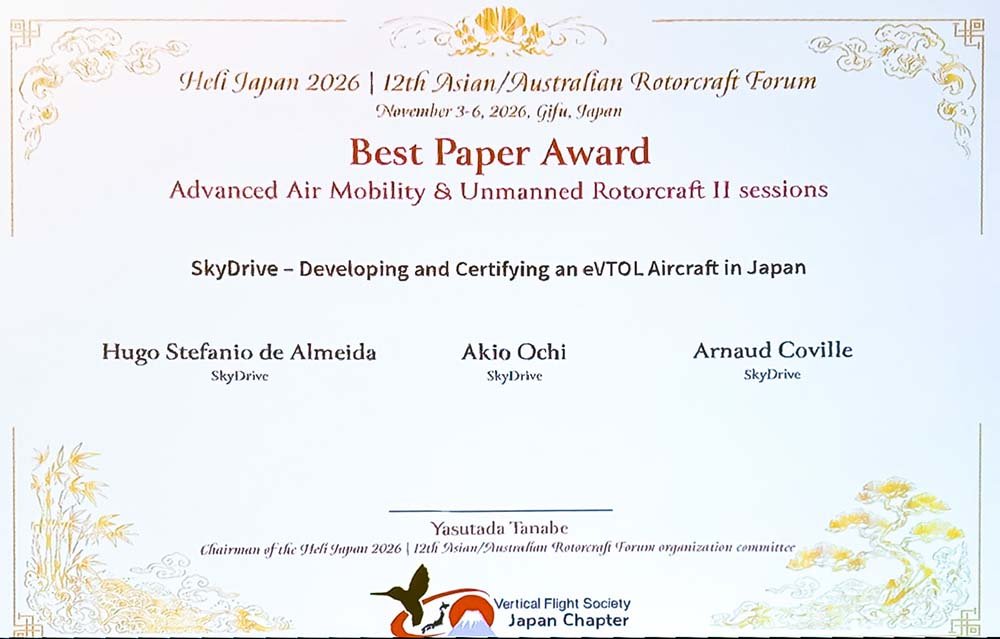
These insights from the prototype phase have been integrated into the certification model of SD-05, which has completed its Critical Design Review (CDR) and is currently transitioning into the manufacturing stage.
Titled SkyDrive Developing and Certifying an eVTOL Aircraft in Japan, the paper has been authored by Hugo Stefanio de Almeida (Director, Aeronautics Development Department), Akio Ochi (Head of Vehicle Development Division / Chief Engineer) and Arnaud Coville (Chief Technology Officer / CTO).
Arnaud Coville, Chief Technology Officer (CTO) of SkyDrive Inc. stated, “In pioneering eVTOL development, safety and regulatory compliance are our utmost priorities. Receiving the Best Paper Award from the Vertical Flight Society—a globally renowned authority in vertical flight—is an incredible honour and a testament to the rigorous engineering, sound design methodology, and thorough validation performed by our team. I would like to extend my sincere gratitude to the authors and the entire engineering team whose relentless dedication made this possible. We will continue advancing our vehicle development with uncompromising safety standards as we move steadily toward commercial service.”
SkyDrive remains dedicated to making air mobility an everyday reality and continues its progress toward commercial launch targeted for 2028.







