


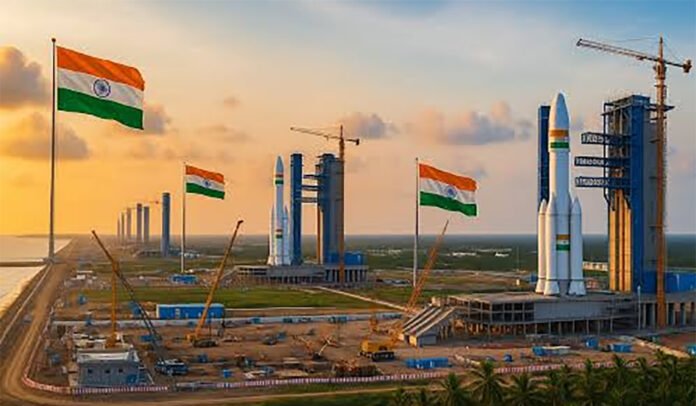
India’s new spaceport facility, under development in Tamil Nadu’s Thoothukudi district, is intended to complement, not replace, the Satish Dhawan Space Centre at Sriharikota, India’s principal spaceport. It will primarily support the Small Satellite Launch Vehicle (SSLV), while also accommodating equivalent launch vehicles operated by non-governmental entities. The distinction matters: Kulasekarapattinam is not a second, all-purpose replacement for Sriharikota, but a site tailored to specific missions and launch needs.
The location is central to its purpose. From Sriharikota, rockets carrying satellites to sun-synchronous polar orbits must follow a curved trajectory to avoid landmasses and ensure spent stages do not fall over populated territory. That manoeuvre reduces the payload a small rocket can carry. Kulasekarapattinam’s position allows a more direct southward route over the sea, improving the efficiency of such launches.

A written response to Parliament from the Department of Space estimated that an SSLV launched from Kulasekarapattinam could carry about 300 kilograms to sun-synchronous polar orbit. The same response said the SSLV’s payload capability for that orbit from Sriharikota was inadequate for a useful payload because of the trajectory constraints. The comparison is specifically about SSLV-class vehicles and that orbit; it should not be read as a general measure of the two spaceports’ overall capacity.
The project has an approved outlay of ₹985.96 crore. In a 2025 parliamentary update, the Department of Space said site-development work had been completed and construction of technical facilities had begun, with equipment and structures being fabricated. It also reported that land acquisition was complete except for land needed to reroute the East Coast Road. The government’s then-stated commissioning target was the 2026-27 financial year.
That schedule has since shifted. ISRO chairman V Narayanan said in early November that the first rocket launch from the site was likely in March or April 2027, and that construction was progressing. The timetable makes the coming months a key test of whether remaining construction, system installation and operational preparations can be completed in time. A projected first launch date is not the same as confirmation that the facility has been commissioned.
The new site forms part of a broader effort to expand India’s launch infrastructure as the country’s commercial space sector grows. A July 2026 response to Parliament described Kulasekarapattinam as India’s second rocket launch site, being developed for SSLV missions and launches by private space start-ups and other non-governmental entities. The government also pointed to an approved third launch pad at Sriharikota, intended for next-generation launch vehicles and as a standby for the existing second pad.

For smaller satellite operators, a dedicated facility could offer more scheduling options and a launch route better suited to polar missions. For private companies, access to launch infrastructure may help turn India’s policy push for greater non-government participation into practical launch opportunities. But the effect will depend on the site’s operational capacity, launch cadence and the availability of compatible rockets, not simply on the completion of construction.
The spaceport’s performance will also be measured against demand. A more efficient route can improve payload economics, but it cannot by itself guarantee competitive prices, frequent launches or a steady flow of customers. Those will depend on launch-vehicle production, mission readiness, regulatory coordination and the ability of public and private operators to use the complex reliably.

For now, the project’s clearest promise is focused: an additional launch complex built around small rockets and southward polar-orbit missions. If the facility enters service as planned, it can broaden India’s options while leaving Sriharikota at the centre of the country’s larger launch programme.







