


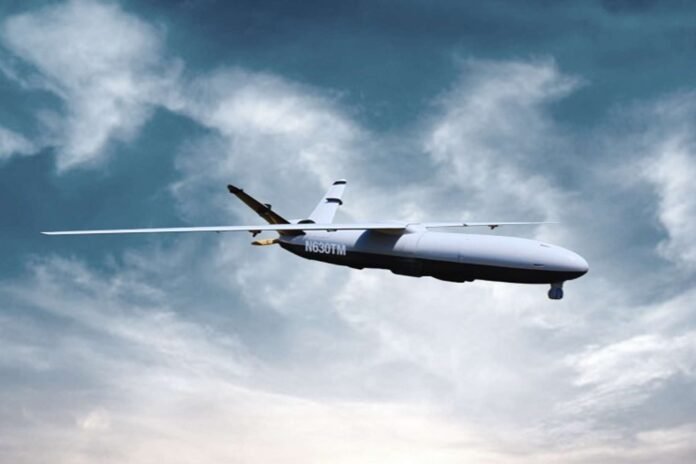
The North Dakota-based Ideal Aerosmith unveiled the Troublemaker, a Group 3 uncrewed aircraft system designed for one-way attack, reconnaissance, surveillance and decoy roles. Ideal Aerosmith says the aircraft can stay aloft for more than 10 hours; company executive David Markert has also described a range exceeding 750 nautical miles and a payload capacity of 30 pounds. Those figures place the platform in a category intended to offer substantial reach without the infrastructure demands of larger aircraft.
The drone has a wingspan of about 15 feet and can be launched by catapult or from a truck, according to Markert. A skid landing allows it to be recovered after flight, giving operators the option to reuse it when a mission does not require the aircraft to be expended. Ideal presents that flexibility as a distinction from low-cost cruise missiles, which are not recovered after launch. The company says Troublemaker can also operate in swarms, though public details about its autonomy, communications, navigation and command-and-control systems remain limited.

The launch marks a shift for Ideal Aerosmith, a company founded in 1938 that has more recently supplied test equipment for navigation systems. Markert told Breaking Defense the company began pursuing defence customers directly about three years ago, choosing a low-cost attack drone as demand grew for systems that could be produced in quantity. Ideal says Troublemaker is built around a modular design and a US-based supply chain, and is intended to work in austere or contested environments.
Production, rather than specifications alone, will determine whether the aircraft can meet the promise of affordable mass. Ideal has built 26 Troublemakers and is making about two per week, Markert said. He added that existing infrastructure could support output of up to 20 weekly if customer demand is sufficient. That is a potential production rate, not a confirmed order or funded commitment. The company has not publicly disclosed a contract value, procurement quantity or delivery schedule. Markert said Ideal has a Navy “sponsor” for the system, but that description does not establish a formal production contract.
The product arrives amid a broader Pentagon push to field lower-cost autonomous systems more quickly. The Defense Department’s Replicator initiative, announced in 2023, set out to accelerate the deployment of large numbers of attritable uncrewed systems. But scaling has proved difficult: a 2025 account citing Congressional research said only hundreds, rather than the targeted thousands, had materialised by the initiative’s August deadline, with cost and technical hurdles still in play. Troublemaker’s stated emphasis on production capacity speaks directly to that challenge, but it remains to be seen whether its performance and price can satisfy military requirements at scale.
Budget uncertainty could also affect the company’s plans. Markert told Breaking Defense that a continuing resolution beginning October 1 freezes new-start programmes while maintaining funding at prior-year levels. Ideal has submitted proposals for relevant solicitations, he said, but the impact on the company’s efforts was not yet clear. The Navy’s sponsorship may help bring the aircraft to potential customers, but procurement will depend on funding, testing and operational evaluation.

For now, Troublemaker is a company-built platform entering low-rate production – not a proven fielded capability. Its combination of long endurance, flexible launch and possible recovery offers a different proposition from disposable missiles and larger unmanned aircraft. Whether that mix becomes a useful military option will depend on costs, reliability, mission integration and the ability to turn stated surge capacity into sustained deliveries.






